Lead Generation and Lead Management: How the Two Work Together
13 Mar, 2026
Most businesses treat lead generation and lead management as two...


Auto Capturing, nurturing, and converting potential customer leads.

Manage AMC contracts, track service requests, ensure timely renewals.

Tracks, resolves, manages issues, and gathers customer feedback.

Manage purchases, expenses, vendors, and POs efficiently with CRM.

Manages order lifecycle from placement to delivery completion.

Generates invoices and manages sales transactions and records efficiently.

Manages stock levels, tracks items, ensures efficient inventory control.

Manages dealer workflows, assigns leads, and tracks progress centrally.

WhatsApp CRM integration with bulk messaging, auto notifications, chatbots.

IVR enabled CRM integrates click-to-call, bulk dialling, recording features.

Achieves optimum productivity of tele-sales team with auto dialler.

Updated: 13th March, 2026
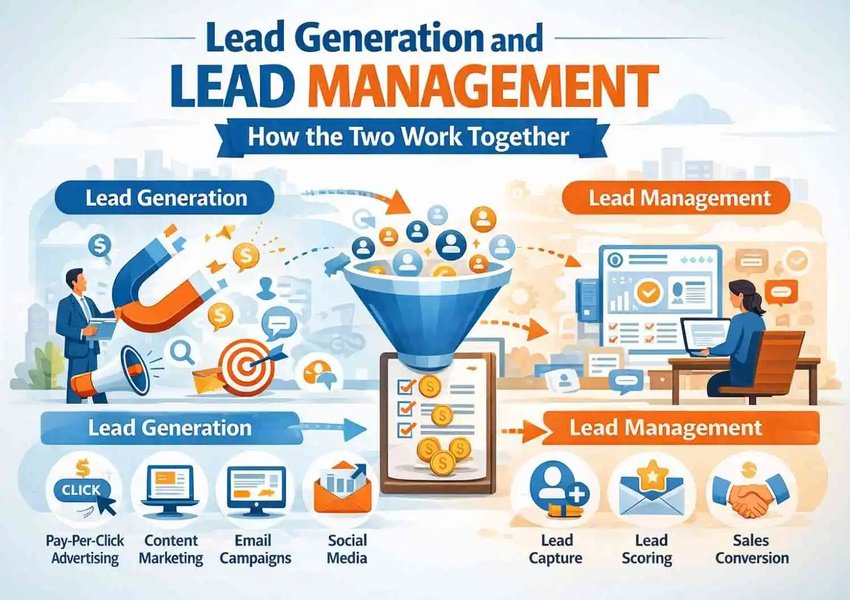
Most businesses treat lead generation and lead management as two separate conversations. Marketing owns lead generation. Sales owns lead management. The two teams rarely discuss how their work connects, and when revenue targets are missed, each blames the other.
The truth is they are not separate disciplines. They are two halves of the same system. Lead generation without lead management is a leaking bucket. Lead management without lead generation is an empty pipeline. When the two work together, businesses build a revenue engine that is predictable, scalable, and continuously improving.
Lead generation is the process of attracting potential customers and capturing their contact information so your sales team can begin a conversation. It is the top of the funnel, the mechanism that fills your pipeline with new opportunities.
It happens across many channels: content marketing, SEO, paid advertising, social media, webinars, cold email, and outbound prospecting. The goal is not just volume but qualified volume. A hundred leads that match your Ideal Customer Profile are worth more than a thousand that do not.
According to HubSpot’s State of Marketing report, 61% of marketers say generating traffic and leads is their top challenge. Yet many of those same businesses have an equally serious problem they are not measuring: the leads they generate are not being managed well enough to convert.
Lead management is the process of organizing, tracking, nurturing, and converting the leads your generation efforts produce. It picks up where lead generation ends and carries each prospect through the sales process until they buy or are disqualified.
A structured lead management process includes capturing every lead in a central system, qualifying them against defined criteria, assigning them to the right rep, nurturing with relevant communication, and measuring conversion at each stage.
Without lead management, even the best lead generation program underdelivers. Leads come in and nothing systematic happens. Some get followed up with. Others do not. Nothing is measured so nothing improves. Lead management is what turns lead generation investment into actual revenue.
The disconnect between lead generation and lead management is one of the most costly and preventable problems in sales and marketing. It typically shows up in three ways.
Slow follow-up
Leads sit in someone’s inbox for hours before anyone contacts them. By then the prospect has moved on. Research from Harvard Business Review found that businesses responding within an hour are seven times more likely to have a meaningful conversation than those who wait longer. Most businesses wait far longer.
No qualification filter
When marketing passes every lead to sales regardless of fit, reps waste time on poor prospects and stop trusting the leads they receive. Good leads get less attention because reps have been burned too many times.
No nurture for leads that are not ready
Most leads are not ready to buy on first contact. Businesses focused only on immediate buyers are ignoring the majority of their pipeline. Structured nurturing keeps those leads warm until their timing changes.
The connection between lead generation and lead management is not just a handoff. It is a continuous loop where each function improves the other.
Lead generation fills the pipeline using CRM data from closed deals. Marketing identifies which sources, industries, and job titles produce the customers with the highest close rates. This shapes where budget and effort are directed.
Lead management converts those prospects and feeds back conversion data. Over time marketing generates better-qualified leads because it knows what sales actually closes. Sales converts more because leads match the profile more closely. The cost of acquiring each customer drops as both sides become more efficient.
Groweon CRM sits at the center of this loop, giving both marketing and sales a shared view of every lead from first touch to final conversion. When both teams work from the same data, the blame cycle ends and results improve.
Define your ICP with precision. The more specific your Ideal Customer Profile, the more targeted your lead generation and the more your sales team will trust the leads they receive.
Diversify your channels. Relying on a single channel for leads creates fragility. Build across at least three to four: organic search, paid ads, content, referrals, and outbound prospecting form a resilient mix.
Capture intent signals. A prospect who has visited your pricing page three times and downloaded two case studies is far closer to buying than someone who clicked an ad once. Your lead generation tools should pass these behavioral signals into your CRM so sales can act on them intelligently.
Align content with sales conversations. Content that generates leads should address the specific questions and objections that come up in sales calls. Leads that arrive pre-educated move through the pipeline significantly faster.
Capture every lead in your CRM immediately and automatically
Connect every lead source so that every form submission, chat inquiry, and inbound call creates a new record the moment it arrives. No manual entry, no gaps.
Qualify before handing to sales
Assess every lead against your qualification criteria before it enters the active pipeline. Use BANT or a simpler scoring model, and log outcomes in the CRM so your criteria sharpen over time.
Automate first contact
Set a response time standard of under five minutes for inbound leads. Use CRM automation to send an instant acknowledgement while the rep receives a real-time notification to follow up personally.
Build a nurture track for leads that are not ready
Qualified leads that are not yet buying should enter an automated sequence, not be discarded. Relevant content delivered consistently keeps your brand visible until their timing changes.
Create closed-loop reporting
Tag every lead with its source and track that tag all the way to closed won or lost. This creates a direct line from lead generation activity to revenue outcome and tells you exactly which channels are worth investing in.
A CRM is the infrastructure that makes a connected lead generation and lead management system possible. Without it the two functions operate on separate data and the feedback loop that improves both never forms.
With a CRM at the center, marketing sees which leads are converting and why. Sales sees where each lead came from and what content they engaged with. Both teams make decisions based on the same evidence.
Groweon CRM delivers automatic lead capture from all channels, lead source tagging that persists through the full pipeline, lead scoring that combines behavioral and profile data, automated nurture workflows, and reporting that connects campaign performance directly to revenue. It is the shared platform that closes the gap between generation and management and turns both into a single, aligned revenue system.
Lead generation and lead management are not competing priorities. They are two stages of the same process. The businesses that treat them that way consistently outperform those that do not.
When your lead generation fills the pipeline with the right prospects and your lead management converts them with speed and consistency, the result is a revenue system that compounds over time. Every closed deal improves your understanding of which leads to generate next. Every piece of management data makes your next campaign more precise.
Groweon CRM gives you the platform to build that system, connecting lead generation and lead management in one place so nothing is lost between the two and your investment in attracting new business translates consistently into closed revenue.
Q1. What is the difference between lead generation and lead management?
Lead generation attracts and captures new prospects. Lead management qualifies, nurtures, and converts them into customers. Both are essential and each makes the other more effective.
Q2. Why do lead generation and lead management need to work together?
Because generating leads without a system to convert them wastes marketing spend, and a strong sales process without enough leads leaves your team idle. When aligned through a shared CRM, conversion rates improve and acquisition costs drop.
Q3. How does a CRM connect lead generation and lead management?
It captures leads from every source, tags them with their origin, scores them, assigns them to reps, and tracks every touchpoint through to conversion, giving both teams a shared real-time view.
Q4. How quickly should a new lead be followed up with?
Within five minutes for inbound leads. Response speed is one of the strongest predictors of conversion and CRM automation makes this achievable without adding pressure to your team.
Q5. What metrics should I track across both functions?
Lead volume and quality by source, lead-to-opportunity conversion rate, response time, opportunity-to-close rate, and cost per acquired customer by channel.
13 Mar, 2026
Most businesses treat lead generation and lead management as two...
11 Mar, 2026
CRM implementation has a reputation problem. Ask any sales leader...
10 Mar, 2026
Every sales leader wants the same thing: more revenue, more...
09 Mar, 2026
Choosing a CRM is one of the most important technology...

05 Mar, 2026
India’s sales landscape is changing faster than most businesses realize....