WhatsApp Marketing Automation: How to Send the Right Message at…
17 Mar, 2026
Email open rates hover around 20%. WhatsApp open rates sit...


Auto Capturing, nurturing, and converting potential customer leads.

Manage AMC contracts, track service requests, ensure timely renewals.

Tracks, resolves, manages issues, and gathers customer feedback.

Manage purchases, expenses, vendors, and POs efficiently with CRM.

Manages order lifecycle from placement to delivery completion.

Generates invoices and manages sales transactions and records efficiently.

Manages stock levels, tracks items, ensures efficient inventory control.

Manages dealer workflows, assigns leads, and tracks progress centrally.

WhatsApp CRM integration with bulk messaging, auto notifications, chatbots.

IVR enabled CRM integrates click-to-call, bulk dialling, recording features.

Achieves optimum productivity of tele-sales team with auto dialler.

Updated: 16th March, 2026
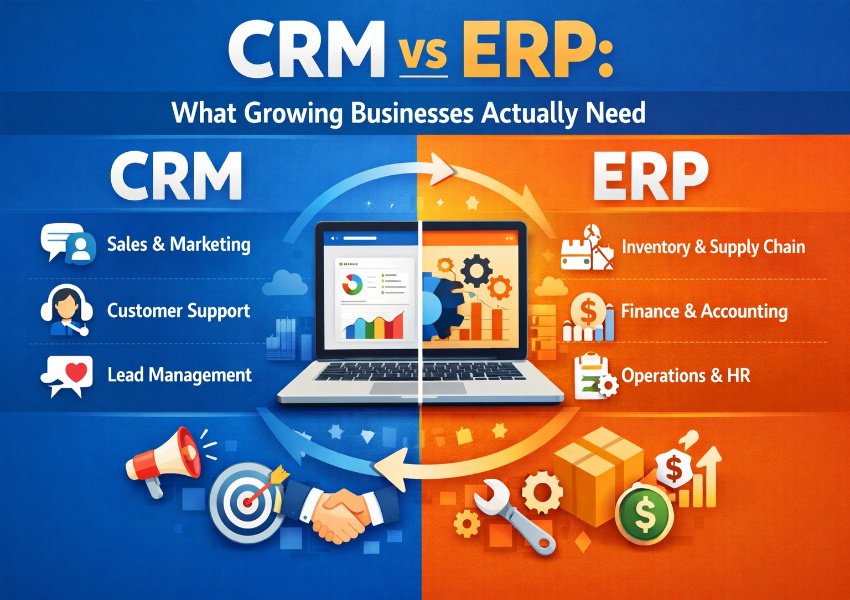
At some point in every growing business, the same question comes up: do we need a CRM, an ERP, or both? The two are often mentioned in the same breath, sometimes confused with each other, and occasionally sold as interchangeable solutions. They are not.
CRM vs ERP is a comparison that matters because choosing the wrong system, or investing in the wrong one first, can slow your growth, drain your budget, and create more operational complexity than you started with.
This guide cuts through the confusion. You will understand exactly what each system does, where they overlap, which one your business actually needs right now, and when it makes sense to have both.
A CRM (Customer Relationship Management) system is software that manages everything related to your customers and prospects. It tracks leads, manages your sales pipeline, logs every customer interaction, automates follow-ups, and gives your sales and marketing teams a shared view of every relationship your business has.
The core job of a CRM is to help you win more customers and keep the ones you have. It focuses on the front end of your business: who you are selling to, where those prospects are in the buying journey, and what needs to happen next to move them toward a decision.
Businesses use CRM software to capture and qualify leads, manage sales pipelines, automate outreach and follow-up, track customer communication history, measure sales team performance, and forecast revenue.
According to Gartner’s definition of ERP, an ERP (Enterprise Resource Planning) system is software that manages the internal operations of a business. It integrates processes like finance and accounting, inventory and supply chain, procurement, HR, payroll, manufacturing, and order management into a single platform.
The core job of an ERP is to make your operations more efficient and give leadership a unified view of how the business is running internally. It focuses on the back end: how resources are being used, how money is flowing, and how orders move from placement to delivery.
Businesses use ERP software to manage accounts and financial reporting, track inventory levels and warehouse operations, process purchase orders and supplier relationships, run payroll and HR functions, and handle production planning and logistics.
The simplest way to understand CRM vs ERP is this:
A CRM manages your relationships with the outside world, specifically your customers and prospects. An ERP manages your relationships with your internal world, specifically your resources, processes, and finances.
A CRM answers questions like: Who are our best leads right now? Why did we lose that deal? What is our pipeline worth this quarter? How quickly is our sales team following up?
An ERP answers questions like: What is our current inventory level? Are we profitable on this product line? What does our cash flow look like next month? Are our suppliers delivering on time?
Both systems deal with data. But they deal with fundamentally different data serving fundamentally different functions.
The CRM vs ERP distinction is clear at the extremes but there is a zone of overlap that causes confusion, particularly around customer data and order management.
When a prospect becomes a customer, the data that lived in your CRM, their contact details, their deal value, their product preferences, often needs to flow into your ERP to trigger invoicing, inventory allocation, and fulfillment. Without integration, this handoff is manual, slow, and error-prone.
Some ERP platforms include a basic CRM module. Some CRM platforms include lightweight invoicing or inventory features. These overlapping capabilities can work well for businesses with simple needs, but they rarely replace the depth of a dedicated system in either direction.
For most growing businesses the answer is not CRM vs ERP but rather which one first, and how to connect them when the time comes.
This is where the CRM vs ERP debate gets practical. The right starting point depends entirely on where your biggest constraint is right now.
If your biggest problem is sales and revenue growth, you need a CRM first. If leads are falling through the cracks, follow-ups are inconsistent, your pipeline has no structure, and you have no reliable way to forecast revenue, a CRM solves these problems directly. No amount of operational efficiency from an ERP will fix a leaking sales process.
If your biggest problem is operational chaos, you may need an ERP first. If you are running out of stock, losing track of orders, struggling to close your books each month, or unable to manage supplier relationships without spreadsheets, an ERP addresses the internal infrastructure that keeps your business running.
For most early-stage and mid-sized businesses, the revenue problem comes first. You cannot optimize operations if you are not generating enough revenue to sustain growth. This is why CRM is typically the first enterprise software investment a growing business makes, and ERP follows once the operational complexity of managing that growth demands it.
Groweon CRM is built specifically for this stage of business growth. It gives growing teams the sales infrastructure they need to scale revenue without the complexity or cost of a full ERP implementation.
Salesforce’s State of Sales research shows that high-performing sales teams are significantly more likely to use a CRM as their primary tool for pipeline management. Here are the signs your business has reached that point.
Your sales process lives in spreadsheets or email. There is no shared view of your pipeline and deals are being lost to missed follow-ups and lack of visibility.
You cannot forecast revenue accurately. Without a structured pipeline and stage-based tracking, your monthly revenue predictions are more guess than data.
Your team is growing but performance is inconsistent. Some reps close well while others struggle and you have no data to understand why or coach effectively.
Leads from marketing are not converting. There is no structured process for following up with inbound leads quickly or nurturing prospects over longer buying cycles.
You are losing deals you should be winning. Competitors are responding faster, following up more consistently, and presenting themselves more professionally at every stage.
Your financials are managed across multiple disconnected tools. Invoicing, payroll, and expense tracking live in separate systems that do not talk to each other.
Inventory management is breaking down. You are either running out of stock unexpectedly or holding too much, and you have no reliable system to manage reordering.
Order fulfillment is slow and error-prone. Orders are being processed manually, mistakes are common, and customers are experiencing delays.
You cannot get a clear picture of business profitability. Without integrated financial data, understanding which products, customers, or regions are actually profitable is difficult.
You are scaling across multiple locations or entities. Managing operations, compliance, and finances across multiple business units without a centralized system becomes increasingly unmanageable.
Yes, and many mid-sized and enterprise businesses do. The two systems are designed to complement each other, not compete.
A well-integrated CRM and ERP gives your business end-to-end visibility. A lead enters your CRM, progresses through the sales pipeline, and when the deal closes, the customer and order data flows automatically into your ERP to trigger invoicing, inventory allocation, and fulfillment. Customer payment history from the ERP is visible in the CRM so your sales team knows which accounts need attention before renewal conversations.
This integration eliminates the manual handoff between sales and operations, reduces data entry errors, and gives leadership a complete picture of business performance from first prospect to final delivery.
When evaluating a CRM, check that it integrates cleanly with the ERP platforms your business is likely to adopt. Groweon CRM is built with open integrations that connect to leading ERP and accounting tools, ensuring that as your business grows and operational complexity increases, your CRM and ERP work together rather than creating more silos.
CRM focuses on customers, prospects, and revenue. ERP focuses on internal operations, resources, and finance.
CRM is used by sales, marketing, and customer success teams. ERP is used by finance, operations, HR, and supply chain teams.
CRM solves pipeline visibility, lead conversion, and customer retention. ERP solves operational efficiency, financial accuracy, and resource management.
CRM is typically adopted first by revenue-stage businesses. ERP follows as operational complexity grows.
CRM is generally faster to implement and lower cost at entry. ERP implementations are typically longer, more complex, and significantly more expensive.
For growing businesses navigating the CRM vs ERP decision, the most important thing is to solve your most urgent problem first without overcomplicating your technology stack.
Groweon CRM is designed to give growing sales teams the pipeline visibility, automation, and reporting they need to scale revenue, without the lengthy implementation timelines or enterprise price tags of larger platforms.
It captures leads automatically, manages your pipeline visually, automates follow-up sequences, tracks every customer interaction, and delivers real-time reporting that tells you exactly where your revenue is coming from and where it is being lost.
What makes Groweon CRM particularly valuable for growing businesses is that it does not stop at sales. Groweon also includes inventory management, order management, service ticket management, and AMC (Annual Maintenance Contract) management built directly into the platform. This means businesses that are not yet ready for a full ERP implementation can manage several of the most common operational workflows inside the same system their sales team already uses every day.
For many small and mid-sized businesses, this overlap covers the exact gap between a pure CRM and a full ERP, giving you operational control without the cost and complexity of a separate enterprise system.
When your business eventually reaches the point where a dedicated ERP is needed, Groweon CRM’s integrations ensure the two systems work together seamlessly. You do not have to choose one forever. You choose the right one first, and Groweon grows with you every step of the way.
The CRM vs ERP debate is ultimately a question of priorities. What is costing your business the most revenue or efficiency right now? Start there.
For most growing businesses, the answer is sales and customer management. Deals are being lost, leads are going uncontacted, and there is no reliable view of the pipeline. A CRM fixes all of this directly and immediately.
Groweon CRM gives you the sales infrastructure to build a pipeline that converts, a process that scales, and a customer base that grows. When your operations demand more, ERP is the logical next step. But getting to that stage requires first building the revenue engine that makes growth worth managing.
Q1. What is the main difference between CRM and ERP? A CRM manages customer relationships and sales processes. An ERP manages internal operations like finance, inventory, and HR. One focuses on revenue, the other on operational efficiency.
Q2. Should a growing business get a CRM or ERP first? Most growing businesses need a CRM first. If your biggest challenge is winning and retaining customers, a CRM solves that directly. ERP becomes necessary once operational complexity demands it.
Q3. Can CRM and ERP work together? Yes. Many businesses use both. When integrated, a CRM handles the front-end sales process and an ERP handles back-end fulfillment, invoicing, and operations, giving leadership full end-to-end visibility.
Q4. Do some platforms offer both CRM and ERP? Some platforms include basic features of both but rarely match the depth of a dedicated system. For serious sales operations or complex back-end processes, a purpose-built CRM or ERP will always outperform a hybrid tool.
Q5. Is Groweon CRM suitable for businesses that also use an ERP? Yes. Groweon CRM is built with open integrations that connect with leading ERP and accounting platforms, so your sales data and operational data stay in sync as your business scales.

17 Mar, 2026
Email open rates hover around 20%. WhatsApp open rates sit...
16 Mar, 2026
At some point in every growing business, the same question...
13 Mar, 2026
Most businesses treat lead generation and lead management as two...
11 Mar, 2026
CRM implementation has a reputation problem. Ask any sales leader...
10 Mar, 2026
Every sales leader wants the same thing: more revenue, more...