AI-Powered CRM Trends 2026: What Indian Companies Need to Know
05 Mar, 2026
India’s sales landscape is changing faster than most businesses realize....


Auto Capturing, nurturing, and converting potential customer leads.

Manage AMC contracts, track service requests, ensure timely renewals.

Tracks, resolves, manages issues, and gathers customer feedback.

Manage purchases, expenses, vendors, and POs efficiently with CRM.

Manages order lifecycle from placement to delivery completion.

Generates invoices and manages sales transactions and records efficiently.

Manages stock levels, tracks items, ensures efficient inventory control.

Manages dealer workflows, assigns leads, and tracks progress centrally.

WhatsApp CRM integration with bulk messaging, auto notifications, chatbots.

IVR enabled CRM integrates click-to-call, bulk dialling, recording features.

Achieves optimum productivity of tele-sales team with auto dialler.

Updated: 18th December, 2025
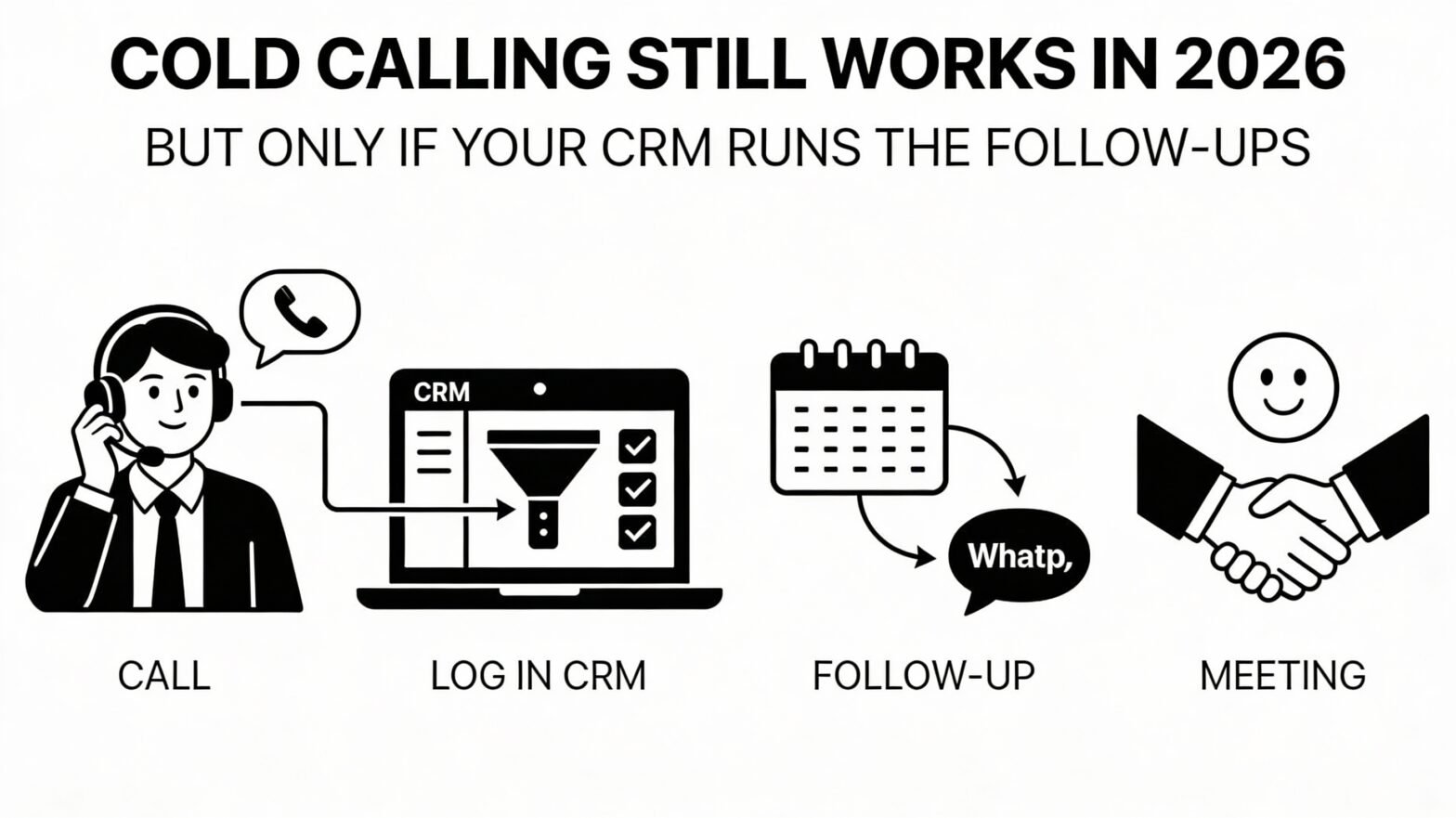
Cold calling still works in 2026—but the teams winning aren’t “hustling harder.”
They’re running a tight follow-up system inside their CRM.
Industry benchmarks consistently show that average cold-calling success rates hover around ~2–3%, while best-in-class teams reach ~6–10%. The difference isn’t confidence or talk time—it’s targeting, context, and disciplined follow-ups.
Cold calling isn’t dead.
Random, untracked cold calling is.
Cold calling means reaching out to someone who doesn’t know you yet—no prior conversation, no meeting, no warm introduction.
The biggest mistake teams still make is expecting the first call to close.
In reality, the job of a cold call is much simpler:
Selling comes later—if at all.
People didn’t stop answering calls.
They stopped tolerating bad calls.
Cold calling still works today when:
Most cold calls fail not because of rejection—but because nothing happens after the call.
Cold calling without a robust CRM is just guesswork.
Context disappears:
The next call feels disconnected—or worse, repetitive.
A Telecalling CRM turns cold calls into a pipeline by:
Instead of relying on memory or sticky notes, every interaction becomes connected.
A CRM for cold calling should capture more than just a dial attempt.
At minimum, it should track:
This turns cold calling from a stressful activity into a repeatable system.
Cold calls don’t need scripts.
They need clarity.
A respectful opener works better than a long pitch because it invites a clear yes/no decision on relevance.
Example opener:
“Hi, this is [Name]. I’ll be quick. I’m calling because we work with businesses like yours, and I wanted to check if this is relevant for you right now.”
The real difference-maker is what happens next:
Your CRM should immediately log the outcome and schedule the next step—so nothing relies on memory.
Most cold calls fail for boring reasons:
When follow-ups are driven by a CRM—not personal discipline—results become predictable instead of chaotic.
Very few deals move forward from a single call.
Multiple data-backed outbound studies consistently show that multiple touches matter. The real value of a CRM is ensuring those touches happen with timing and context.
A simple cadence that works:
Cold calling succeeds when the system—not the salesperson’s memory—runs this process.
The goal isn’t to sell on the first call.
The goal is to decide whether the conversation is worth continuing—and then run a clean follow-up system if it is.
That’s what separates average teams from high-performing ones.
If your team is already cold calling but struggling with missed follow-ups, scattered notes, or inconsistent callbacks, Groweon CRM helps you turn every call into a structured pipeline.
With Groweon CRM, you can:
Book a free 15-minute demo and see how organized follow-ups can transform your cold calling results in 2026.
1. Does cold calling still work in 2026?
Yes, cold calling still works in 2026—but only when it’s targeted and supported by a structured follow-up system. Random, high-volume calling no longer performs well. Teams that use a CRM to track calls, log outcomes, and automate follow-ups consistently achieve much higher success rates.
2. What is a Telecalling CRM and why is it important?
A Telecalling CRM is a system that logs every call, captures conversation context, tracks outcomes, and schedules follow-ups automatically. It ensures that no lead is forgotten and every next action happens on time, turning cold calls into a structured sales pipeline.
3. What success rate can businesses expect from cold calling today?
On average, cold calling success rates are around 2–3%, while well-structured teams with strong targeting and CRM-driven follow-ups can reach 6–10%. The difference comes from process discipline, not just calling volume.
4. How many follow-ups are needed for cold calling to work?
Most deals require multiple touchpoints. A simple and effective cadence includes 2–3 follow-up calls combined with short recap messages. A CRM helps manage this cadence by setting reminders and preserving context for each interaction.
5. How does Groweon CRM improve cold calling results?
Groweon CRM helps sales teams log calls automatically, capture notes and objections, assign follow-up tasks, and maintain a clear calling cadence. This removes guesswork, reduces missed follow-ups, and turns cold calling into a predictable, repeatable process.

05 Mar, 2026
India’s sales landscape is changing faster than most businesses realize....

02 Mar, 2026
Here is a number that should concern every sales leader:...

28 Feb, 2026
Your customers are already on WhatsApp. With over 2 billion...

27 Feb, 2026
Every business runs on leads. But generating leads is only...

24 Feb, 2026
Sales is one of the most human-driven professions in business....