Cloud CRM vs On-Premise CRM: Which One Is Right for…
09 Mar, 2026
Choosing a CRM is one of the most important technology...


Auto Capturing, nurturing, and converting potential customer leads.

Manage AMC contracts, track service requests, ensure timely renewals.

Tracks, resolves, manages issues, and gathers customer feedback.

Manage purchases, expenses, vendors, and POs efficiently with CRM.

Manages order lifecycle from placement to delivery completion.

Generates invoices and manages sales transactions and records efficiently.

Manages stock levels, tracks items, ensures efficient inventory control.

Manages dealer workflows, assigns leads, and tracks progress centrally.

WhatsApp CRM integration with bulk messaging, auto notifications, chatbots.

IVR enabled CRM integrates click-to-call, bulk dialling, recording features.

Achieves optimum productivity of tele-sales team with auto dialler.

Updated: 9th March, 2026
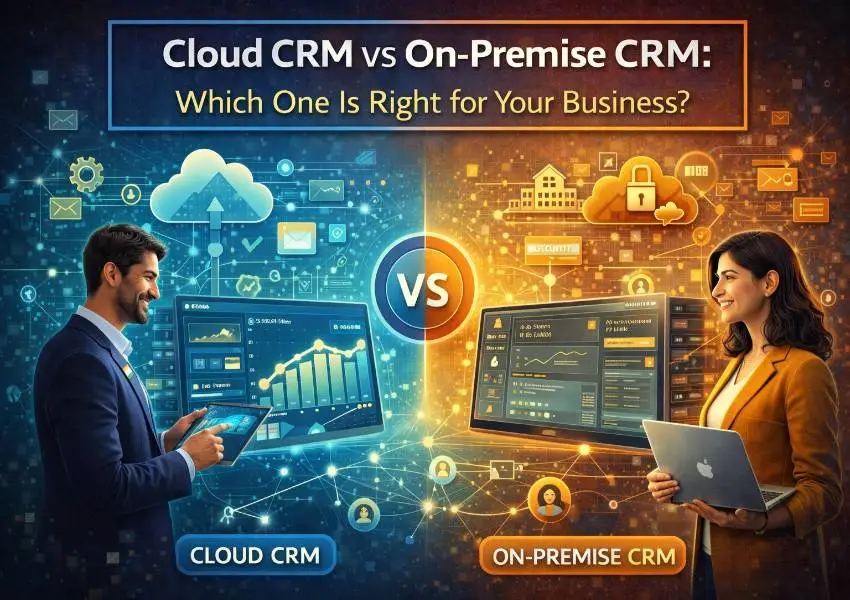
Choosing a CRM is one of the most important technology decisions a growing business makes. But before you compare features, pricing plans, or integrations, there is a more fundamental question to answer: should your CRM live in the cloud or on your own servers?
Cloud CRM and on-premise CRM are not just different deployment options. They represent two completely different philosophies around how software should be owned, managed, and scaled. The right choice depends on your business size, budget, IT capabilities, data sensitivity requirements, and how quickly you need to get up and running.
According to Gartner’s CRM market research, CRM is the largest and fastest-growing enterprise software category in the world. Yet many businesses still make their deployment decision without fully understanding the trade-offs involved.
This guide breaks down everything you need to know about cloud CRM versus on-premise CRM, so you can make the right call for your business with confidence.
A cloud CRM is a CRM platform hosted on the vendor’s servers and accessed via the internet. You do not install anything on your own hardware and log in through a browser or mobile app, and everything, your data, your pipeline, your automations, lives on servers managed by the CRM provider.
You pay a subscription fee, typically monthly or annually per user, and the provider handles all maintenance, updates, security patches, and infrastructure scaling. When a new feature is released, it appears in your account automatically. When you add new users, it takes minutes.
Most modern CRM platforms operate on this model. Groweon CRM, Salesforce, HubSpot, Zoho, and Pipedrive are all cloud-based. The growth of cloud CRM has been dramatic: Statista reports that cloud CRM now accounts for over 80% of total CRM software revenue globally, a figure that continues to grow year on year.
An on-premise CRM is software that is installed and run on your own company’s servers, within your own physical or virtual infrastructure. Instead of paying a subscription to access software hosted elsewhere, you purchase a license, install the software on hardware you own or manage, and your IT team is responsible for maintaining, updating, securing, and scaling the system.
On-premise CRM gives you complete control over your data and infrastructure. Nothing leaves your servers. You are not dependent on a vendor’s uptime or pricing decisions. But that control comes with significant responsibility and cost.
Examples of on-premise CRM solutions include older versions of Microsoft Dynamics CRM, SAP CRM, and SugarCRM. Many large enterprises and regulated industries have historically preferred this model, though even among large organizations the shift toward cloud is accelerating.
Before diving into which is right for your business, it helps to understand how the two models compare across the dimensions that matter most.
Cloud CRM operates on a subscription model. You pay per user per month and the cost scales with your team. There is no large upfront investment. On-premise CRM requires a significant upfront license purchase, hardware investment, and ongoing IT staffing costs. The total cost of ownership for on-premise is typically much higher, particularly for small and mid-sized businesses.
A cloud CRM can be set up in hours or days. Your team logs in, configures the pipeline, imports contacts, and starts selling. An on-premise CRM implementation can take weeks or months, involving hardware procurement, software installation, configuration, testing, and training.
With cloud CRM, the vendor handles all updates, security patches, and infrastructure maintenance automatically. With on-premise, your IT team is responsible for every update, backup, and security measure. This is a significant ongoing operational burden.
On-premise CRM gives you complete control over where your data lives and who can access it. Cloud CRM stores your data on the vendor’s servers, which some businesses, particularly those in regulated industries, find concerning. Reputable cloud CRM providers offer strong data security, encryption, and compliance certifications, but the data is not physically in your building.
Cloud CRM can be accessed from anywhere with an internet connection, on any device. This is particularly valuable for remote teams, field sales reps, and businesses with multiple offices. On-premise CRM is typically accessible only within your network unless you invest in additional remote access infrastructure.
Scaling a cloud CRM means adding user licenses. Scaling an on-premise CRM means purchasing additional server capacity, which is costly and slow. For growing businesses, cloud CRM scales far more easily.
On-premise CRM traditionally offers deeper customization at the infrastructure level. For businesses with highly complex, unique processes that no standard CRM can accommodate, on-premise can be adapted more extensively. Cloud CRM platforms have significantly closed this gap in recent years, offering substantial customization within the platform without touching infrastructure.
For the vast majority of businesses in 2026, cloud CRM is the right choice. Here is why.
Lower barrier to entry. There is no large capital expenditure to get started. A small business or startup can access a professional, full-featured CRM for a monthly per-user fee that is a fraction of the cost of on-premise. This democratization of CRM technology is one of the most significant shifts in sales software over the past decade.
Faster deployment. Time to value matters. With cloud CRM, your team can be up and running in a day. With on-premise, you might spend months before a single rep logs their first lead. In a competitive sales environment, that difference is significant.
Automatic updates and innovation. Cloud CRM vendors continuously release new features, AI capabilities, and integrations. Your platform gets better over time without any effort on your part. On-premise users either pay for upgrade licenses or fall behind, using software that no longer reflects the current state of the art.
Remote and mobile access. Your sales reps are not always at their desks. Cloud CRM works from a laptop in a coffee shop, a phone on the road, or a tablet at a client’s office. For businesses with field sales teams or remote employees, this is not optional.
Predictable costs. Subscription pricing makes budgeting straightforward. You know exactly what you are spending each month. On-premise costs are harder to predict, with hardware failures, IT staffing changes, and upgrade cycles creating unplanned expenses.
Built-in security. Reputable cloud CRM providers invest more in security infrastructure than most individual businesses ever could. Enterprise-grade encryption, regular security audits, and compliance with standards like GDPR, SOC 2, and ISO 27001 are standard features of leading cloud platforms.
On-premise CRM is not the right choice for most businesses in 2026. But for a specific set of organizations, it remains a valid option worth considering.
Strict data sovereignty requirements. Some industries, including defence, government, certain financial services sectors, and healthcare in specific jurisdictions, have regulations that require customer data to remain on-site or within a specific geography. For these organizations, cloud CRM may not be compliant without specific contractual and technical arrangements.
Existing IT infrastructure investment. Large enterprises that have invested heavily in on-premise infrastructure may find that the total cost of migrating to cloud CRM, factoring in data migration, retraining, and integration rebuilding, outweighs the benefits in the short term. For these organizations, a phased approach or hybrid model may make more sense.
Highly customized legacy systems. Organizations whose CRM has been deeply customized over many years to match complex processes may find it difficult to replicate that customization in a cloud environment. In these cases, maintaining on-premise while gradually rebuilding processes for cloud can be a practical transition strategy.
No reliable internet connectivity. This is increasingly rare but remains a genuine consideration for businesses operating in locations with unreliable internet infrastructure. On-premise CRM does not depend on external connectivity to function.
It is worth noting that even these use cases are being addressed by cloud CRM providers. Private cloud deployments, regional data hosting options, and highly configurable enterprise cloud platforms are closing the gap between what cloud can offer and what on-premise used to be the only solution for.
Many businesses are attracted to on-premise CRM by the idea of a one-time license purchase rather than ongoing subscription fees. But the true total cost of ownership is rarely what it appears at first glance.
Hardware costs. Servers, storage, networking equipment, and the physical space and power to run them are all costs that fall entirely on your business with on-premise CRM.
IT staffing. On-premise CRM requires skilled IT staff to install, configure, maintain, update, and troubleshoot the system. Depending on the complexity of your deployment, this can mean one or more full-time roles dedicated primarily to CRM infrastructure.
Upgrade costs. Moving to a newer version of on-premise software often requires purchasing an upgrade license and going through a significant implementation process. Meanwhile, cloud CRM users receive continuous improvements automatically.
Downtime risk. When your on-premise CRM server fails, your entire sales operation can grind to a halt. Cloud CRM providers maintain high-availability infrastructure with redundant systems specifically to prevent this.
Security costs. Protecting on-premise data from breaches, ransomware, and unauthorized access requires ongoing investment in security tools, monitoring, and expertise that cloud providers bundle into their service.
When all of these costs are added up over a three to five year period, on-premise CRM is almost always more expensive than cloud CRM for small and mid-sized businesses, often significantly so.
Use this framework to guide your decision.
Choose cloud CRM if: you are a small or mid-sized business, you want to be operational quickly, your team works remotely or in the field, you want predictable monthly costs, you do not have dedicated IT infrastructure staff, you want access to the latest AI and automation features, or you need to scale your team up or down flexibly.
Choose on-premise CRM if: you operate in a regulated industry with strict data residency requirements that cloud cannot meet, you have an existing large-scale IT infrastructure that makes cloud migration impractical in the short term, you have highly specific customization needs that no cloud platform can accommodate, or internet connectivity in your operating environment is genuinely unreliable.
Consider a hybrid approach if: you need some data kept on-site for compliance reasons but want the usability and scalability of cloud for your sales team’s day-to-day work. Many enterprise CRM providers now offer hybrid deployment models that combine both.
For most Indian businesses in 2026, including startups, SMEs, and growing enterprises across sectors like SaaS, real estate, manufacturing, and financial services, cloud CRM is the clear, practical choice. The infrastructure is reliable, the costs are accessible, and the capabilities, particularly in AI, automation, and mobile access, are simply not available in on-premise solutions at a comparable price point.
Groweon CRM is a fully cloud-based CRM platform designed for the way modern sales teams actually work. There is nothing to install, no servers to manage, and no IT team required to get started. You sign up, configure your pipeline, and your team is selling within the same day.
With Groweon CRM you get enterprise-grade security and data encryption without enterprise-level complexity, automatic updates that bring new AI and automation features to your account without any action on your part, full mobile access so your reps can manage their pipeline from anywhere, scalable pricing that grows with your team without surprise costs, and seamless integrations with email, WhatsApp, calendars, and marketing tools that connect your entire sales operation in one place.
For businesses that want the full power of a modern, AI-powered CRM without the infrastructure burden of on-premise, Groweon CRM is built precisely for you.
Is my data safe in a cloud CRM? Yes, when you choose a reputable provider. Leading cloud CRM platforms use AES-256 encryption, regular third-party security audits, role-based access controls, and compliance with international data protection standards. In most cases, your data is more secure in a professional cloud environment than on an on-premise server maintained by an in-house IT team with limited security resources.
What happens to my data if I cancel my subscription? Reputable cloud CRM providers give you the ability to export your data in standard formats before cancellation. Always check the data export policy before committing to any platform.
Can I migrate from on-premise to cloud CRM? Yes. Most cloud CRM platforms, including Groweon CRM, offer data migration support to help you move your existing contacts, deals, and history from your current system. The process is typically much smoother than businesses expect.
Will cloud CRM work if my internet goes down? Most cloud CRM platforms offer offline functionality for core features via their mobile apps, syncing data automatically when connectivity is restored. For teams in areas with consistently unreliable connectivity, this is worth checking with your provider before committing.
The cloud versus on-premise debate has largely been settled by the market. Over 80% of new CRM deployments are cloud-based, and that number is only going up. The flexibility, affordability, speed of deployment, and continuous innovation that cloud CRM delivers are simply not matched by on-premise alternatives at any comparable cost.
For most businesses, the question is not really cloud versus on-premise. It is which cloud CRM platform best fits your sales process, your team size, and your growth ambitions.
Groweon CRM is built to be that platform for growing Indian businesses. Fast to set up, easy to use, powerful enough to scale, and priced to be accessible from day one.
Stop managing your sales process on spreadsheets or an outdated system that no longer serves your team. Make the move to cloud CRM and build the foundation your sales operation needs to grow.
Q1. What is the main difference between cloud CRM and on-premise CRM?
Cloud CRM is hosted by the vendor and accessed via the internet, with no hardware or maintenance required from your side. On-premise CRM is installed on your own servers, giving you full data control but requiring your IT team to manage everything.
Q2. Is cloud CRM more expensive than on-premise in the long run?
For most businesses, cloud CRM is significantly cheaper. On-premise has hidden costs including hardware, IT staffing, upgrades, and security that make the total cost of ownership much higher than a straightforward subscription fee.
Q3. Is data secure in a cloud CRM?
Yes. Reputable cloud CRM providers use enterprise-grade encryption, regular security audits, and international compliance standards. In most cases, cloud data is more secure than on-premise data managed by a small internal IT team.
Q4. Can a small business use cloud CRM without an IT team?
Absolutely. That is one of cloud CRM’s biggest advantages. Platforms like Groweon CRM are designed so that any business owner or sales manager can set up and manage the system without any technical background.
Q5. When does on-premise CRM still make sense? Mainly for organizations in regulated industries with strict data residency laws, large enterprises with deeply customized legacy systems, or businesses operating in locations with genuinely unreliable internet connectivity.
09 Mar, 2026
Choosing a CRM is one of the most important technology...

05 Mar, 2026
India’s sales landscape is changing faster than most businesses realize....

02 Mar, 2026
Here is a number that should concern every sales leader:...

28 Feb, 2026
Your customers are already on WhatsApp. With over 2 billion...

27 Feb, 2026
Every business runs on leads. But generating leads is only...