

Best CRM for Rubber and Tyre Manufacturers
16 Oct, 2026
Summary (TL;DR) The best CRM for rubber and tyre manufacturers...
Updated: 31st August, 2026
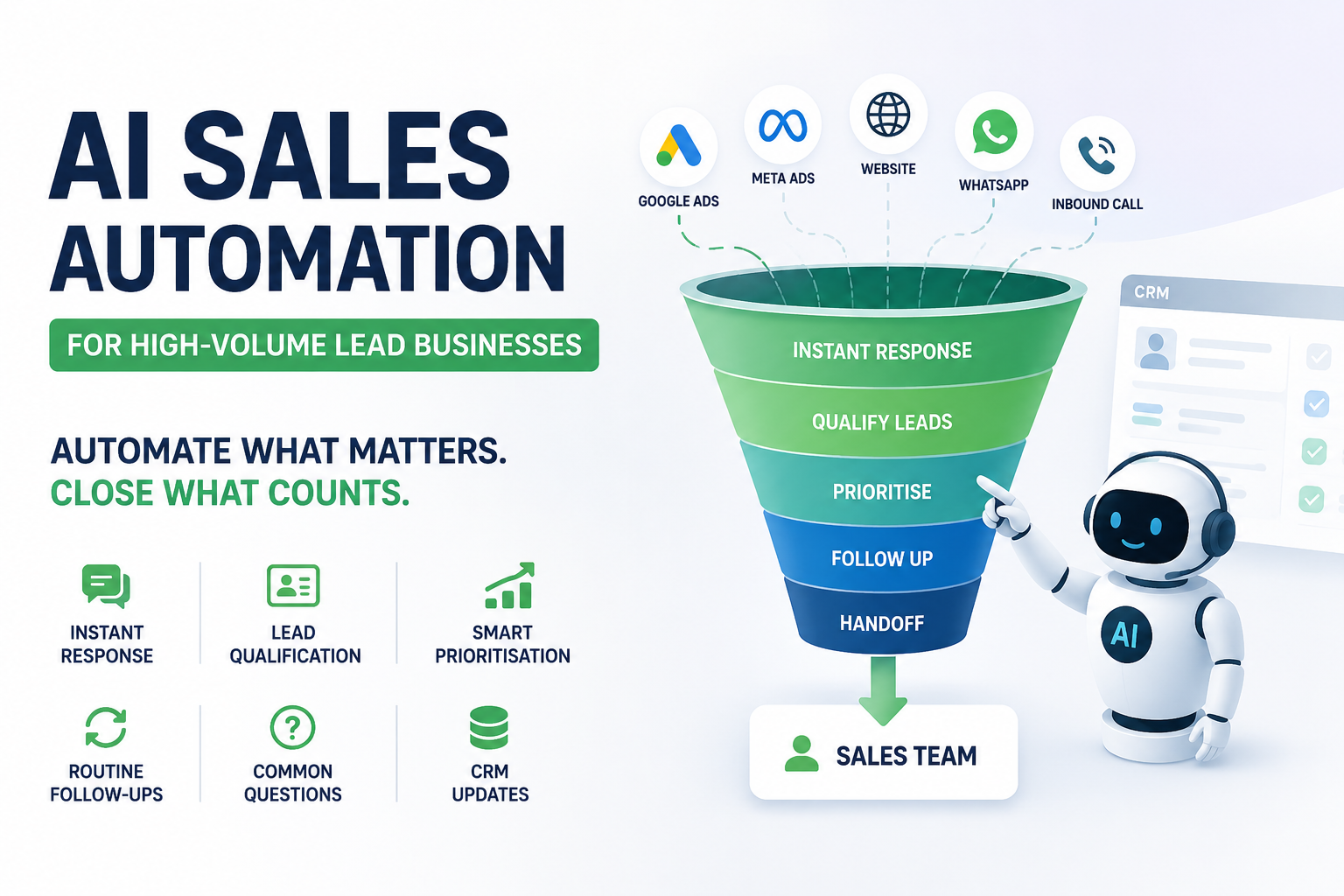
AI sales automation helps high-volume businesses manage leads faster without increasing repetitive work for sales teams.
The best starting points are instant response, lead qualification, prioritisation, routine follow-ups and CRM updates.
AI should handle repetitive activities while salespeople remain responsible for complex conversations, negotiation and deal closure.
Connecting AI with CRM software gives sales teams better customer context and makes automated engagement more useful.
The goal is not to automate everything, but to automate the right activities first and give salespeople more time to convert valuable opportunities.
For businesses generating hundreds or thousands of leads every month, the real sales challenge often begins after the lead is generated.
A prospect may come through Google Ads, Meta campaigns, a website form, WhatsApp, or an inbound call. From there, someone needs to respond, understand the requirement, qualify the lead, update the CRM, follow up, schedule a meeting and eventually move the opportunity toward closure.
When lead volume is low, salespeople can manage many of these activities manually. But when enquiries increase, the same process can create delays, missed follow-ups and unnecessary administrative work.
This is where AI sales automation becomes valuable. Instead of trying to automate everything at once, businesses should identify the sales activities that are repetitive, time-sensitive and have a measurable impact on conversion.
The right question is not simply “What can AI automate?”
It is “What should we automate first to make our sales team faster and more productive?”
Lead volume creates a scale problem.
A salesperson may be able to personally manage a limited number of opportunities, but handling hundreds of incoming enquiries requires a different operating model. New leads need immediate attention while existing prospects still require follow-ups, demos, proposals and negotiations.
This creates several common problems:
Speed is particularly important at the beginning of the sales journey. Research from Harvard Business Review on online sales leads found that companies often respond much more slowly to online enquiries than they should.
That makes instant lead engagement one of the most practical places to begin with AI.
Businesses should prioritise activities that are high-volume, repetitive, time-sensitive and easy to measure.
The objective is not to replace the salesperson. It is to remove the repetitive layer surrounding the salesperson.
1. Automate the First Response
For high-volume businesses, instant lead response should usually be the first automation priority.
When someone fills out a form or requests a demo, their interest is current. Waiting several hours before making contact can reduce the opportunity to engage them while they are actively looking for a solution.
InsideSales’ 2021 research analysed more than 55 million sales activities involving 5.7 million inbound leads and reported that conversion rates were significantly higher when leads were engaged within the first five minutes.
AI can provide that first layer of engagement.
Instead of waiting for a salesperson to become available, an AI agent can acknowledge the enquiry, understand the basic requirement and begin collecting relevant information.
This is particularly useful when leads arrive outside working hours or when the sales team is already handling other conversations.
After responding to the lead, qualification is the next logical area for automation.
Salespeople often ask the same basic questions repeatedly:
What are you looking for?
Which industry are you in?
How many users do you have?
What are you currently using?
When do you want to implement the solution?
AI can collect this information during the initial conversation.
The questions should be based on the company’s actual qualification criteria rather than generic scripts.
For example, a CRM company may qualify leads according to industry, team size, current process, implementation timeline and interest in a demo.
A connected lead management solution can then keep these qualification details connected with the lead record, follow-up history and sales activities.
The salesperson receives more than a name and phone number. They receive context.
Not every lead has the same buying intent.
One prospect may simply be researching solutions, while another may have a defined requirement, ask about pricing and request a product demonstration.
Both are leads, but they should not necessarily receive the same sales priority.
AI can help analyse available signals from customer responses, engagement and CRM activity to identify opportunities that may deserve faster attention.
This is consistent with the direction of modern agentic sales systems. McKinsey’s 2026 research describes how agentic AI can help identify, score and route opportunities while giving sellers more context about the next best action.
The purpose is not to let AI make every final sales decision. It is to help sales teams spend their limited time where it is most valuable.
Follow-up is one of the biggest opportunities for sales automation.
A prospect may enquire today, receive pricing tomorrow and then stop responding. The salesperson may intend to call again, but new leads and meetings can push that activity down the list.
AI can help maintain follow-up consistency.
The important difference is contextual follow-up.
A prospect who asked about pricing should not necessarily receive the same message as someone who requested implementation information. The AI should use the previous interaction to determine what type of communication makes sense.
This turns automation from simply sending more messages into maintaining a more relevant sales conversation.
Sales teams frequently spend time answering repetitive questions about product features, implementation, availability, support and basic pricing information.
Suitable questions can be handled by AI using approved business information.
If the customer asks something complex or outside the AI’s defined scope, the conversation can be transferred to a salesperson.
This creates a practical division:
AI handles repetitive information requests.
Salespeople handle complex customer conversations.
That distinction is important because the objective of AI sales automation should be to increase sales capacity, not remove human expertise from the buying process.
CRM administration is another area where high-volume teams lose time.
After calls and conversations, salespeople may need to update lead status, add notes, record requirements, change the sales stage and create the next follow-up task.
Each activity may take only a few minutes, but hundreds of leads can turn those minutes into hours of administrative work.
AI can assist with capturing information from customer interactions and keeping CRM records updated.
This is why the connection between AI and CRM software matters. The AI should not operate separately from the sales process; customer conversations and actions should remain connected to the opportunity record.
An AI agent becomes significantly more useful when it can work with relevant customer context.
Imagine a prospect has already:
If an AI system only knows that the person is a “lead,” it cannot provide a very useful next interaction.
With CRM context, the system can understand where the prospect is in the journey and support a more appropriate next step.
Businesses looking to centralise their sales information can use Sales CRM to keep lead records, activities, sales stages and follow-ups connected.
Once a prospect is qualified and interested, scheduling the next conversation can become another source of unnecessary back-and-forth.
AI can support meeting scheduling by offering suitable time slots, confirming appointments and helping manage reminders.
This is particularly useful for businesses conducting large numbers of product demos or consultations.
The goal is to reduce the distance between “I am interested” and “Let’s talk.”
The fewer manual steps involved, the easier it becomes for a sales team to handle a larger number of qualified opportunities.
What Should Remain Human?
Not every sales activity should be automated.
Complex negotiations, strategic accounts, sensitive customer situations and final commercial decisions often require human judgement.
A practical approach is to let AI handle initial engagement, basic qualification, routine follow-ups and repetitive information requests while salespeople take control of product consultation, complex objections, negotiation and closure.
The strongest AI sales strategy is therefore human-led selling supported by automated execution.
Traditional automation works well when the next action is predictable.
For example:
New lead → assign salesperson → send email → create reminder
AI agents become more useful when the next action depends on what the prospect says or does.
For example, the system can engage a new lead, understand their requirement, ask qualification questions, respond to relevant queries, continue appropriate follow-up and alert the salesperson when the opportunity becomes sales-ready.
That is the difference between automating a task and supporting a sales process.
McKinsey’s 2026 research argues that businesses are increasingly gaining value by applying agentic AI to end-to-end commercial workflows rather than treating AI as isolated productivity tools.
How AION Can Support High-Volume Lead Engagement
For businesses handling large numbers of incoming enquiries, AION AI+ can support AI-powered sales activities within the broader Groweon ecosystem.
Groweon’s AION capabilities include AI-powered calling, WhatsApp engagement, lead qualification, bulk calling, rule-based calling and qualified-lead alerts.
For businesses specifically looking to automate calling, an AI Calling Agent can support automated lead conversations and qualification.
Similarly, an Auto Lead Qualifier can help collect relevant information and identify leads that meet predefined qualification requirements.
The benefit becomes stronger when these interactions remain connected with CRM data instead of operating as separate activities.
Businesses do not need to automate everything at once. A phased approach is more practical: Response — automate instant engagement with new enquiries. Qualification — collect the information salespeople need to understand the opportunity. Prioritisation — identify high-intent leads that require faster attention. Follow-Up — automate routine and contextual follow-ups. CRM Management — reduce manual data entry and administrative work. Human Handoff — define clear situations where salespeople should take over. Optimisation — track response time, qualification, meetings, conversions and revenue impact.
This approach allows businesses to start with the activities that create the clearest operational benefit and expand automation based on actual results.
AI sales automation should be measured through business outcomes rather than the number of automated conversations.
Important metrics include:
If response time improves but qualified opportunities and conversions do not, the business should review the qualification criteria, messaging and follow-up strategy.
The answer depends on the sales process, but for most high-volume lead businesses, the priority should be clear.
Start with speed. Respond to new leads immediately.
Then improve qualification. Collect the information salespeople actually need.
Next automate prioritisation and follow-ups. Make sure high-intent prospects receive attention and interested leads do not disappear from the pipeline.
Then reduce administration. Use AI to assist with CRM updates and repetitive customer interactions.
Finally, introduce clear human handoffs so that AI supports salespeople rather than attempting to replace them.
Businesses can explore Groweon CRM to connect lead management, sales activities, customer information and AI-powered engagement within one CRM environment.
AI sales automation should not be treated as a race to automate the maximum number of tasks.
The better strategy is to automate the activities that consume the most repetitive sales time while keeping important customer conversations human-led.
For high-volume businesses, that usually means starting with instant lead response, qualification, prioritisation, follow-up and CRM administration.
Once those areas are working effectively, businesses can gradually introduce more advanced AI capabilities.
The result is a sales operation where AI handles repetitive execution, CRM keeps customer context connected and salespeople focus on the conversations that actually require their expertise.
That is the real value of AI sales automation: not replacing the sales team, but helping the same team manage more opportunities with greater speed, consistency and context.
What should a high-volume business automate first in sales?
Businesses should generally start with instant lead response, basic qualification, lead prioritisation, routine follow-ups and repetitive CRM updates because these activities occur frequently and can consume substantial sales time.
Can AI qualify sales leads automatically?
Yes. AI can ask business-specific questions, collect prospect information and help identify leads that meet predefined qualification criteria before passing relevant opportunities to sales.
Can AI handle sales follow-ups?
Yes. AI can support routine follow-ups and use previous customer interactions to make those communications more relevant. Complex or sensitive conversations can be transferred to human representatives.
Should businesses automate deal closure?
Deal closure should generally remain human-led. AI can support the process with information, reminders and workflow assistance, but negotiations and final commercial decisions often require human judgement.
Why is CRM integration important for AI sales automation?
CRM integration gives AI access to lead history, customer information, sales stages and previous interactions. This allows automated engagement to be more contextual and makes human handoff more effective.
How can businesses measure AI sales automation?
Track response time, qualification rate, qualified leads, follow-up completion, demo bookings, sales handoff time, conversion rate and overall sales productivity.

16 Oct, 2026
Summary (TL;DR) The best CRM for rubber and tyre manufacturers...

16 Oct, 2026
Summary (TL;DR) A CRM for agricultural equipment manufacturers tracks farmer...

16 Oct, 2026
Summary (TL;DR) The best CRM for paint and coatings manufacturers...

15 Oct, 2026
Summary (TL;DR) A CRM for cement and building material manufacturers...

15 Oct, 2026
Summary (TL;DR) A CRM for pharma API and bulk drug...