

Best Mobile CRM Apps for Sales Teams in India (2026…
09 Oct, 2026
Summary (TL;DR): The best mobile CRM apps in India combine...
Updated: 25th August, 2026
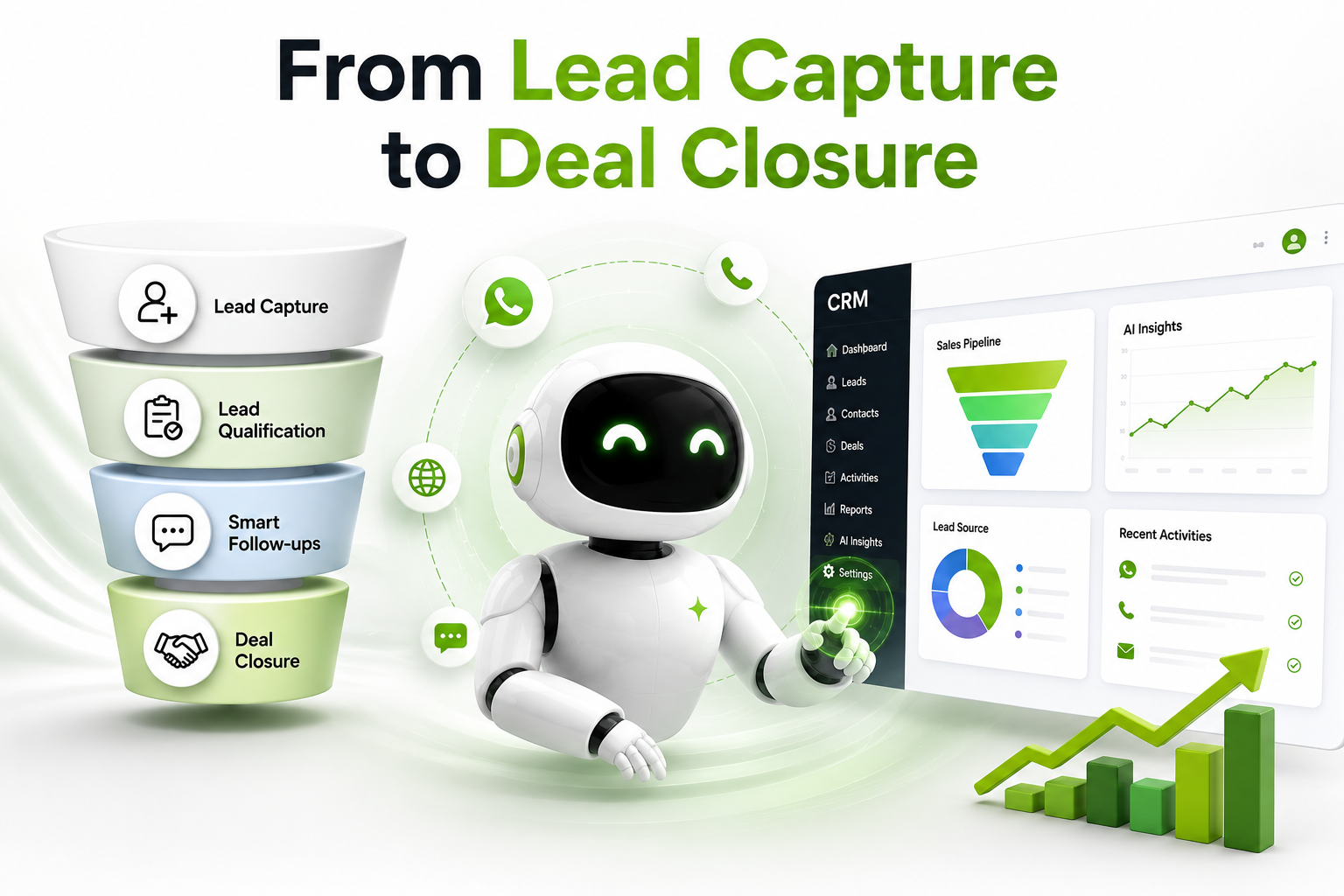
AI agents can help businesses respond to leads instantly and begin qualification while customer interest is still active. They can analyse lead information, identify buying intent and help sales teams prioritise valuable opportunities. Connected with CRM software, AI can also support customer data management, follow-ups and sales activity tracking.
This reduces repetitive administrative work and helps salespeople focus on complex conversations and negotiations. The biggest advantage is a more consistent and connected sales process from lead capture to deal closure. Ultimately, AI agents work best as a support system that combines automation with human sales expertise.
Generating a lead is only the beginning of the sales process. The real challenge is making sure that every promising enquiry receives the right response, qualification and follow-up before the opportunity goes cold.
For growing businesses, this becomes difficult when enquiries arrive simultaneously through websites, advertisements, WhatsApp, calls and other channels. Salespeople have to respond to new leads while managing demos, proposals, negotiations and existing customers.
This is where AI agents are changing the role of CRM software. Instead of using a CRM only to record customer information, businesses can use AI to support the activities that move an opportunity through the sales funnel.
A new enquiry does not automatically become a sales opportunity. Someone still needs to understand what the prospect wants, determine whether the requirement is relevant and decide how quickly the lead should be followed up.
Response time can have a measurable impact at this stage. Research from InsideSales found that responding to inbound leads within five minutes can significantly improve contact and qualification outcomes.
The problem is that sales teams cannot always respond immediately. A salesperson may already be on a call or handling another customer when a new enquiry arrives.
An AI agent can provide the first layer of engagement while the sales team is occupied. This allows the business to acknowledge the enquiry, begin understanding the requirement and keep the prospect engaged until human intervention is required.
The quality of a lead cannot be understood from a name and phone number alone. Sales teams need information about the prospect’s requirement, urgency, budget, business type or other factors relevant to the buying decision.
AI agents can collect this information during an initial conversation. Instead of sending every enquiry directly to a salesperson, the system can establish basic context first.
For example, a business selling CRM software may need to know the prospect’s industry, team size, current process and expected implementation timeline. Capturing these details early gives the salesperson a much clearer starting point.
A structured lead management solution can then keep this information connected with the lead record, follow-up history and sales activities.
Lead volume is not the same as sales opportunity.
A company may receive hundreds of enquiries, but their buying intent can vary considerably. One prospect may simply be researching solutions, while another may already have a defined requirement and be ready for a product demonstration.
AI-assisted qualification helps sales teams identify these differences earlier.
The system can use information gathered during conversations along with available CRM activity to help determine which opportunities require immediate attention. This does not eliminate human judgement; it gives salespeople better information before they make that judgement.
Many sales opportunities do not disappear because the prospect was never interested. They disappear because the follow-up process was inconsistent.
A customer may attend a demo, ask for pricing and then stop responding. The salesperson may intend to call again, but new enquiries and other responsibilities can push that follow-up down the priority list.
Traditional CRM automation can create reminders for such situations. AI agents can make the process more contextual by using the customer’s previous interactions to support the next communication.
A prospect who previously asked about implementation should not necessarily receive the same follow-up as someone who only requested a brochure.
The difference is important because effective sales automation is not about sending more messages. It is about maintaining a relevant conversation throughout the buying journey.
A CRM can contain valuable information about every opportunity, but sales teams often struggle to use all of it effectively.
Call records, previous conversations, requirements, follow-up history and sales stages can become difficult to review manually when the pipeline grows.
AI can help turn this information into usable sales context. It can assist with conversation summaries, customer requirement identification and CRM updates, reducing the amount of administrative work expected from salespeople.
This makes the CRM more than a place where information is stored. It becomes a source of context that can support the next sales decision.
AI agents can handle repetitive parts of the sales process, but not every sales interaction should be automated.
Complex requirements, negotiation, commercial discussions and relationship-building still require human judgement. The most effective model is therefore not AI replacing salespeople, but AI taking care of repetitive work around them.
This division allows sales representatives to spend more time on activities that directly influence revenue.
Research from McKinsey also highlights how AI can reshape B2B sales workflows while allowing sellers to focus on higher-value commercial activities.
There is a difference between a traditional automated workflow and an AI agent.
A basic automation usually follows a fixed instruction. For example, when a lead submits a form, the system may send a predefined email.
An AI agent can operate within a broader set of business rules and respond according to the context of the interaction. If a prospect provides a requirement, asks a question and requests a demonstration, the next action can be different from the action required for a prospect who has stopped responding.
This makes AI agents particularly relevant to sales funnels, where the correct next step often depends on what happened earlier in the customer journey.
AI becomes significantly more useful when it is connected to the CRM environment.
Without CRM context, an AI system may be able to communicate with a prospect, but it may not understand the full history of that opportunity.
When AI works with lead information, previous interactions, sales stages and follow-up records, it can support a more connected customer journey.
Businesses looking for an integrated platform can use Groweon CRM to manage leads, sales activities, customer information and follow-ups within one CRM environment.
The CRM provides the operational foundation, while AI can help automate and accelerate parts of the sales process.
The value of AI agents becomes clearer when the entire sales journey is considered rather than individual features.
A prospect enters through a marketing channel and is captured in the CRM. The AI can engage the prospect, collect relevant information and help qualify the enquiry.
The opportunity can then be prioritised according to available buying signals. When human involvement becomes necessary, the salesperson receives the relevant customer context rather than starting the conversation from the beginning.
After the interaction, the CRM continues to track the opportunity and supports the next stage of follow-up.
This creates a more connected relationship between lead generation, customer engagement and sales execution.
Businesses should not choose an AI sales solution simply because it offers a long list of AI features.
The important consideration is whether the technology fits the existing sales process. The system should be able to respond to enquiries, understand business-specific qualification requirements and maintain customer context throughout the interaction.
It should also work with the company’s CRM software, support lead updates and provide a clear process for transferring qualified opportunities to human sales representatives.
Management visibility is equally important. Sales leaders should be able to understand how AI is engaging prospects, which opportunities are being qualified and whether automated activities are helping the pipeline move forward.
A strong AI sales solution should therefore combine automation, CRM integration, human handoff and management control rather than treating AI as an isolated feature.
The strongest argument for AI agents is not simply that they can perform tasks faster. Their greater value comes from maintaining consistency across a sales process that is difficult to manage manually at scale.
A salesperson may provide excellent follow-up to ten opportunities. Maintaining that same level of attention across hundreds of prospects becomes considerably harder.
AI can handle the repetitive layer of engagement while salespeople focus on conversations that require expertise, trust and negotiation.
Groweon’s AION Autopilot brings AI-powered calling, WhatsApp engagement, lead qualification, bulk calling and qualified-lead alerts into the sales workflow, allowing businesses to automate parts of lead engagement while keeping human sales teams involved where needed.
AI agents are not simply another automation feature inside CRM software. They represent a shift towards sales systems that can participate in the execution of the customer journey.
The traditional CRM primarily answered:
What happened with this lead?
AI-enabled CRM is increasingly capable of helping answer:
What should happen next?
That distinction can make a significant difference for businesses managing high enquiry volumes.
When lead capture, qualification, prioritisation, engagement, CRM updates and follow-up work together, sales teams can spend less time managing repetitive processes and more time converting genuine opportunities.
The future of sales is therefore unlikely to be completely manual or completely autonomous. It is more likely to be a combination of AI-driven execution and human sales expertise, with technology handling repetitive work and salespeople focusing on the conversations that move qualified opportunities towards deal closure.
[wpforms id=”535″ title=”true” description=”true”]

09 Oct, 2026
Summary (TL;DR): The best mobile CRM apps in India combine...

09 Oct, 2026
Summary (TL;DR): Groweon Mobile CRM vs Groweon Lite comes down...

09 Oct, 2026
Summary (TL;DR) A barcode system turns every scan into an...

08 Oct, 2026
Summary The lead management software vs CRM choice comes down...

08 Oct, 2026
Summary (TL;DR) A CRM with Meta Ads integration should do...