

Best CRM for Rubber and Tyre Manufacturers
16 Oct, 2026
Summary (TL;DR) The best CRM for rubber and tyre manufacturers...
Updated: 2nd September, 2026
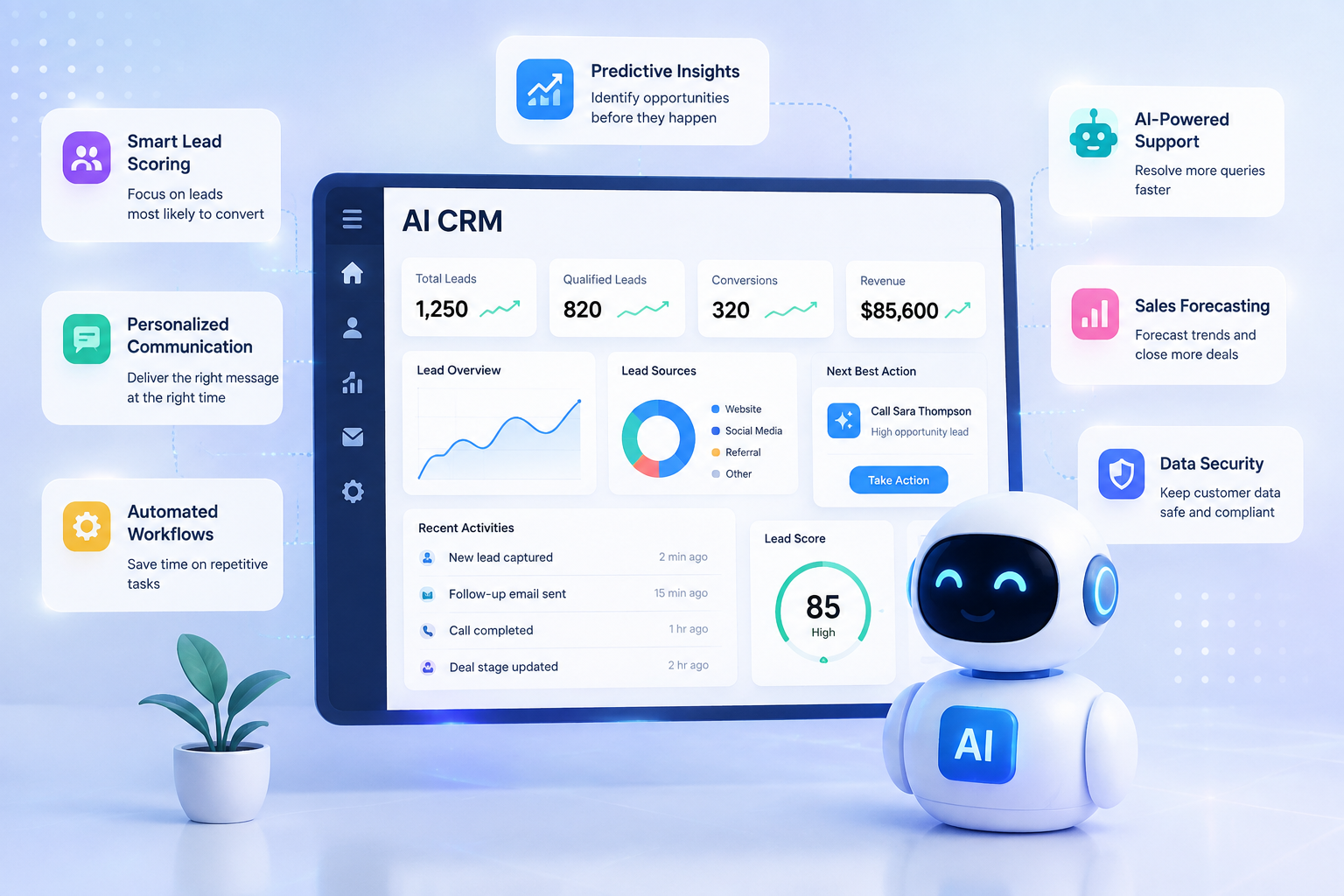
AI is transforming CRM from a system that stores customer data into an intelligent platform that can analyze and act on it.
AI CRM software helps businesses improve lead qualification, personalization, follow-ups, customer service, and sales decisions.
Predictive analytics and AI-powered automation allow teams to focus on higher-value customer interactions.
AI agents are taking CRM further by executing multi-step sales activities with defined human oversight.
Businesses adopting AI-powered CRM can build faster, more personalized, and more scalable customer relationship processes.
Customer expectations have changed. People want faster responses, relevant communication, personalized recommendations, and consistent service across every channel. At the same time, businesses are handling more customer data than sales and support teams can realistically manage manually.
This is where Artificial Intelligence (AI) is transforming Customer Relationship Management (CRM). Instead of using CRM software only to store contacts, record activities, and track deals, businesses can now use AI to analyze customer data, identify opportunities, automate repetitive work, and recommend the next best action.
According to IBM’s research on AI in CRM, AI can improve areas such as predictive analytics, personalization, automation, lead scoring, sentiment analysis, and customer data management.
Traditional CRM software has been essential for organizing customer information and managing sales pipelines. But most of the work still depends on people. Sales representatives have to review leads, update records, decide whom to contact, write follow-up messages, and remember when to follow up again.
As lead volumes increase, this manual approach becomes difficult to maintain.
An AI CRM changes this model by adding intelligence to the customer data already stored in the system. Instead of simply answering “What happened?”, an AI-powered CRM can help teams understand “What is likely to happen next?” and “What should we do now?”
For example, an AI CRM can identify a highly engaged lead, prioritize it for a salesperson, analyze previous interactions, suggest a relevant follow-up, and update the CRM after the interaction.
Lead management is one of the areas where AI can create an immediate difference.
An AI CRM can analyze lead source, engagement, previous conversations, customer information, and behavioral signals to identify which prospects are more likely to convert. Instead of treating every enquiry equally, sales teams can focus their attention on leads showing stronger buying intent.
AI-powered lead scoring can also continuously reassess leads as new information becomes available.
This makes a lead management solution more proactive rather than simply acting as a database.
Speed matters in sales and customer service. A delayed response can give a potential customer enough time to contact another business.
AI can help businesses respond faster through automated chat, email assistance, WhatsApp communication, and AI-powered calling. More importantly, AI can use existing customer context to make those responses more relevant.
For example, instead of sending the same follow-up message to every prospect, AI can consider the customer’s previous enquiry, interaction history, product interest, and current stage before generating a response.
IBM explains how AI agents can support lead prioritization and follow-ups, while still keeping human salespeople involved in important conversations and decisions.
Personalization becomes difficult when a business has thousands of customers.
AI helps solve this problem by analyzing customer preferences, purchase history, engagement patterns, communication history, and other available data. Businesses can then tailor their messages, recommendations, offers, and follow-ups according to individual customer context.
This is especially valuable for businesses managing customers across multiple channels.
AI can help maintain continuity so that a customer who interacts through WhatsApp, email, website forms, or a sales call does not have to repeatedly explain the same requirement.
One of the biggest advantages of AI CRM software is its ability to turn historical customer data into useful predictions.
AI can analyze patterns in previous sales and customer interactions to identify trends such as:
This gives managers more than historical reports. They can use AI-generated insights to make faster, data-informed decisions.
Salespeople spend significant time on administrative work: updating CRM records, writing emails, recording call notes, checking reminders, and preparing follow-ups.
AI can reduce this workload.
Modern Sales CRM software can combine automation with AI to help teams manage repetitive activities while keeping customer information updated.
For instance, after a customer interaction, AI can help summarize the conversation, create a CRM update, generate a follow-up message, and identify the next action.
This allows sales representatives to spend more time on conversations that actually require human judgment.
AI is also changing customer service inside CRM systems.
AI chatbots and virtual agents can answer common questions, collect customer information, provide basic assistance, and route complex issues to the appropriate employee. This allows businesses to provide support beyond normal working hours without requiring employees to handle every repetitive query manually.
The objective is not to remove human interaction. Instead, AI handles routine interactions while employees focus on complex problems, negotiations, complaints, and relationship-building.
The next stage of AI CRM is moving beyond rule-based automation.
Traditional automation follows predefined instructions: if this happens, perform that action.
AI agents can analyze context, determine the appropriate action, and execute multiple steps within defined business rules.
For example, an AI agent could identify a new enquiry, assess its quality, initiate a conversation, qualify the prospect, update the CRM, notify the salesperson, and continue a follow-up journey when appropriate.
This is why the industry is increasingly moving toward agentic CRM, where AI becomes an active participant in the sales process rather than simply an assistant.
Groweon’s AION Autopilot is designed around this approach, bringing AI calling, lead qualification, follow-ups, WhatsApp conversations, and lead intelligence into the CRM workflow.
Choosing an AI CRM should not be about selecting the platform with the longest feature list. Businesses should evaluate whether the AI actually improves their existing sales and customer processes.
Key capabilities to consider include:
It is also important to have clean and reliable CRM data. AI recommendations are only as useful as the information available to the system.
IBM notes that accurate data and privacy measures are important foundations for effective AI in CRM.
Groweon combines traditional CRM capabilities with AI-powered sales automation through its AION ecosystem.
With AION AI+, sales teams can use capabilities such as AI Lead Scoring, Lead Analyzer, AI Email Writer, AI WhatsApp Writer, and automated CRM updates within the sales workflow.
The broader goal is simple: capture customer information, understand intent, automate repetitive actions, and help sales teams take the right action at the right time.
As AI becomes more deeply integrated into CRM, businesses will increasingly move from simply recording customer relationships to actively improving them.
AI is changing CRM from a passive record-keeping system into a more intelligent operating layer for customer-facing teams.
The future will involve CRM platforms that can understand customer context, predict buying intent, personalize interactions, automate routine work, and increasingly execute multi-step sales activities with appropriate human oversight.
For businesses, the real opportunity is not simply “using AI.” It is using AI where it can remove delays, improve customer experiences, and help employees make better decisions.
The businesses that integrate AI thoughtfully into their CRM processes will be better positioned to manage growing customer expectations while scaling their sales operations efficiently.
Frequently Asked Questions
1. What is AI in Customer Relationship Management?
AI in CRM means using artificial intelligence to analyze customer data, automate tasks, score leads, personalize communication, predict customer behavior, and provide actionable insights within a CRM system.
2. What is an AI CRM?
An AI CRM is customer relationship management software with built-in artificial intelligence capabilities. It can help businesses automate sales activities, prioritize leads, personalize communication, analyze customer data, and improve decision-making.
3. How does AI improve CRM software?
AI makes CRM software more intelligent by analyzing customer information and recommending or performing actions such as lead qualification, follow-ups, scoring, content generation, and customer support.
4. Can AI CRM replace salespeople?
No. AI CRM is primarily designed to support sales teams by handling repetitive work and providing insights. Human employees remain important for negotiations, complex requirements, relationship building, and strategic decisions.
5. What is the difference between AI CRM and traditional CRM?
Traditional CRM primarily stores and organizes customer information and tracks activities. AI CRM adds intelligence that can analyze data, predict outcomes, personalize interactions, recommend actions, and automate more complex workflows.

16 Oct, 2026
Summary (TL;DR) The best CRM for rubber and tyre manufacturers...

16 Oct, 2026
Summary (TL;DR) A CRM for agricultural equipment manufacturers tracks farmer...

16 Oct, 2026
Summary (TL;DR) The best CRM for paint and coatings manufacturers...

15 Oct, 2026
Summary (TL;DR) A CRM for cement and building material manufacturers...

15 Oct, 2026
Summary (TL;DR) A CRM for pharma API and bulk drug...