7 Signs Your CRM Needs an Agentic AI Upgrade
25 Jul, 2026
Summary Most CRM teams already use some form of AI,...


Auto Capturing, nurturing, and converting potential customer leads.

Manage AMC contracts, track service requests, ensure timely renewals.

Tracks, resolves, manages issues, and gathers customer feedback.

Manage purchases, expenses, vendors, and POs efficiently with CRM.

Manages order lifecycle from placement to delivery completion.

Generates invoices and manages sales transactions and records efficiently.

Manages stock levels, tracks items, ensures efficient inventory control.

Manages dealer workflows, assigns leads, and tracks progress centrally.

WhatsApp CRM integration with bulk messaging, auto notifications, chatbots.

IVR enabled CRM integrates click-to-call, bulk dialling, recording features.

Achieves optimum productivity of tele-sales team with auto dialler.

Updated: 16th January, 2026
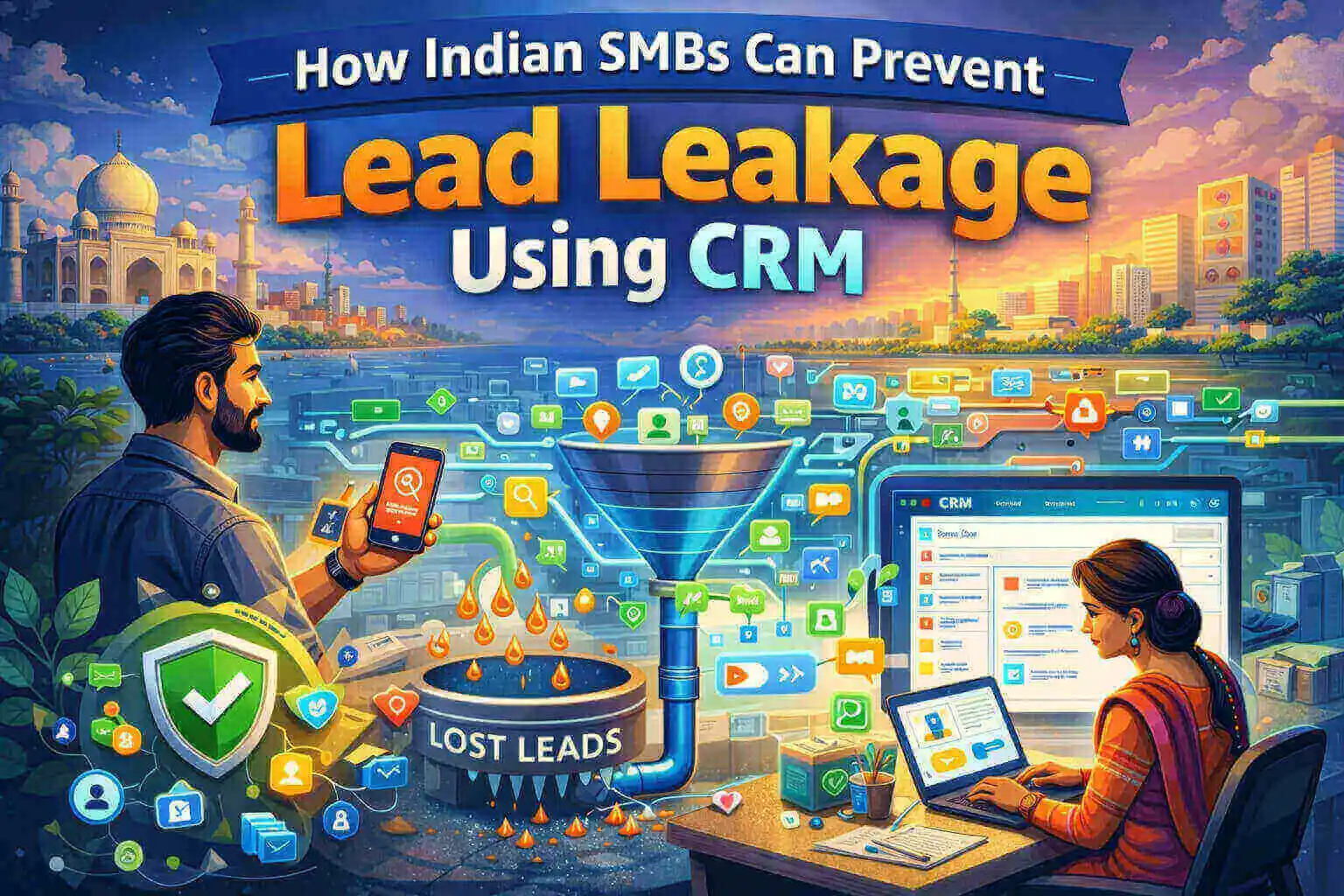
In most Indian SMBs today, lead generation isn’t the bottleneck anymore—lead handling is.
You can spend heavily on ads, hire more sales reps, and still lose revenue every day if leads aren’t captured, assigned, and followed up consistently. The issue isn’t effort or intent; it’s the absence of a system.
Lead leakage simply means genuine prospects fall through the cracks:
they don’t get called on time, they don’t receive a quote, or they’re never followed up properly. Even a 10–15% leakage rate can quietly wipe out lakhs of rupees in potential revenue each month.
The fix isn’t motivation or micromanagement; it’s building a repeatable process where every enquiry is tracked until it’s clearly marked Won or Lost (with a reason).
If any of these feel familiar, leakage is already happening:
None of this looks like a big disaster—but together, it steadily bleeds revenue.
For Indian SMBs, WhatsApp is the default sales channel. Customers expect it. Sales teams rely on it. It’s fast, informal, and convenient.
But WhatsApp chats are not a sales pipeline.
They don’t enforce ownership, they don’t remind reps to follow up, and they don’t give management any visibility. Running your sales process entirely inside WhatsApp is like running accounting on screenshots.
That’s why WhatsApp-to-CRM workflows matter.
The goal isn’t to stop using WhatsApp—it’s to stop running the business inside WhatsApp.
When WhatsApp conversations are connected to a CRM:
A CRM doesn’t magically “increase sales.”
What it actually does is remove the operational reasons leads get missed.
Here are the mechanisms that directly reduce leakage:
All enquiries: ads, forms, calls, chats, marketplaces enter one system.
Nothing stays trapped in one person’s phone or inbox.
Every lead has a clear owner.
This prevents the classic “I thought someone else called” problem.
The right salesperson is notified the moment a lead comes in—improving response time and engagement.
Reminders prevent silent deal deaths.
Triggers nudge reps when a lead opens a proposal, replies, or goes inactive.
A visual pipeline (New → Contacted → Qualified → Proposal → Won/Lost) shows exactly where deals stall, so bottlenecks are visible and fixable.
Strong CRM usage includes periodic checks for:
This setup works well for most SMBs with 5–50 sales users, without enterprise complexity.
Keep it simple to ensure adoption:
This creates a shared language and makes leakage measurable (for example: “New but not contacted in 30 minutes”).
List your top lead sources, such as:
Each source should create a lead record in the CRM, not just a message or missed call.
If a source can’t be integrated immediately, set a fallback rule:
Any lead shared on WhatsApp must be created in the CRM within 10 minutes.
Manual assignment works only until things get busy: then it breaks.
Common SMB-friendly rules:
The goal is simple: no lead stays unowned.
Response time is where most revenue leaks.
Practical SLAs:
This ensures follow-up doesn’t depend on memory or mood.
Calls, messages, meetings, notes: everything should live inside the CRM.
This:
If you track only five things every week, track these:
What gets measured gets fixed.
Before choosing a CRM, ensure it supports:
Preventing lead leakage in an Indian SMB isn’t about working harder, it’s about building a system where lead capture, ownership, and follow-ups are non-negotiable.
When every enquiry lands in one place, gets assigned instantly, and always has a next action due, the pipeline becomes predictable and revenue stops slipping out silently.
Start small:
Within a few weeks, you’ll clearly see where deals stall—and what fixes actually lift conversions.
If you’d like to see how this works in practice, schedule a quick demo of Groweon CRM.
We’ll show you exactly how lead capture, auto-assignment, follow-up reminders, and pipeline tracking work together to eliminate lead leakage.
Lead leakage happens when genuine sales enquiries are not properly captured, assigned, or followed up. This could mean a lead is never contacted, contacted too late, forgotten after a quote, or lost because no one clearly owns it. Leakage isn’t always visible—but it quietly reduces conversion rates and revenue.
Yes. In fact, SMBs are more vulnerable than large enterprises. Smaller teams rely heavily on WhatsApp, calls, and memory-based follow-ups. Even losing 2–3 leads per day due to missed follow-ups or slow response time can translate into significant monthly revenue loss.
WhatsApp is excellent for communication, but it’s not a lead management system. It doesn’t enforce ownership, track follow-ups, show pipeline stages, or provide reporting. Without a CRM connected to WhatsApp, businesses end up managing sales through chats and screenshots, making leakage inevitable.
No. Preventing leakage doesn’t require enterprise-level complexity. Most Indian SMBs only need:
The key is consistent usage, not advanced features.
In many cases, businesses start seeing improvement within 2–4 weeks. Faster response times, fewer forgotten follow-ups, and better visibility usually show results almost immediately, especially when SLAs and weekly reviews are enforced from day one.

25 Jul, 2026
Summary Most CRM teams already use some form of AI,...

24 Jul, 2026
Summary Roughly 35% of purchased insurance leads never get contacted...

24 Jul, 2026
Summary A generic CRM is built around a sales pipeline....

23 Jul, 2026
Summary Site visits, not inquiries, are the real conversion lever...

23 Jul, 2026
Summary Agentic AI has moved past pilot stage. 62% of...