

Best AI Calling CRM 2027: Groweon vs 5 Others
20 Nov, 2026
Summary AI Calling CRM software helps businesses automate customer...
Updated: 20th November, 2026
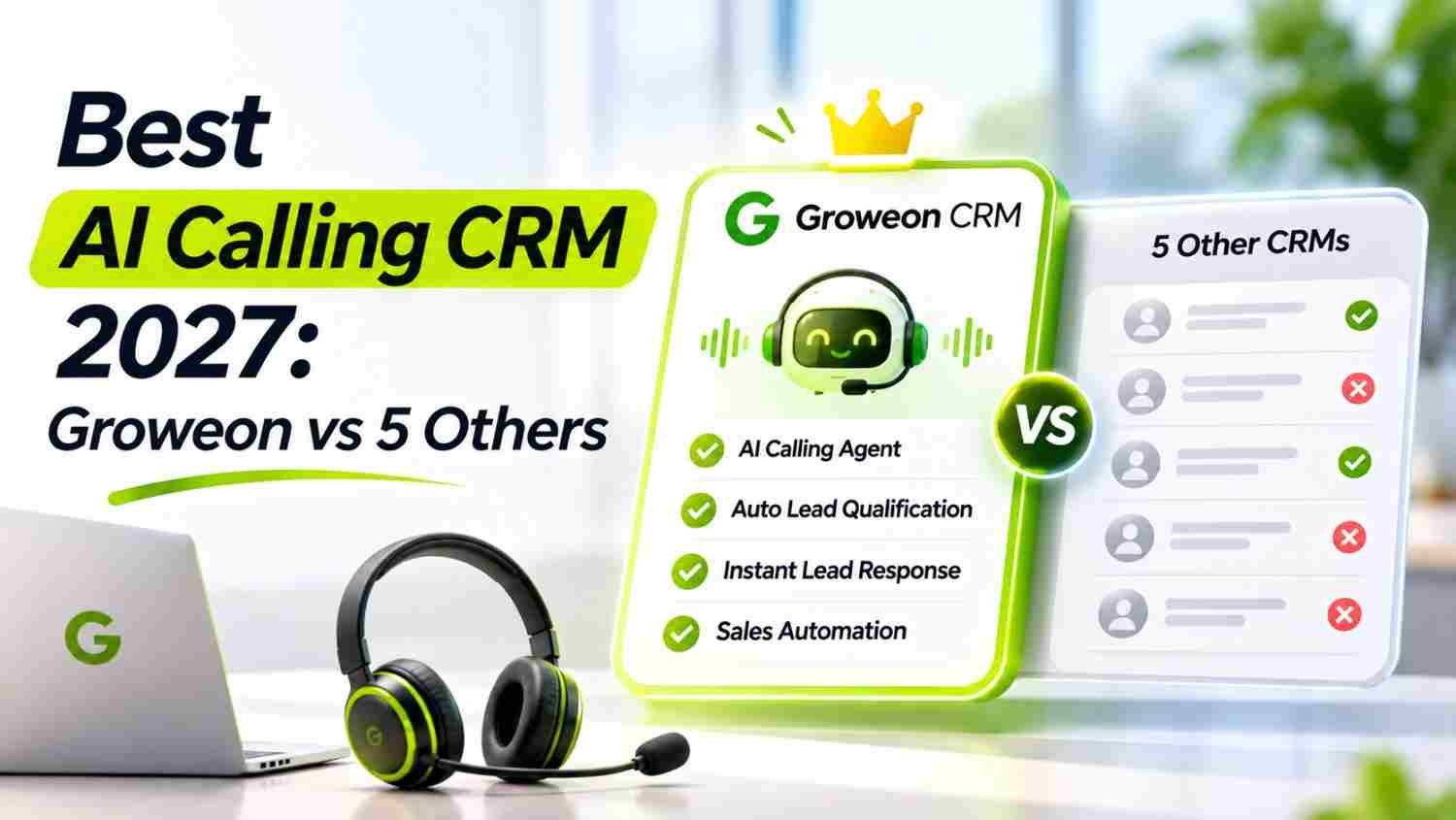
AI Calling CRM software helps businesses automate customer conversations, qualify prospects and improve sales response times.
AI voice agents can handle initial enquiries, collect customer requirements and connect qualified prospects with sales representatives.
This comparison explores Groweon and five other CRM platforms offering calling, automation and sales management capabilities.
Discover their features, differences and suitability to identify the right AI Calling CRM for your business.
A new enquiry can become a lost business opportunity when nobody contacts the prospect at the right time. Businesses invest in Google Ads, Meta campaigns, IndiaMART listings and website promotions to generate leads. However, managing every enquiry through manual calling creates delays and additional work for sales teams.
Consider a business receiving 100 enquiries in a day. Its sales representatives must check the lead details, dial prospects, explain products, understand requirements, update CRM records and schedule callbacks. When enquiry volumes increase, maintaining the same level of attention becomes difficult.
This is where an AI Calling CRM can make a difference.
Instead of depending entirely on manual calling, businesses can use AI voice agents to initiate conversations, ask relevant questions, capture customer requirements and identify interested prospects.
Modern AI voice technology is making conversational interactions more accessible, while CRM platforms connect customer information with sales activities.
For businesses, the objective is simple: respond to more enquiries, reduce repetitive calling work and help sales representatives concentrate on qualified opportunities.
An effective sales automation system should connect lead capture, calling, qualification and follow-ups rather than treating each activity separately.
Choosing the right platform requires understanding what each CRM actually offers. Some platforms focus on autonomous AI voice conversations, while others specialise in dialling, call recording, conversation analysis and sales team management.
Here are six platforms worth comparing:
Featured platform
Groweon CRM brings lead management, sales automation and AI-powered customer communication together in one platform.
Its AI ecosystem, AION, is designed to automate customer engagement and sales activities through autonomous AI agents. AION Autopilot connects voice conversations, lead qualification, WhatsApp engagement and follow-up workflows.
The AI Calling Agent can automatically contact incoming leads, conduct conversations and capture customer requirements.
AION initiates outbound calls when new enquiries enter the CRM. It conducts contextual conversations, asks relevant questions and captures customer responses.
Businesses can configure automated calling workflows to contact new enquiries from Meta Ads, websites and integrated lead sources. Groweon’s published AI Calling Agent page describes an under-60-second first-call workflow.
The agent collects information such as product requirements, budget, location and purchase timeline. This information helps sales representatives understand customer intent before taking over the conversation.
AION supports lead prioritisation through qualification criteria and AI-powered lead intelligence, helping teams identify prospects that need immediate attention.
Call outcomes, customer requirements, objections and next actions can be captured in CRM records, reducing manual data entry.
Businesses can configure calling retries when prospects do not answer, helping sales teams maintain consistent follow-ups.
When a prospect shows strong buying intent, AION can notify the assigned representative with conversation context and qualification information.
The AION Autopilot ecosystem extends beyond voice calling.
Its capabilities include:
This approach allows businesses to connect the first customer interaction with subsequent sales activities instead of managing every step separately.
For example, when a new enquiry arrives, AION can initiate a call, collect requirements, qualify the prospect and notify the sales representative when the lead is ready for human interaction.
Groweon also supports Sales CRM capabilities, including lead assignment, pipeline management, customer communication and sales reporting.
Best suited for: Indian SMBs, B2B companies, manufacturers, distributors, real estate businesses and sales teams managing enquiries from multiple channels.
Website: Groweon CRM
Product capabilities: Groweon’s official AI Calling Agent and AION Autopilot documentation.
NeoDove focuses on telecalling CRM, lead distribution and sales team productivity. It helps businesses organise outbound calling operations and monitor the activities of their telecalling representatives.
For organisations where phone conversations are a major part of the sales process, a dedicated telecalling CRM can improve visibility and calling discipline.
Businesses evaluating NeoDove should check the availability, pricing and specific capabilities of its AI voice agent offerings separately rather than assuming every telecalling feature is autonomous AI calling.
Best suited for: Businesses managing dedicated telecalling teams, outbound campaigns and large enquiry databases.
Website: NeoDove
LeadSquared provides CRM and sales automation capabilities for organisations managing large volumes of customer enquiries.
Its voice AI platform, Invorto, extends calling automation by handling repetitive and time-sensitive conversations.
Invorto is particularly relevant for organisations that want to connect automated calling with structured sales and customer engagement workflows.
Best suited for: Education, healthcare, financial services and enterprises with complex lead management requirements.
Website: LeadSquared
Runo focuses on business calling, call management and sales team productivity. Its platform connects calling activities with customer records, helping managers monitor conversations and sales performance.
Rather than positioning every calling activity as autonomous AI, Runo offers AI-powered analysis of calls made by sales representatives.
Runo is useful for organisations that want to understand the quality of sales conversations, monitor calling performance and reduce manual call documentation.
Best suited for: Inside sales teams, telecalling departments and businesses that depend heavily on phone-based customer interactions.
Website: Runo CRM
Kylas CRM is designed for growing businesses that want to organise their sales activities, manage customer relationships and monitor opportunities through a centralised CRM platform.
Its AI capabilities focus on improving sales conversations through call analysis, lead insights and automated assistance.
Kylas is a relevant option for businesses that want to understand recorded sales conversations and use AI insights to improve their sales team’s performance.
Its documented AI call-analysis capabilities should not be confused with an autonomous voice agent that independently initiates and conducts outbound calls.
Best suited for: Growing businesses, SMB sales teams and organisations looking for AI-assisted sales management.
Website: Kylas CRM
TeleCRM is designed for businesses that manage customer enquiries through phone-based sales operations.
It combines lead management and calling activities to help sales representatives maintain customer records, monitor calls and organise follow-ups.
TeleCRM is suitable for businesses looking to organise their traditional telecalling operations through a centralised CRM.
Best suited for: Small and medium-sized businesses with dedicated telecalling and inside sales teams.
Website: TeleCRM
When comparing AI Calling CRM software, businesses should distinguish between autonomous AI voice agents, AI-assisted call analysis and traditional auto diallers.
These technologies solve different problems.
| Features | Groweon | NeoDove | LeadSquared | Runo | Kylas | TeleCRM |
|---|---|---|---|---|---|---|
| Autonomous AI calling | Yes | Verify offering | Yes | Not established | Not established | Not established |
| AI lead qualification | Yes | Verify offering | Yes | AI-assisted | AI-assisted | Not established |
| AI call summaries | Yes | Verify offering | Yes | Yes | Yes | Not established |
| AI sentiment analysis | Verify module | Verify offering | Yes | Yes | Yes | Not established |
| Auto dialler | Yes | Yes | Calling workflows | Yes | Calling integrations | Yes |
| Automated follow-ups | Yes | Available | Yes | Reminders | Workflow-based | Yes |
| WhatsApp integration | Yes | Verify plan | Available | Yes | Available | Yes |
| Lead management | Yes | Yes | Yes | Yes | Yes | Yes |
| Sales pipeline | Yes | Verify plan | Yes | Yes | Yes | Yes |
Comparison is based on publicly documented capabilities available during research in November 2026. Verify individual plans, integrations and feature availability with vendors before publishing. “Not established” means the specific autonomous calling capability was not verified.
There are three important categories to understand:
Autonomous AI Calling: The AI agent independently initiates conversations, understands responses and collects information from prospects.
AI Call Intelligence: AI analyses recorded conversations to generate summaries, identify customer sentiment and evaluate sales performance.
Traditional Auto Dialling: The software automatically dials phone numbers, but a human sales representative generally handles the conversation.
Groweon and LeadSquared have documented autonomous voice capabilities. Runo and Kylas provide AI-assisted conversation intelligence. NeoDove and TeleCRM are relevant telecalling platforms, but specific AI agent capabilities should be checked against the selected product plan.
An AI Calling CRM connects the lead generation process with automated voice conversations and sales activities.
Consider a business generating enquiries through digital advertising. Without calling automation, a representative must manually check the lead, dial the number, understand the requirement and update the CRM.
With an AI Calling CRM, this process can be structured into the following stages.
The system receives enquiries from websites, landing pages, advertisements, WhatsApp or other integrated sources.
For example, Meta Lead Ads and Google lead forms can generate enquiries that businesses route into their CRM.
Groweon’s CRM Software supports lead management and multi-source lead capture.
When a new enquiry enters the system, a configured workflow can trigger an AI voice call.
The agent introduces itself, understands the enquiry and starts a conversation based on the business’s products, services and qualification requirements.
Technologies such as Dialogflow CX and Twilio Voice demonstrate how conversational voice applications can be developed and integrated into customer communication workflows.
During the conversation, the AI agent asks questions to understand the prospect’s requirements.
For example:
Modern speech technologies, including Azure Speech, support speech recognition and speech generation for voice applications.
The AI evaluates customer responses against configured qualification criteria.
Groweon’s AI Lead Qualifier helps capture requirements, understand buying signals and prioritise leads as hot, warm or cold.
After the conversation, relevant information can be saved to the CRM record, including call outcomes, requirements and next actions.
Qualified prospects can then be routed to sales representatives for product demonstrations, pricing discussions and negotiations.
Not every prospect is ready to purchase immediately. Some need additional information, while others request a callback.
Groweon’s WhatsApp AI Chatbot can support customer engagement through WhatsApp alongside the calling workflow.
The WhatsApp Business Platform provides businesses with infrastructure for integrating WhatsApp communication into their customer engagement processes.
A traditional CRM primarily stores customer information, manages sales pipelines and records interactions. However, many calling activities still depend on sales representatives.
An AI Calling CRM introduces voice automation into this process.
| Traditional CRM | AI Calling CRM |
| Manual outbound calling | Automated AI conversations |
| Manual lead qualification | AI-assisted lead qualification |
| Representatives write call notes | AI-generated call summaries |
| Manual callback scheduling | Automated follow-up workflows |
| Human-led first interaction | AI-led initial interaction |
| Manual lead prioritisation | AI-assisted lead prioritisation |
The purpose is not to eliminate human sales representatives. It is to reduce repetitive work and allow them to focus on meaningful conversations and conversions.
When a customer submits an enquiry, the business has an opportunity to start a conversation while the prospect is actively interested.
Automated calling workflows can reduce the delay between lead capture and first contact.
Sales representatives often spend hours dialling numbers and asking the same initial questions.
AI voice agents can handle configured first-contact conversations, allowing representatives to concentrate on qualified opportunities.
Different sales representatives may ask different questions or record customer information differently.
AI-powered qualification workflows help businesses apply consistent criteria across incoming enquiries.
AI conversations can capture customer requirements, budget, location and purchase timelines.
This information provides sales representatives with useful context before they take over a conversation.
Missed calls and unanswered enquiries can create gaps in the sales process.
Automated calling and messaging workflows help businesses manage callbacks and maintain communication with prospects.
Managers can review call outcomes, lead status and follow-up activities through CRM dashboards.
For businesses that also manage customer communication through phone-based sales teams, Tele-Sales Management capabilities help connect calling activities with lead records and sales operations.
Before purchasing AI Calling CRM software, businesses should evaluate the following factors.
Check whether the software can independently initiate and conduct conversations or only automates dialling for human representatives.
For Indian businesses, language flexibility is important. Evaluate whether the platform supports the languages and regional communication styles required by your customers.
The AI should understand customer responses and capture meaningful information instead of simply following a fixed list of questions.
Calling should be connected to the customer record. Check whether the system automatically saves call outcomes, summaries and qualification details.
The platform should provide a clear process for transferring qualified prospects to sales representatives when human intervention is required.
Compare subscription charges, AI calling minutes, telephony charges, concurrent call capacity, setup fees and integration costs.
Businesses should be able to configure calling scripts, qualification questions, business knowledge and follow-up conditions according to their sales process.
Automated calling must be implemented responsibly. Businesses in India should understand the applicable telecom regulations before running outbound campaigns.
According to TRAI’s UCC guidance, unsolicited commercial communication includes unwanted voice calls and messages. Businesses should review sender registration, telemarketer requirements and the TCCCPR regulations before deploying commercial calling workflows.
TRAI’s 2025 regulatory amendments also reinforce the importance of responsible commercial communication.
The right CRM depends on how a business generates leads, manages sales conversations and handles customer follow-ups.
| Business Requirement | Platform to Evaluate |
| AI calling with connected sales automation | Groweon |
| Dedicated telecalling operations | NeoDove |
| Enterprise voice AI and sales workflows | LeadSquared |
| Call analytics and team monitoring | Runo |
| AI-assisted sales management | Kylas |
| Traditional telecalling and lead tracking | TeleCRM |
Businesses often purchase separate tools for lead generation, calling, customer communication and follow-up management. This can create disconnected customer records and make it difficult to understand the complete sales journey.
Groweon brings these activities together through its CRM platform and AION AI ecosystem.
With AION Autopilot, businesses can automate initial customer conversations, qualify prospects and trigger follow-up activities based on configured workflows.
Its capabilities extend to WhatsApp engagement, lead intelligence, tele-sales management and sales pipeline tracking.
Businesses can also use the Groweon Mobile App to access customer records, manage leads and stay connected with sales activities while working away from the office.
The platform extends beyond initial lead conversion, with Order Management and inventory capabilities supporting additional business operations.
AI Calling CRM software is changing how businesses approach lead management and customer communication. Instead of depending entirely on sales representatives for every initial conversation, businesses can automate repetitive interactions and create a more organised sales process.
NeoDove is worth considering for telecalling operations, LeadSquared for enterprise voice automation, Runo for call management, Kylas for AI-assisted sales intelligence and TeleCRM for traditional telecalling requirements.
Groweon CRM is a strong option for businesses looking to connect AI calling with lead management and broader sales automation.
Its AION ecosystem combines:
For businesses looking to move beyond traditional CRM and dialling software, this connected approach offers an opportunity to automate more of the customer journey.
Your sales team should spend more time converting qualified prospects, not repeatedly chasing every new enquiry.
CTA: Book Your Free Groweon CRM Demo Today.
The best AI Calling CRM depends on your business requirements. Groweon, NeoDove and LeadSquared are options to evaluate for autonomous voice automation, while Runo and Kylas offer AI-powered call intelligence. TeleCRM is another option for telecalling and lead management.
An AI Calling CRM combines customer relationship management with AI-powered voice calling. It can automate customer conversations, collect requirements, qualify leads and connect call outcomes with CRM records.
An AI Calling Agent initiates a call, introduces itself, understands customer responses and asks relevant questions. It can capture information, identify customer intent and route qualified prospects to human sales representatives.
Yes. CRM platforms with autonomous outbound calling can trigger calls when new enquiries enter the system. Businesses can configure calling rules based on lead source, customer information and workflow conditions.
Yes. Groweon offers an AI Calling Agent through its AION AI ecosystem. It supports automated conversations, lead qualification, customer requirement collection, CRM updates and sales representative handoff.
An AI dialer automates the process of dialling phone numbers, but a human representative usually handles the conversation. An AI voice agent can independently communicate with prospects, ask questions and collect customer information.
Yes. AI agents can ask questions about customer requirements, budget, location and purchase timelines. The collected information helps businesses prioritise prospects based on their qualification criteria.
Yes. Small businesses can use AI Calling CRM to automate repetitive conversations, contact incoming enquiries and reduce manual follow-up work without building a large telecalling team.
Several CRM platforms support WhatsApp integration. Groweon combines AI calling with WhatsApp Business API integration and chatbot capabilities to support customer engagement across channels.
Businesses should evaluate autonomous calling, supported languages, lead qualification, call summaries, CRM integration, human handoff, calling costs, scalability and regulatory compliance.

20 Nov, 2026
Summary AI Calling CRM software helps businesses automate customer...

20 Nov, 2026
Summary Slow responses, inconsistent follow-ups and manual lead qualification...

20 Nov, 2026
Summary AI CRM helps businesses understand customer data, prioritise leads...

19 Nov, 2026
Summary Sales teams handle multiple activities, from capturing enquiries to...

19 Nov, 2026
Summary (TL;DR): A Sales CRM helps businesses organise customer information,...