

Best CRM for Rubber and Tyre Manufacturers
16 Oct, 2026
Summary (TL;DR) The best CRM for rubber and tyre manufacturers...
Updated: 2nd September, 2026
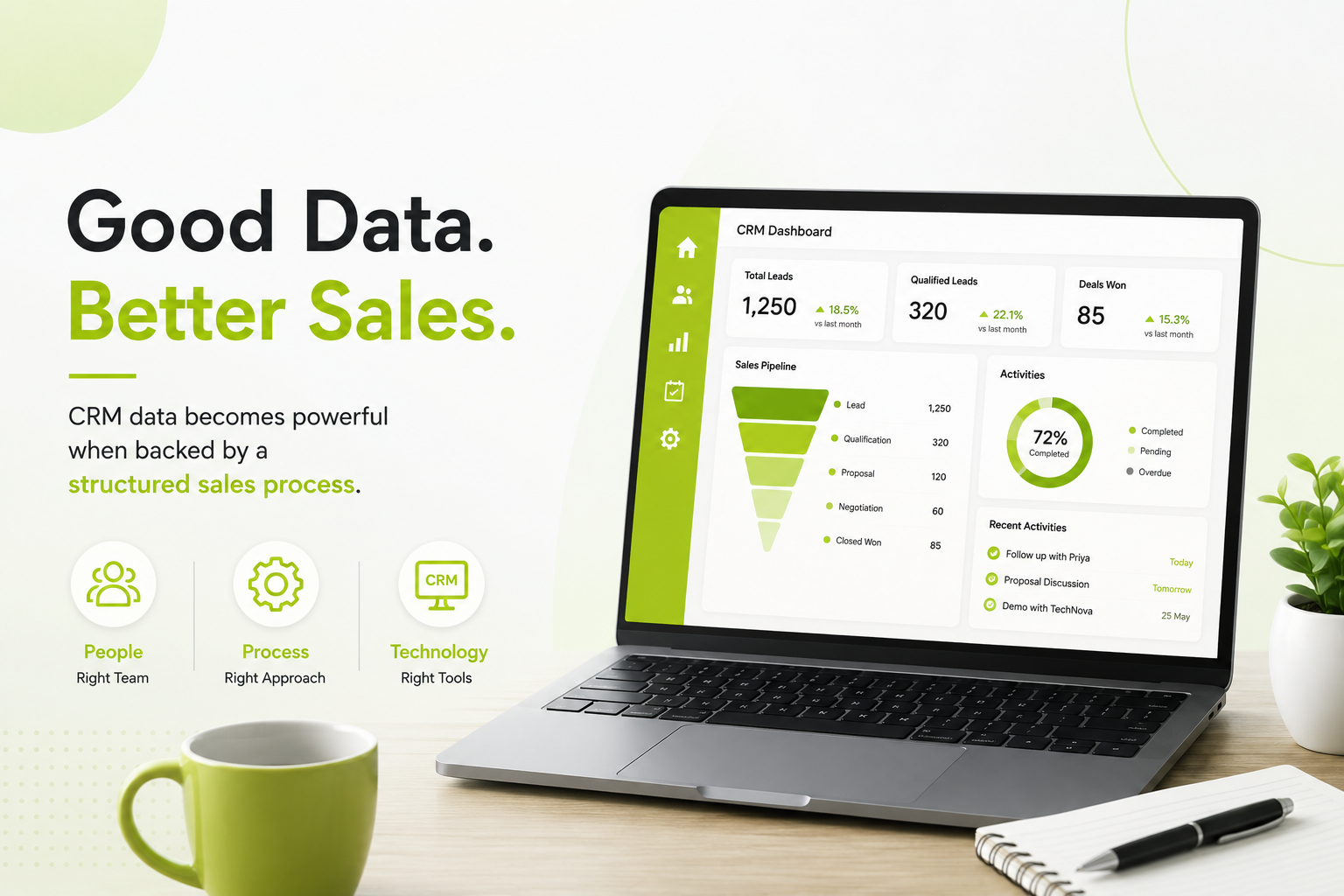
CRM data becomes useful only when supported by a structured sales process.
Without standard stages, qualification and follow-up rules, CRM records become incomplete and unreliable.
Poor data affects reporting, forecasting, management decisions and sales performance.
AI can improve CRM effectiveness, but only when data quality is strong.
The best results come when people, process and CRM technology work together.
Businesses invest in CRM software to organise customer information, improve follow-ups and increase sales visibility. Over time, these systems collect large amounts of data, including leads, calls, emails, meetings, quotations, customer interactions and sales activities.
However, many organisations still struggle to improve conversions despite having access to this information. In many cases, the real challenge is not the amount of data but how effectively teams use it. When customer information is connected to a structured sales process, a CRM can support better sales performance.
According to research from McKinsey on data-driven sales organisations, companies that effectively use customer data and structured processes are better positioned to improve commercial performance and decision-making.
Similarly, Harvard Business Review’s research on sales process discipline highlights that CRM technology alone cannot improve outcomes if the underlying sales process is unclear.
This is why businesses should think about CRM and sales process design together rather than treating them as separate initiatives.
CRM data refers to the information businesses collect throughout their customer interactions and sales activities. This information creates a record of the customer journey and gives sales teams context for future conversations.
This may include:
Over time, this information becomes more valuable because it provides important context. For example, when a prospect has already requested pricing, attended a demo and discussed implementation, the salesperson can review this history before making the next call. As a result, the conversation becomes more relevant and informed. Moreover, this context helps the salesperson understand the prospect’s needs and plan the next step effectively.
Good CRM data helps teams answer three important questions:
Many businesses purchase CRM software expecting immediate improvement.
But CRM systems do not automatically create discipline.
Without a defined sales process, teams often:
Over time, reporting becomes unreliable.
Managers cannot clearly understand pipeline status because the data does not accurately reflect actual sales activity.
A CRM can only be as useful as the process that supports it.
Consider two sales teams.
The first team follows a defined process:
Every salesperson updates the CRM at each stage.
The second team works without standardisation.
Some representatives update leads regularly. Others maintain notes in spreadsheets or WhatsApp chats. Sales stages mean different things to different people.
Both companies have CRM software.
Only one company has usable data.
The difference is not technology.
It is process consistency.
CRM data becomes valuable when businesses define:
For example, if a company defines that every lead must include:
Managers receive more reliable reports.
Salespeople also spend less time searching for information because the CRM already contains the required context.
A structured Sales CRM can support this approach by connecting customer information with sales activities and pipeline stages.
Poor CRM discipline creates several business problems.
These problems affect more than reporting.
They affect revenue.
If managers cannot understand which opportunities are active, which leads need attention and where deals are getting delayed, improving sales performance becomes difficult.
Many companies compare CRM software based on features:
These capabilities are useful, but they cannot compensate for an unclear process.
A business with a strong sales process and a simple CRM often performs better than a business with advanced software and poor discipline.
This is why organisations should first define:
Only then should automation be introduced.
AI is changing how businesses use CRM information.
Traditionally, CRM systems answered:
What happened?
AI can increasingly help answer:
What should happen next?
For example, AI can:
However, AI still depends on data quality.
Poor CRM information produces poor AI recommendations.
This is why businesses should improve process discipline before expecting value from AI.
Groweon’s Auto Lead Qualifier can support standardised lead qualification, while an AI Calling Agent can help maintain consistent customer engagement.
When AI activities remain connected with CRM records, teams receive better customer context and stronger reporting.
Managers rely on CRM data for:
If CRM information is incomplete, management decisions become weaker.
For example:
A dashboard may show 500 active opportunities.
But if only 250 are genuinely active, forecasting becomes inaccurate.
This is why data quality is not an administrative issue.
It is a management issue.
This sequence creates stronger CRM data and more reliable sales insights.
Research from CSO Insights’ sales enablement studies has repeatedly shown that CRM adoption and process consistency influence sales effectiveness.
A CRM delivers value when sales teams use it consistently.
That means:
Technology supports behaviour.
It does not replace it.
Businesses looking for a connected CRM environment can use Groweon CRM to manage leads, customer information, follow-ups and sales activities within one platform.
Its Lead Management Solution can help businesses organise enquiries and create structured workflows.
For businesses introducing AI, AION AI+ can support lead engagement, qualification and sales automation while keeping activities connected with CRM data.
The advantage is not simply collecting information.
It is creating a process where information leads to action.
Businesses often assume that collecting more data will automatically improve sales.
In reality, more data without process often creates more confusion.
Useful CRM data depends on:
The strongest CRM systems are not necessarily the ones with the most features.
They are the ones connected to a disciplined sales process.
Because CRM software does not improve sales by itself.
People, process and technology working together improve sales.
Why does CRM data become inaccurate?
CRM data becomes inaccurate when teams do not follow standard processes, skip updates or maintain information outside the CRM.
Is CRM software enough to improve sales?
No. CRM software is most effective when supported by a clear sales process and consistent usage.
Why are sales stages important in CRM?
Sales stages create visibility into opportunities and make reporting, forecasting and follow-ups more reliable.
Can AI improve CRM data quality?
AI can support updates, qualification and follow-ups, but it still depends on accurate and consistent CRM information.
What is the biggest reason CRM projects fail?
One major reason is poor adoption and lack of process discipline rather than limitations in the software itself.

16 Oct, 2026
Summary (TL;DR) The best CRM for rubber and tyre manufacturers...

16 Oct, 2026
Summary (TL;DR) A CRM for agricultural equipment manufacturers tracks farmer...

16 Oct, 2026
Summary (TL;DR) The best CRM for paint and coatings manufacturers...

15 Oct, 2026
Summary (TL;DR) A CRM for cement and building material manufacturers...

15 Oct, 2026
Summary (TL;DR) A CRM for pharma API and bulk drug...