

Best CRM for Rubber and Tyre Manufacturers
16 Oct, 2026
Summary (TL;DR) The best CRM for rubber and tyre manufacturers...
Updated: 1st September, 2026
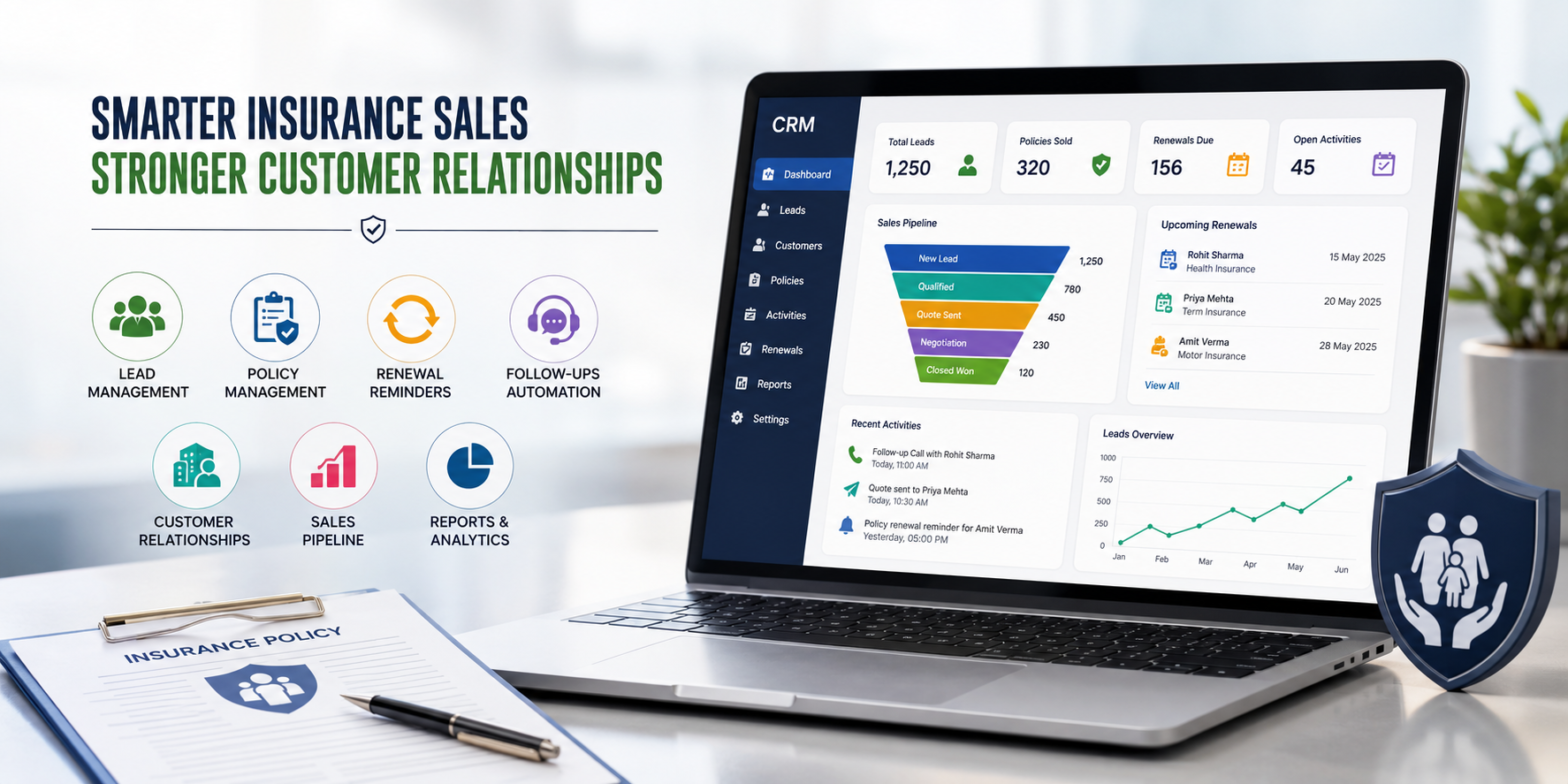
Insurance CRM software helps agents and companies manage leads, customers, policies, renewals, and follow-ups from one platform.
It replaces scattered spreadsheets and manual processes with centralized customer and policy data.
CRM automation helps sales teams schedule follow-ups, track opportunities, and improve lead response.
Policy management and renewal reminders can help insurance businesses maintain ongoing customer relationships.
Groweon provides CRM capabilities designed to streamline insurance sales, customer management, and follow-up workflows.
Insurance sales involve continuous lead management, customer communication, policy documentation, renewals, and follow-ups. As the number of prospects and customers increases, managing these activities through spreadsheets, emails, and messaging apps can become difficult.
This is where insurance CRM software in India becomes useful.
A CRM brings customer information, sales activities, policy details, follow-up schedules, and communication history into one centralized system. Instead of searching through multiple files to understand a customer’s status, sales representatives can access relevant information from a single platform.
The scale of India’s insurance industry also makes organized customer management increasingly important. The IRDAI Handbook on Indian Insurance Statistics provides official data on India’s insurance sector and is a useful reference for understanding industry trends.
Insurance CRM software is a customer relationship management system designed to help insurance agents, brokers, and companies manage their sales and customer lifecycle.
A typical insurance CRM can help businesses manage:
For businesses looking for an industry-focused solution, Groweon’s Insurance CRM is designed to support insurance and financial-services workflows.
Lead management is one of the most important CRM functions for insurance businesses.
A CRM can capture leads, organize them according to source or requirement, assign them to sales representatives, and track their progress through different sales stages.
A structured process can look like:
New Lead → Contacted → Qualified → Quote Sent → Negotiation → Policy Issued
This gives managers better visibility into the sales pipeline.
Managing policy information becomes challenging when customer records are distributed across spreadsheets and documents.
An insurance CRM can centralize important information such as policy type, customer details, policy status, dates, and related communication.
This makes it easier for sales teams to access customer information when required.
Renewals are an important part of insurance customer retention.
Instead of depending on manual calendars, CRM software can help teams schedule renewal reminders and follow-up activities.
For example:
Policy Expiry → Renewal Reminder → Customer Contact → Follow-Up → Renewal
Automated workflows can make this process more consistent.
Insurance prospects may not purchase immediately after receiving a quotation. They may need multiple conversations before making a decision.
A CRM can help representatives schedule follow-ups and track pending activities so that promising leads do not get forgotten.
Insurance is a long-term relationship business.
A centralized customer profile can provide representatives with information about previous interactions, policies, requirements, and sales activities.
This allows teams to have more informed conversations with customers.
An insurance sales CRM gives managers a visual overview of opportunities.
Sales teams can identify:
This helps managers understand where prospects are getting stuck.
The right CRM should make important sales and customer metrics easier to track.
For broader information about India’s insurance market, businesses can also refer to official publications from the Insurance Regulatory and Development Authority of India.
Many insurance businesses start with Excel because it is familiar and inexpensive. However, spreadsheets are primarily designed for data storage rather than complete customer relationship management.
As lead volume and team size increase, CRM software can provide a more structured alternative to manually maintained spreadsheets.
A strong insurance lead management system should not only store leads but also help sales teams take action.
Consider a lead generated through a website form.
The CRM can capture the enquiry, assign it to a representative, record the customer’s requirement, schedule a follow-up, and track the lead until conversion.
This creates a consistent process:
Lead Capture → Assignment → Qualification → Follow-Up → Quote → Conversion
Groweon’s sales CRM platform provides lead management, sales tracking, automation, and reporting capabilities that can support structured sales workflows.
Acquiring a new customer is only one part of insurance sales. Maintaining an existing customer relationship is equally important.
A CRM can help teams identify upcoming renewals and create timely communication workflows.
For example, an insurance business could create reminders at different intervals before policy expiration. Representatives can then contact customers, discuss renewal requirements, and update the policy status.
This makes renewal management a defined business process rather than a task dependent on individual memory.
The best CRM for insurance agents should fit the actual workflow of an insurance business.
Groweon provides industry-focused CRM capabilities that help businesses manage leads, customer relationships, sales activities, policy-related workflows, renewals, and follow-ups.
Its centralized approach can help insurance teams reduce manual coordination while giving managers greater visibility into sales activity.
Businesses can also explore Groweon’s CRM software to understand how its broader CRM capabilities can support different sales and industry workflows.
What is the best CRM for insurance agents in India?
The best CRM for insurance agents should provide lead management, customer management, follow-up automation, policy tracking, renewal reminders, sales pipeline management, and reporting.
How does CRM help insurance agents?
An insurance CRM helps agents organize prospects, manage customer information, schedule follow-ups, track sales opportunities, and maintain policy-related information.
Can insurance CRM software manage policy renewals?
Yes. CRM software can store policy dates and create reminders or workflows for upcoming renewals.
Is CRM useful for insurance brokers?
Yes. Insurance brokers can use CRM software to manage leads, customer relationships, sales activities, policy information, follow-ups, and renewals.
Why use CRM instead of Excel for insurance sales?
Excel can store data, but CRM software provides dedicated features for lead management, automation, sales pipelines, reminders, reporting, and customer relationship management.
The best insurance CRM software in India should help businesses manage the complete customer journey rather than simply store contact information.
From lead generation and qualification to quotations, policy management, renewals, and follow-ups, CRM software creates a structured process for insurance sales teams.
For insurance agents, brokers, and companies looking to improve lead tracking and policy-related customer management, an industry-focused CRM such as Groweon can provide a centralized platform for managing sales and customer relationships.

16 Oct, 2026
Summary (TL;DR) The best CRM for rubber and tyre manufacturers...

16 Oct, 2026
Summary (TL;DR) A CRM for agricultural equipment manufacturers tracks farmer...

16 Oct, 2026
Summary (TL;DR) The best CRM for paint and coatings manufacturers...

15 Oct, 2026
Summary (TL;DR) A CRM for cement and building material manufacturers...

15 Oct, 2026
Summary (TL;DR) A CRM for pharma API and bulk drug...