

Best CRM for Rubber and Tyre Manufacturers
16 Oct, 2026
Summary (TL;DR) The best CRM for rubber and tyre manufacturers...
Updated: 31st August, 2026
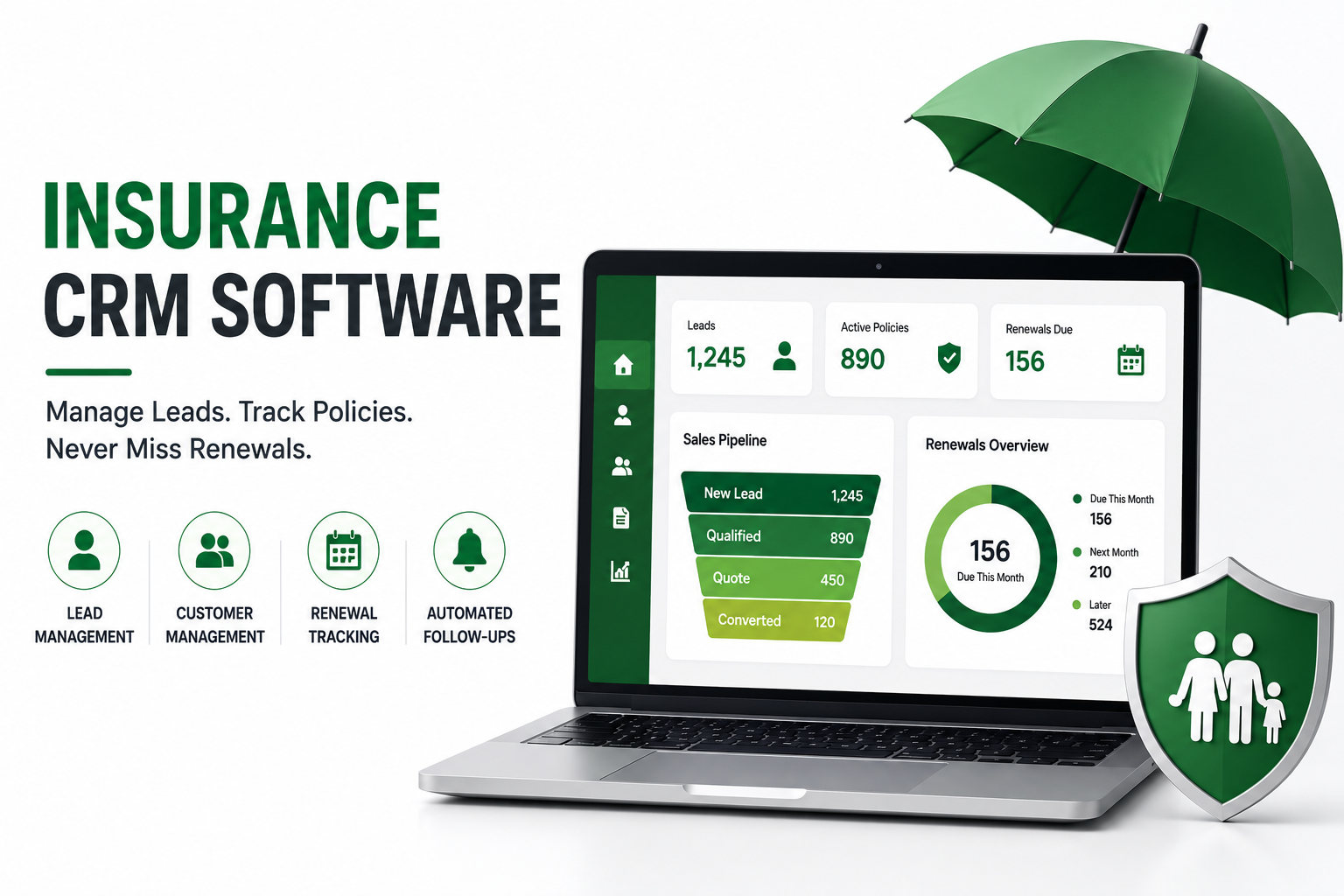
Insurance CRM software helps companies, agents and intermediaries organise leads, customers, sales activities, renewals and follow-ups in one system.
The most useful capabilities include lead management, customer management, sales pipelines, follow-up automation and reporting.
AI can further support insurance teams through automated calling, lead qualification and customer engagement.
CRM pricing in India depends on users, features, integrations, automation and customisation requirements.
For businesses looking for a connected CRM and AI-powered sales environment, Groweon CRM can be a strong option for modern insurance sales and customer management.
Insurance is a relationship-driven business. A customer may have multiple policies, renewal dates, documents, service requests and follow-ups. Managing these details through spreadsheets, emails and separate communication channels can quickly become difficult as the customer base grows.
This is where insurance CRM software can help. A CRM brings leads, customer information, sales activities, follow-ups and policy-related processes into one organised system.
For insurance businesses in India, the right CRM should do more than store contact details. It should help teams manage the complete customer journey—from the first enquiry to policy conversion, renewal and ongoing engagement.
According to Salesforce’s insurance CRM overview, CRM technology can help insurance organisations centralise customer information and improve sales and service processes.
The regulatory environment is another important consideration. Insurance businesses should evaluate technology alongside applicable IRDAI regulations and guidelines to ensure their internal processes meet relevant requirements.
Insurance CRM software is a customer relationship management platform designed to support insurance sales and customer management activities.
Instead of keeping customer details in different spreadsheets or applications, teams can maintain information in a centralised CRM. This can include lead details, communication history, sales stages, follow-up activities, policy-related information and customer requirements.
For an insurance agent or sales representative, this means less time searching for information and more time engaging with customers.
A CRM can also provide managers with better visibility into the sales pipeline, helping them understand which leads require attention and where opportunities may be getting delayed.
Insurance sales often involve multiple interactions before and after a policy is purchased. A prospect may request information, compare options, ask questions, submit documents and then require future renewal communication.
When these activities are managed manually, several problems can occur:
A CRM creates a structured process around these activities. It can help teams capture enquiries, assign leads, schedule follow-ups and track opportunities from one place.
The best insurance CRM is not necessarily the one with the longest feature list. It is the one that fits the company’s actual sales and customer-management process.
Insurance leads can come from websites, advertisements, referrals, calls and social media. A CRM should capture these enquiries and help sales teams organise them.
A lead management solution can help businesses assign leads, track their status, manage follow-ups and monitor their movement through the sales pipeline.
Insurance teams need access to customer information throughout the relationship.
A CRM can maintain contact details, previous interactions, requirements and relevant sales information in one place. This gives representatives better context when communicating with existing or prospective customers.
Renewals are an important part of insurance customer management. Missing a renewal-related follow-up can affect customer retention and recurring business.
A CRM can help teams organise renewal dates, create reminders and maintain relevant customer interactions so representatives can approach customers at the appropriate time.
Insurance sales involve continuous follow-up. Manual reminders can become difficult when representatives manage hundreds of prospects and customers.
CRM automation can create tasks and reminders according to predefined workflows. This helps salespeople maintain consistency without relying entirely on memory or spreadsheets.
A clear pipeline shows where each opportunity currently stands.
For example, an insurance enquiry may move from New Lead → Qualified → Requirement Discussed → Quote → Documentation → Converted.
A dedicated Sales CRM can help teams track these stages and identify opportunities that need immediate attention.
Insurance customers may communicate through calls, WhatsApp, email and other channels. Keeping relevant interactions connected to the customer record gives salespeople greater visibility.
This reduces the need to repeatedly ask customers for information they may have already provided.
Managers need visibility into lead sources, conversion rates, sales activity, follow-up performance and salesperson productivity.
CRM dashboards can bring these metrics together and make it easier to identify bottlenecks in the sales process.
A well-implemented CRM can improve both sales productivity and customer experience.
First, it helps teams respond to enquiries more systematically. Second, automated follow-ups can reduce the possibility of leads being forgotten. Third, centralised customer information gives salespeople better context during conversations.
CRM software can also reduce administrative work. Instead of maintaining multiple spreadsheets and manually preparing reports, teams can use a single system to manage sales activities and monitor performance.
For growing insurance businesses, this becomes particularly valuable because lead volume can increase without requiring the same increase in manual administrative effort.
A generic CRM may provide contact management, sales pipelines and basic automation. However, insurance businesses often need workflows around renewals, customer servicing, documentation and long-term relationships.
The right platform therefore depends on the organisation’s specific requirements.
An insurance agency may prioritise lead generation and renewals, while a larger organisation may require integrations, advanced reporting and more extensive automation.
Before selecting a CRM, businesses should map their actual workflow and check whether the platform can support it without excessive manual work or customisation.
AI is making CRM platforms more useful for high-volume sales teams.
Instead of using CRM software only to store information, businesses can use AI to support lead qualification, calling, customer engagement and sales prioritisation.
For example, an AI agent can communicate with a new enquiry, collect basic information and determine whether the prospect meets predefined qualification criteria.
Groweon’s Auto Lead Qualifier can support automated lead qualification, while an AI Calling Agent can support AI-powered calling activities.
This can help insurance sales teams spend more time on qualified opportunities rather than manually screening every incoming enquiry.
There is no single price for insurance CRM software in India. Pricing generally depends on users, features, automation, integrations, customisation and support requirements.
Businesses should compare overall value rather than selecting a platform solely because its subscription price is lower.
For businesses looking for a connected CRM environment, Groweon CRM brings lead management, sales activities, customer information and automation together.
Its Insurance & Loan CRM is designed for businesses managing insurance and loan-related customer journeys.
Groweon also provides AI capabilities that can support lead qualification and sales engagement. This gives insurance teams the option to combine traditional CRM management with AI-powered sales automation.
The key advantage is having customer information, sales activity and automated engagement within a connected workflow rather than relying on multiple disconnected tools.
Before purchasing insurance CRM software, businesses should evaluate the platform against their actual workflow.
Check whether it can capture leads from the channels you use, manage customer information, automate follow-ups, support renewal-related processes and provide useful reporting.
Also evaluate integrations, user permissions, data security, scalability, implementation and customer support.
Most importantly, ask for a practical demo.
Instead of only checking feature lists, test a real scenario: capture an enquiry, qualify the customer, assign the lead, schedule follow-up, record the interaction and move the opportunity through the sales pipeline.
That gives management a much clearer picture of whether the CRM can actually support daily insurance operations.
What is the best CRM for insurance companies in India?
The best CRM depends on the company’s workflow, lead volume and automation requirements. Groweon is a strong option for businesses looking to combine CRM, lead management, sales automation and AI capabilities.
Can CRM software manage insurance leads?
Yes. Insurance CRM software can capture, assign, qualify and track leads while helping teams manage follow-ups and sales activities.
Can an insurance CRM help with policy renewals?
Yes. CRM workflows can help teams organise renewal dates, reminders and related follow-up activities.
Is AI useful for insurance sales?
Yes. AI can support lead qualification, calling and customer engagement, helping sales teams focus more of their time on qualified opportunities.
How much does insurance CRM software cost in India?
Pricing varies according to users, features, integrations, automation and customisation. Businesses should compare the total value and expected productivity benefits rather than price alone.
What should I check before buying insurance CRM software?
Evaluate lead management, customer management, renewal workflows, follow-up automation, communication, reporting, integrations, security, scalability and support. A practical product demo should also be part of the evaluation.
16 Oct, 2026
Summary (TL;DR) The best CRM for rubber and tyre manufacturers...

16 Oct, 2026
Summary (TL;DR) A CRM for agricultural equipment manufacturers tracks farmer...

16 Oct, 2026
Summary (TL;DR) The best CRM for paint and coatings manufacturers...

15 Oct, 2026
Summary (TL;DR) A CRM for cement and building material manufacturers...

15 Oct, 2026
Summary (TL;DR) A CRM for pharma API and bulk drug...