

CRM Buying Checklist for Indian SMBs: 12 Points to Verify…
05 Oct, 2026
Summary (TL;DR): Most CRM buying mistakes trace back to a...
Updated: 20th August, 2026
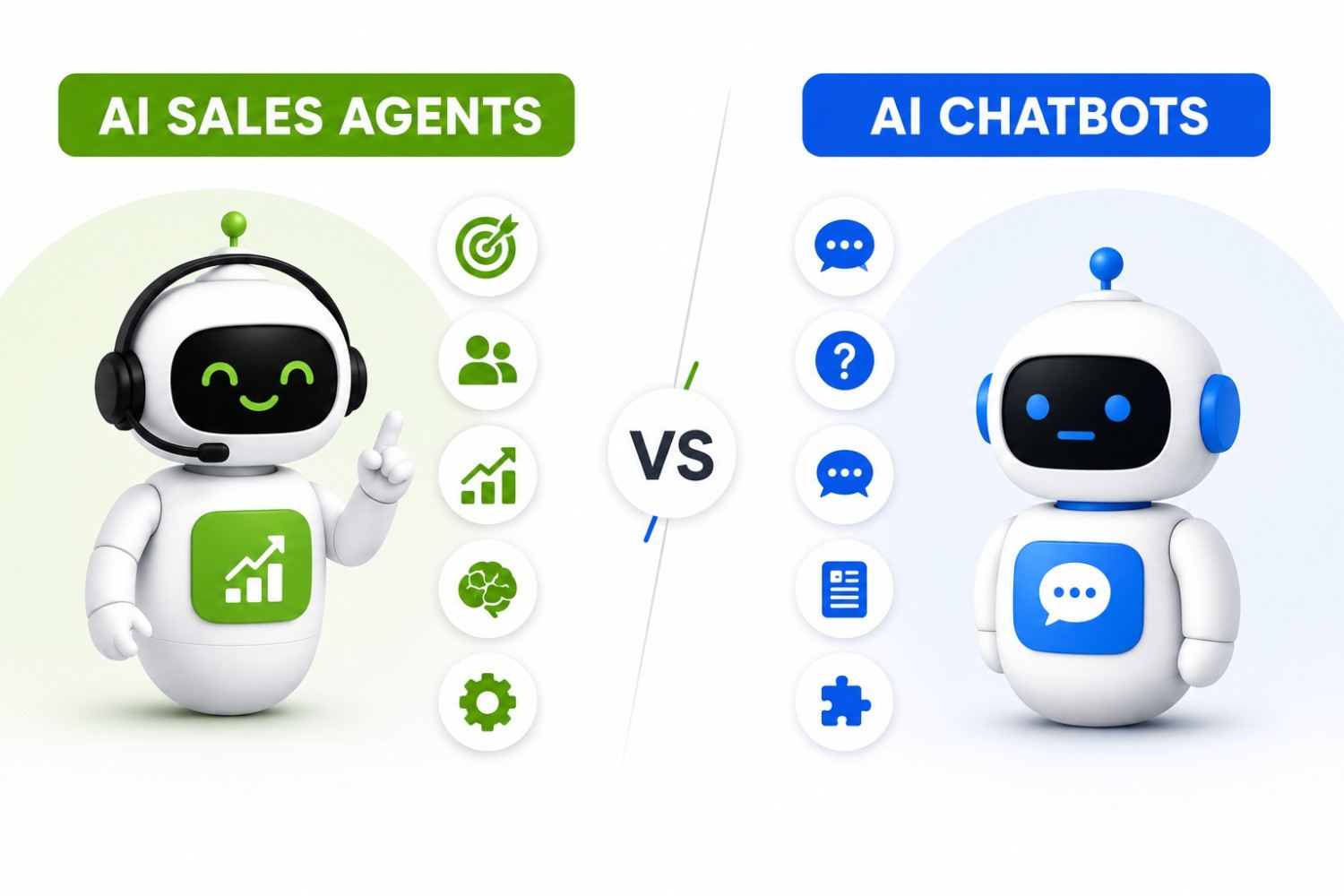
AI is changing how businesses manage customer conversations, lead qualification and sales follow-ups. But as businesses adopt more AI-powered tools, two terms are increasingly being used interchangeably: AI sales agents and AI chatbots.
They may both communicate with customers, but they do not perform the same role.
An AI chatbot is generally built to answer questions, provide information and help users complete specific tasks. An AI sales agent can go further by understanding customer requirements, qualifying leads, using CRM data, triggering actions, scheduling follow-ups and moving prospects through defined sales workflows.
This distinction matters for businesses investing in AI-powered CRM software because adding an AI chatbot to a CRM does not automatically make the CRM capable of autonomous sales work.
McKinsey’s 2025 research found that 62% of respondents said their organisations were at least experimenting with AI agents, although most companies were still in the early stages of scaling them. McKinsey’s State of AI research provides useful context on how businesses are moving from AI experimentation toward practical applications.
So, what exactly separates an AI sales agent from an AI chatbot?
An AI chatbot is a software system designed to communicate with users through a conversational interface.
Businesses commonly use chatbots on:
A chatbot can answer frequently asked questions, provide product information, collect contact details and guide customers through simple processes.
For example:
Customer: “What are your working hours?”
AI Chatbot: “Our support team is available from 9 AM to 6 PM, Monday to Saturday.”
The customer gets an immediate response without waiting for a support executive or salesperson.
Modern AI chatbots can understand natural language and handle flexible conversations much better than traditional rule-based bots. However, their primary purpose remains conversation and assistance.
IBM’s explanation of AI chatbots and AI agents also highlights this distinction: conversational systems can respond to users, while AI agents can take a more active role in completing tasks and interacting with other systems.
An AI sales agent is designed to participate directly in a sales workflow.
Instead of only answering a customer’s question, an AI sales agent can potentially:
For example, imagine a prospect submits an enquiry for CRM software.
A chatbot might respond:
“Thank you for contacting us. Here is our product information.”
An AI sales agent could continue the conversation:
“How many sales representatives are currently using your system?”
The prospect responds:
“We have around 30 salespeople.”
The agent can then ask relevant qualification questions, understand the requirement, collect information and potentially update the lead record.
The difference is simple:
The chatbot answers.
The AI sales agent can answer, understand and act.
The easiest way to understand the difference is:
AI Chatbot = Conversation + Assistance
AI Sales Agent = Conversation + Understanding + Action
| Area | AI Chatbot | AI Sales Agent |
|---|---|---|
| Answer FAQs | ✓ | ✓ |
| Customer conversations | ✓ | ✓ |
| Lead capture | ✓ | ✓ |
| Lead qualification | Basic / use-case dependent | Core capability |
| Requirement understanding | Limited / use-case dependent | Core capability |
| Lead scoring | Limited | Can be integrated |
| CRM updates | Sometimes | Common workflow |
| Follow-up automation | Basic | Advanced |
| Meeting scheduling | Possible | Common |
| Sales workflow execution | Limited | Strong |
| Next-action recommendations | Limited | More central |
| Human handoff | ✓ | ✓ |
| Multi-step task execution | Limited | ✓ |
| Autonomous action | Limited | Core capability |
The most important difference is what happens after the conversation.
A chatbot may provide the required information.
An AI sales agent can use that information to move the customer to the next stage of the sales process.
A basic chatbot generally follows a simple pattern:
Customer asks → AI understands → Response is provided
An AI sales agent can operate through a broader loop:
Customer interaction → Understand intent → Assess situation → Decide next action → Execute action → Observe result → Continue or escalate
That is why AI sales agents are closely connected with the broader concept of agentic AI.
An AI agent is not valuable simply because it can produce a human-like response. Its value comes from its ability to work toward a defined objective and perform appropriate actions within the permissions and business rules provided to it.
For most businesses, generating a lead is only the beginning.
The actual sales journey may look like:
Advertisement → Enquiry → Qualification → Follow-Up → Demo → Negotiation → Conversion
A chatbot can help with the initial enquiry.
But businesses that want AI to participate throughout the sales process need more than conversation automation.
For example, an AI sales agent can potentially:
The AI is therefore not simply responding to the customer.
It is helping move the sales process forward.
This is where the difference becomes particularly important for businesses evaluating CRM software.
A conventional CRM primarily helps businesses store and organise customer information.
It can show:
An AI-powered CRM can take this information further.
An AI sales agent connected to the CRM can potentially use customer information to personalise conversations, qualify prospects and trigger relevant actions.
For example, suppose a prospect has already:
A generic chatbot may not have access to this complete customer journey.
An AI sales agent connected to the CRM can use this context to continue the conversation instead of starting from zero.
This is where AI-powered CRM software becomes more than a database.
It becomes part of the sales operation.
This is also where AION Autopilot becomes relevant.
Groweon describes AION Autopilot as its agentic AI engine built directly into Groweon CRM. Rather than waiting for a salesperson to initiate every action, AION can engage leads, qualify them through AI calling and WhatsApp, run follow-up sequences and alert human salespeople when a lead is ready for further sales action.
The distinction is important.
AION is not positioned simply as an FAQ chatbot.
Its role is to automate parts of the sales workflow.
For example:
Lead enters CRM
↓
AI engages lead
↓
Requirement is understood
↓
Lead is qualified
↓
CRM record is updated
↓
Follow-up continues
↓
Qualified lead is handed to salesperson
This is much closer to an AI sales workflow than a conventional chatbot interaction.
One of the most practical applications of AI sales agents is lead qualification.
Imagine a business receives 500 enquiries in a month.
Not every enquiry has the same buying intent.
Some prospects are researching.
Some want pricing.
Some are comparing solutions.
Some are ready for a demo.
Others may not fit the company’s target customer profile.
An AI sales agent can ask questions such as:
The collected information can then help prioritise leads.
This is different from simply collecting a name and phone number.
The AI is helping the business understand whether the lead is relevant and what should happen next.
Groweon’s AI lead qualification approach focuses on using AI to assess incoming enquiries and distinguish stronger opportunities from low-intent or unsuitable leads.
Lead qualification is only one part of the sales process.
Follow-up is another area where businesses can lose opportunities.
A prospect may enquire today, request pricing tomorrow and then stop responding.
Without a structured process, salespeople may forget the next follow-up or fail to remember what was discussed previously.
An AI sales agent can support workflows such as:
New Lead → Qualification → No Response → Follow-Up → Re-Engagement
The exact sequence should depend on the company’s sales process and rules.
The advantage is consistency.
Instead of every follow-up depending entirely on salesperson memory, the AI can execute defined actions at the appropriate stage.
The rise of AI sales agents does not mean chatbots are outdated.
Chatbots remain highly useful when the primary requirement is automated customer assistance.
Common chatbot use cases include:
If the business objective is:
“Help customers get answers quickly.”
An AI chatbot may be the right solution.
If the objective is:
“Help qualified prospects move through the sales process.”
An AI sales agent may be more appropriate.
The biggest difference comes down to the objective.
An AI chatbot may focus on:
“What information does the customer need?”
An AI sales agent can focus on:
“What should happen next in this customer’s journey?”
Consider a prospect asking about pricing.
A chatbot might:
Provide pricing information → End conversation
An AI sales agent could potentially:
Understand requirement → Provide relevant information → Qualify lead → Update CRM → Offer demo → Schedule meeting → Trigger follow-up
The second workflow is much closer to what a salesperson does.
It is therefore important to distinguish between conversation automation and sales workflow automation.
An AI sales agent does not necessarily mean replacing human salespeople.
For most businesses, the more practical approach is a combination of AI and human expertise.
AI can handle repetitive activities such as:
Human salespeople can focus on:
| Sales Activity | AI Sales Agent | Human Salesperson |
|---|---|---|
| Initial response | ✓ | ✓ |
| Basic qualification | ✓ | ✓ |
| Data collection | ✓ | ✓ |
| Follow-up | ✓ | ✓ |
| CRM updates | ✓ | ✓ |
| Complex negotiation | Limited | ✓ |
| Relationship building | Limited | ✓ |
| Strategic decision-making | Limited | ✓ |
| Enterprise negotiation | Limited | ✓ |
| Final conversion | Support | ✓ |
The objective is not to remove people from sales.
It is to reduce repetitive operational work so salespeople can spend more time on activities that require human judgement.
This leads to another important development: agentic CRM.
Traditional CRM software is primarily designed to record and organise sales activity.
A salesperson makes a call.
The salesperson updates the CRM.
The CRM records the activity.
A follow-up reminder appears.
The salesperson takes the next action.
An agentic CRM aims to automate more of this process.
The AI can observe the lead, understand the context and take appropriate actions within defined permissions.
Groweon’s agentic CRM approach describes this shift from a CRM that primarily records activity toward a system where AI agents can execute sales tasks such as calling, qualifying, messaging and routing leads.
This distinction is important because AI inside a CRM does not automatically make the CRM agentic.
The real question is whether the AI can actually perform useful actions.
Before investing in AI sales technology, businesses should evaluate more than how natural the conversation sounds.
Look at whether the system can:
The most important question is:
Can the AI take useful action, or can it only generate a response?
That distinction can significantly affect the business value of the technology.
AI sales agents can be applied across industries where businesses receive enquiries and need structured follow-up.
In real estate, an AI sales agent can qualify property enquiries, understand budget and location requirements and support site-visit workflows.
In education, it can engage prospective students, understand course preferences and support admission teams.
In automobile, it can qualify vehicle enquiries, understand model preferences and support follow-up workflows.
In insurance, it can collect initial requirements and route relevant prospects to advisors.
In B2B sales, it can qualify prospects based on company size, business requirements, budget and purchase timeline.
The common principle is:
The AI should understand the customer’s context and perform relevant actions instead of simply providing generic responses.
The right choice depends on the business objective.
Choose an AI chatbot when you primarily need:
Consider an AI sales agent when you need:
For many businesses, the ideal solution may actually combine both.
A chatbot can handle general customer questions, while an AI sales agent can take qualified prospects through a more advanced sales workflow.
Before investing in AI sales technology, businesses should evaluate more than the quality of the conversation.
Look at whether the system can:
A good AI sales solution should fit into the existing sales process rather than create another disconnected system.
For businesses already using CRM software, integration is especially important.
The AI should not just have a separate conversation with the prospect. The outcome of that conversation should become useful sales data.
The real value of an AI sales agent appears when the conversation becomes connected to conversion.
A complete workflow can look like:
Lead Capture
↓
Instant AI Response
↓
Requirement Understanding
↓
AI Lead Qualification
↓
Lead Scoring
↓
CRM Update
↓
Follow-Up
↓
Human Handoff
↓
Sales Conversion
This is where AI lead conversion becomes different from simply using an AI chatbot for customer conversations.
The objective is not just to make communication faster.
It is to connect communication with the sales pipeline and the next business action.
The evolution of conversational AI can broadly be understood as a progression:
Rule-Based Chatbot
Question → Predefined Answer
↓
AI Chatbot
Question → AI-Generated Response
↓
AI Assistant
Request → AI Helps Complete Task
↓
AI Sales Agent
Goal → Understand → Decide → Act → Follow Up
This represents a move toward more agentic business automation.
In February 2026, NIST launched its AI Agent Standards Initiative to support the development of secure and interoperable AI-agent technologies.
For businesses, however, adopting AI agents should not simply be about following a technology trend.
The technology needs to solve an actual operational problem.
For businesses that want AI to participate directly in lead management and sales workflows, AION Autopilot is designed around an agentic sales model.
AION can work across AI calling, WhatsApp engagement, lead qualification, follow-ups, lead intelligence and qualified-lead alerts.
The important part is that these capabilities operate inside Groweon CRM rather than functioning as an isolated chatbot.
That means the AI’s interactions can remain connected to the lead record and sales pipeline, allowing human salespeople to step in when a prospect requires human judgement, negotiation or relationship-building.
AI chatbots and AI sales agents may look similar because both can communicate with customers.
But their roles are fundamentally different.
An AI chatbot primarily focuses on conversation, assistance and information.
An AI sales agent focuses on conversation, customer understanding and sales-related action.
A chatbot may answer a prospect’s question.
A sales agent can potentially answer the question, qualify the prospect, update the CRM, schedule the next step and continue the follow-up.
That is the real difference.
For businesses evaluating AI-powered CRM software or the best CRM software, the important question is not simply:
“Does this CRM have AI?”
The better question is:
“What can the AI actually do after it understands the customer?”
If the answer is limited to generating responses, you are primarily looking at conversational AI.
If the AI can understand context, use business data, make decisions within defined rules, execute actions and continue a sales workflow, you are moving toward an AI sales agent and agentic CRM.
The future of sales AI is therefore not just about making machines better at talking.
It is about making them capable of understanding, acting and moving the right opportunity to the next stage—while bringing human salespeople in when human judgement matters most.

05 Oct, 2026
Summary (TL;DR): Most CRM buying mistakes trace back to a...

01 Oct, 2026
Summary (TL;DR): Lead management software captures, scores, routes, and nurtures...

01 Oct, 2026
Summary (TL;DR): CRM pricing in India typically runs ₹250 to...

30 Sep, 2026
Summary (TL;DR): A CRM with native Meta Conversions API integration...

29 Sep, 2026
Summary (TL;DR): The best choice depends on whether you want...