

Top 10 Best CRM Software To Manage Just Dial Leads
15 Sep, 2026
Justdial is an important source of local enquiries for Indian...
Updated: 24th July, 2026
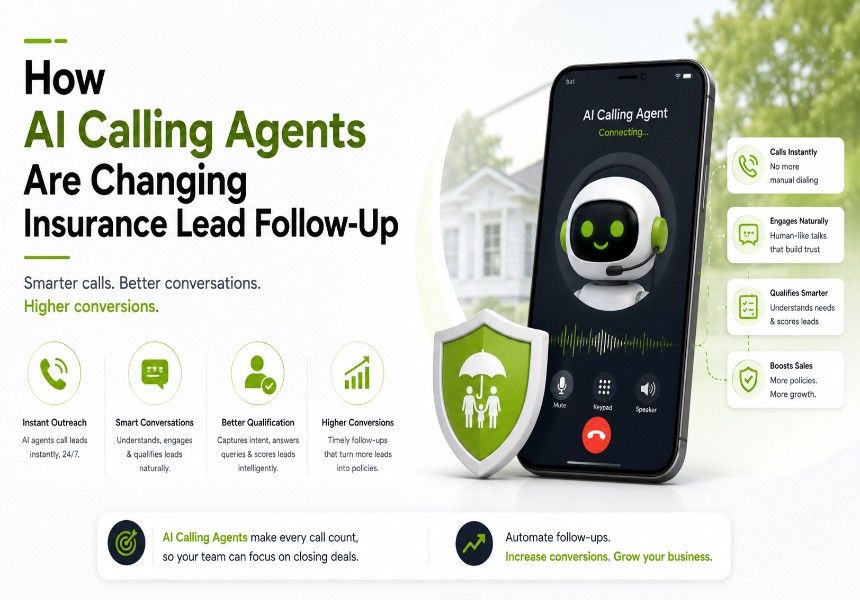
An AI calling agent for insurance exists because insurance follow-up has a math problem, not a motivation problem. Producers buy leads from aggregators, call the newest ones once or twice, and move on the moment a fresher batch arrives. The leads left behind don’t disappear. They just sit uncontacted in the CRM, and that pile of dormant leads is exactly what an AI calling agent for insurance is built to work through.
Here’s what’s actually changing in how insurance teams follow up, and why it matters for every agency still relying on manual dialing.
Insurance agencies routinely pay $15 to $50 per lead from aggregators like QuoteWizard, EverQuote, and MediaAlpha, yet roughly 35% of those purchased leads never get contacted at all. The rest often get one call, maybe two, before a producer chases the next fresh batch instead. A producer earning a fixed salary simply cannot justify spending fifteen minutes on a lead that converts at single-digit rates, so the aged leads pile up untouched.
That’s the gap an AI calling agent for insurance closes. It doesn’t get tired of low-probability leads or deprioritize them in favor of something newer. It dials every lead in the pipeline, aged or fresh, at a cost that makes calling the entire list, not just the top of it, economically sane.
Only about 20% of insurance leads convert on the first touch, which means the other 80% depend entirely on how consistently and quickly a team follows up. In a category where leads are frequently shared across three to eight carriers at once, whoever calls first usually wins the conversation before the prospect even finishes comparing quotes. An AI calling agent for insurance dials within seconds of a form submission, well before a human producer has even seen the notification, which is exactly the window where a shared lead is still deciding who to talk to.
Most agencies treat anything past a few days old as dead weight in the CRM, but aged leads still convert at 3 to 5% when re-engaged with a structured, multi-touch cadence that references the original quote type and coverage interest rather than starting the conversation from scratch. An AI calling agent for insurance can work through a dormant cohort overnight, calling every lead a producer would never have found time for, and the same logic extends to renewals and X-dates. Instead of a producer manually tracking which policies are coming up for renewal, an AI calling agent for insurance can call ahead of the window, check interest in a re-shop, and flag anyone ready for a human conversation.
| Factor | Manual Follow-Up | AI Calling Agent for Insurance |
|---|---|---|
| Contact Rate on Purchased Leads | Roughly 65%, with 35% of leads never contacted | Every lead is called automatically, including aged and dormant leads |
| Speed to First Contact | Minutes to Hours, Depending on Producer Workload | Seconds, Available 24/7 |
| Cost of Working Aged Leads | Rarely Justified Against Producer Time | Low Marginal Cost, Scales Without Additional Headcount |
| Qualifying Consistency | Varies by Producer and Time of Day | Consistent Script and Qualification Questions on Every Call |
| Renewal & X-Date Tracking | Manual Process, Easy to Miss Important Dates | Automated Outreach Before Renewal and X-Date Windows |
| Best Use | Policy Closing, Objection Handling, and Complex Coverage Advice | First Contact, Lead Qualification, Renewal Outreach, and Lead Re-engagement |
Say a homeowner requests a quote through an aggregator at 9 PM on a Sunday. With manual follow-up, that lead waits until Monday morning, by which point it’s likely already been called by two other agents whose leads shared the same request. With an AI calling agent for insurance handling first contact, the homeowner gets a call within seconds, gets asked about current coverage, property details, and renewal date, and gets flagged as qualified before a human producer even starts their week. By the time a producer picks up the conversation, they’re calling someone who already expects the follow-up and has already shared the basics.
This is exactly how AION Autopilot works inside Groweon’s CRM. As an AI calling agent for insurance, it handles first contact and qualification on every lead that enters the pipeline, updates the CRM record with what it learns, and hands off to a human producer only once a lead is genuinely ready for a real conversation about coverage and pricing.
An AI calling agent for insurance is not built to close complex policies, negotiate premiums, or walk a client through the fine print of a coverage comparison. Those conversations still need a licensed human on the line. What changes is how a producer’s day gets filled: instead of dialing through a list hoping to reach someone, they spend their time on leads that have already been contacted, qualified, and are waiting for exactly the kind of conversation only a person can have.
Insurance lead follow-up has never really had a motivation problem. It has a volume problem, and no producer can manually call every lead an agency buys at the speed and consistency the market now demands. An AI calling agent for insurance doesn’t replace the producer. It makes sure every lead an agency has already paid for actually gets a chance to convert, instead of aging quietly into a write-off.
Book a free demo and watch AION Autopilot call, qualify, and route insurance leads automatically, aged leads included.
What does an AI calling agent for insurance actually do?
It calls new and aged leads automatically, asks qualifying questions about coverage and renewal dates, and routes anyone ready for a real conversation to a human producer.
Can an AI calling agent for insurance work through old, dormant leads?
Yes. This is one of its strongest use cases, since aged leads still convert at 3 to 5% when re-engaged, a segment most agencies never have time to call manually.
Will an AI calling agent for insurance replace my producers?
No. It handles first contact, qualification, and renewal outreach. Producers still own the close, the objection handling, and the complex policy conversations.
Is an AI calling agent for insurance compliant for a regulated industry?
Yes, when built for the vertical. It follows the same scripted qualifying questions every time, which makes call handling more consistent and easier to audit than manual calls.
How does Groweon’s AI calling agent for insurance fit into an existing CRM?
AION Autopilot runs natively inside Groweon’s CRM, so every call it makes updates the same lead record your producers already work from, rather than living in a separate tool.
[wpforms id=”535″]

15 Sep, 2026
Justdial is an important source of local enquiries for Indian...

15 Sep, 2026
Summary The best CRM for TradeIndia Leads should capture enquiries...

14 Sep, 2026
Summary FMCG CRM Software reduces manual reporting by capturing field...
14 Sep, 2026
Summary Generative AI is transforming CRM into an intelligent platform...

14 Sep, 2026
CRM software is a system that stores every customer and...