

Beyond Lead Management: How AI CRM Is Transforming Revenue Growth
21 Oct, 2026
Summary (TL;DR): AI CRM is changing how businesses capture, qualify...
Updated: 17th July, 2026
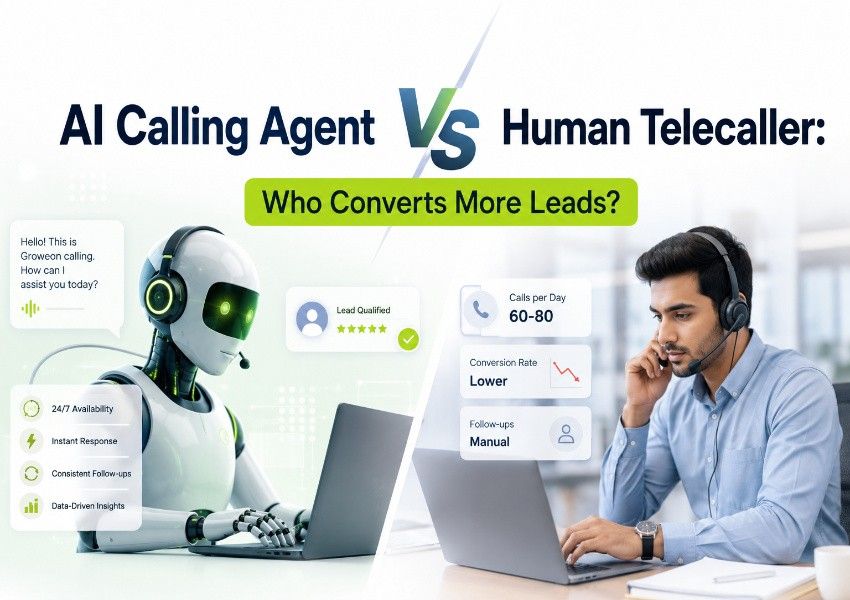
An AI calling agent wins the first five minutes of a lead’s life. A human telecaller wins the conversation that closes the deal. That’s the real answer, and it holds true whether the lead is an admissions enquiry, a car test-drive request, a property site visit, an insurance renewal, a distributor order, or a B2B demo request. The fastest-growing sales teams across every one of these verticals have stopped asking “AI or human” and started asking “AI for what, human for what.”
Here’s the data behind that split.
Response time is the single biggest lever in lead conversion, and this holds regardless of what’s being sold. Human SDR teams average close to 47 hours to make first contact with a new lead. An AI caller typically responds in under a minute. That gap compounds fast: calling a lead back within five minutes makes a rep 21 times more likely to convert them than waiting thirty minutes, per research from MIT and InsideSales.com. Almost no business actually manages that.
Real estate feels this acutely. Agents who respond slowly lose roughly 67% of leads to whichever competitor calls back first. The same pattern plays out elsewhere. An education admissions team that calls an enquiry the next morning has usually already lost the parent to a rival institute that called that evening. An auto dealership that waits till the next shift starts loses the test-drive booking to whichever showroom answered first. An AI agent removes this risk across all of them by dialing the moment a lead lands, at 11 PM or on a Sunday, without waiting for someone to be free.
| Factor | AI Calling Agent | Human Telecaller |
|---|---|---|
| First Response Time | Seconds, 24/7 | Minutes to Hours, Business Hours Only |
| Cost per Lead Touched | Low, Scales Without Adding Headcount | Higher, Scales Only With More Hires |
| Consistency Across Calls | Same Quality on Call 1 and Call 500 | Varies With Mood, Fatigue, and Training |
| Call Volume Capacity | Hundreds of Simultaneous Conversations | One Call at a Time |
| Complex Objection Handling | Limited to Trained Scenarios | Strong, Adapts in Real Time |
| Negotiation and Closing | Not Built for This | Strong |
| Best Role in the Funnel | First Contact, Qualification, Follow-Up | Conversion and Closing |
Instant response, every time
Responding within one minute instead of two produces a 391% jump in conversion. No human floor, however well staffed, holds that line on every lead across every hour. An AI agent does, whether that lead came in through a website form, a WhatsApp enquiry, or a portal like 99acres or MagicBricks.
Identical qualification on every call
Every lead gets asked the same things, whether that’s budget and BHK preference for a property enquiry, course and intake year for an admissions lead, or model and variant for a car buyer. No skips, no bad days, no half-filled CRM fields.
Volume that doesn’t queue
A telecaller handles one call at a time. AION holds hundreds in parallel, which is exactly what a project launch, an admissions season, a festive auto sale, or an insurance renewal cycle demands.
Live conversation quality
Calls that reach a human decision-maker convert to a next step at 22 to 31%, against 12 to 18% for AI agents on similar calls. Tone, hesitation, and rapport are still a people skill.
Groweon’s AION Autopilot narrows that gap, though. Its AI calling agent speaks in a natural human rhythm and tone rather than a flat, scripted cadence, which makes it a far better fit for modern sales teams than older robotic dialers.
Negotiation and off-script objections
When a buyer wants to haggle on price, a parent asks about a scholarship the script never covered, or a distributor pushes back on payment terms, a trained telecaller thinks on their feet in a way today’s AI callers can’t reliably match.
The final close
High-value negotiation and the emotional last mile, whether it’s a property booking, a big-ticket vehicle purchase, or a large B2B contract, still convert best with a human voice on the line.
This is not a compromise. It’s the model that works. Businesses running AI-only outreach, with no human involvement at all, see 25 to 35% lower pipeline value per lead, because AI-qualified leads without any human touch close at lower rates. Pure human-only coverage, meanwhile, can’t keep pace with how fast leads now expect a response, in any vertical.
The model that wins pairs both: an AI caller handles the first three to five touches, qualifying and warming the lead instantly, and a human telecaller steps in once that lead is genuinely ready to talk. That combination cuts cost per qualified lead by 55 to 75% compared to a human-only team.
This is exactly how AION Autopilot works inside Groweon’s CRM, across every vertical it serves. Say a real estate lead comes in from 99acres at midnight, an admissions enquiry lands on an education website after school hours, or a car buyer fills a form after a dealership has closed for the day. AION calls within seconds, captures intent and key qualifying details, scores the lead, and books the next step, a site visit, a campus visit, or a test drive, on the spot. By the time a telecaller picks it up the next morning, they’re not starting cold. They’re calling someone who already knows the offering and has agreed to the next step.
Conversion rate alone is misleading without cost attached. A telecalling team in India carries a fixed monthly cost in salary, incentives, and training, whether they make 20 calls or 200. An AI agent handles a much larger volume at a fraction of that marginal cost. The question isn’t “what’s my conversion rate?” It’s “how much am I paying for each serious buyer conversation?”
For a growing business, whether that’s a coaching institute, an auto dealership group, a brokerage, an insurance agency, or a distributor network, that reframes the decision entirely. Adding an AI calling agent doesn’t mean hiring a bigger telecalling floor. It means your existing team only spends time on leads that are already warm.
Buyer expectations have outpaced most sales floors, and this is not unique to any one industry. 82% of buyers now say they’d rather get an immediate AI response than wait hours for a callback. That expectation shows up in an education aspirant checking multiple institutes at once, a car buyer comparing three showrooms in one evening, a property buyer scrolling three portals in parallel, an insurance shopper requesting quotes from several agents, or a distributor evaluating multiple FMCG suppliers before committing. Whoever responds first, and follows up most consistently, tends to win the deal, and an AI calling agent is what keeps any of these enquiries from going cold before a telecaller even sees them.
The teams winning in 2026, across Education, Automobile, Real Estate, Insurance, FMCG Distribution, and B2B Sales, aren’t picking AI over people. They’re using an AI caller to lock down speed and consistency at the top of the funnel, so their telecallers spend all their time on leads worth closing.
This is not a theoretical model. AION Autopilot runs this exact hybrid approach natively inside Groweon’s CRM, calling, scoring, and booking the next step before a telecaller ever picks up the phone. It works the same way whether the lead is a real estate site visit, a college admissions enquiry, a test drive, an insurance renewal, a distributor order, or a B2B demo request. Your team gets the speed of an AI calling agent and the closing power of a human telecaller, without stitching together two separate tools for each vertical.
The real question was never “AI calling agent vs human telecaller.” It’s which one owns which part of the conversation, and that holds true no matter what you’re selling. Give the AI caller speed, consistency, and round-the-clock coverage. Give the human telecaller judgment, negotiation, and the close. Teams that split the job this way convert more leads than teams betting everything on either side alone.
Book a free demo and see how AION Autopilot qualifies, follows up, and books the next step automatically, whether you’re running education admissions, an auto dealership, a real estate sales team, an insurance agency, an FMCG distribution network, or B2B outreach, before your competitors even pick up the phone.
Does an AI calling agent sound robotic?
Modern AI calling agents, including AION, use natural conversational voice models built for real dialogue and basic objections, not scripted robotic playback.
Will an AI calling agent replace my telecalling team?
No. AI-only outreach underperforms a hybrid model. The AI caller owns instant first response and qualification; your telecallers own the close.
How fast does an AI calling agent respond to a new lead?
Typically within seconds, against an industry average of close to 47 hours for human-only teams.
Is an AI calling agent expensive to add to an existing CRM?
It’s generally far cheaper per lead touched than hiring more telecallers, since one AI agent can run hundreds of simultaneous conversations without added headcount.
Does AION work outside real estate?
Yes. AION Autopilot runs the same AI calling agent across Groweon’s supported verticals, Education, Automobile, Real Estate, Insurance, FMCG Distribution, and B2B Sales, connecting directly to portal, WhatsApp, and website leads and calling them automatically the moment they arrive.
[wpforms id=”535″]

21 Oct, 2026
Summary (TL;DR): AI CRM is changing how businesses capture, qualify...

21 Oct, 2026
Summary (TL;DR): AI CRM is transforming how businesses engage customers...

21 Oct, 2026
Summary (TL;DR): Businesses are moving beyond AI tools that simply...

16 Oct, 2026
Summary (TL;DR) The best CRM for rubber and tyre manufacturers...

16 Oct, 2026
Summary (TL;DR) A CRM for agricultural equipment manufacturers tracks farmer...