

Best Lead Management Software in India: What to Check Before…
01 Oct, 2026
Summary (TL;DR): Lead management software captures, scores, routes, and nurtures...
Updated: 26th March, 2026
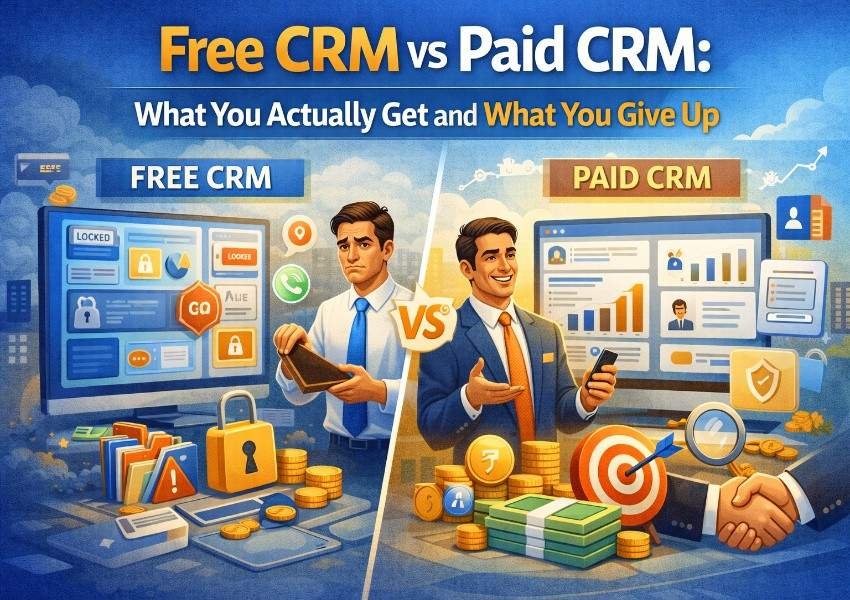
When you are starting out or running a lean operation, the appeal of a free CRM is obvious. No budget required. No approval process. Sign up and start using it today. But as your sales operation grows, the question shifts from “can we afford a paid CRM?” to “how much is a free CRM actually costing us?”
The free CRM vs paid CRM debate is not simply about price. It is about capability, scale, and what your sales team is silently giving up every day they work inside a tool that was not built for the demands of a growing business.
Free CRMs are not without value. For the right use case they are a reasonable starting point. Most free plans deliver basic contact and deal management, a simple pipeline view with fixed stages, email integration with Gmail or Outlook, surface-level reporting, and access for a limited number of users, typically between one and five.
For a solo operator or a team of two handling a handful of deals a month, this covers the basics. The problems start when your business starts growing faster than the free plan was designed to support.
This is where the real free CRM vs paid CRM comparison begins. The limitations of a free tool are not always obvious on day one but they accumulate fast.
Automation
Workflow automation is the feature that multiplies your team’s output. Automated lead assignment, follow-up sequences, task creation, and deal stage triggers are almost universally locked behind paid tiers. Without automation, every repetitive task requires manual effort, which means more time on admin and less time selling.
According to Salesforce’s State of Sales research, sales reps spend only 28% of their working week actually selling. A free CRM with no automation keeps that number low. A paid CRM pushes it significantly higher, and every extra hour spent selling translates directly into revenue.
Integrations
Free plans typically offer a limited number of native integrations. Connecting your CRM to WhatsApp, your marketing platform, your e-commerce store, or your accounting tool usually requires a paid plan. The more disconnected your CRM is from the rest of your tools, the more manual data transfer your team ends up doing every day.
Lead scoring
Free CRMs rarely include intelligent lead scoring. Without it, your team has no systematic way to identify which leads are most likely to convert and prioritization becomes guesswork.
Reporting depth
The gap between free and paid CRM reporting is significant. Free tiers show surface-level metrics. Paid tiers offer customizable dashboards, rep-level performance breakdowns, source attribution, and forecasting data that managers need to coach effectively and plan with confidence.
Support and security
Free plan users are typically limited to community forums. When something goes wrong, paid support is not available. Role-based access controls and audit logs, which protect sensitive customer data, are also almost always paid features.
Free CRM vs paid CRM is not just a feature comparison. It is a comparison of what the limitations cost your business in lost revenue and wasted time.
Think about the leads going cold because no automation is triggering follow-ups. The deals stalling because there are no stage-based alerts. The hours your team spends manually moving data between tools that would integrate automatically on a paid plan. None of these costs appear on an invoice but they show up in your conversion rates and your revenue.
According to HubSpot’s CRM statistics, businesses that use CRM automation see significantly higher lead conversion rates than those managing their pipeline manually. The gap between free and paid is not just operational. It is financial.
You are a solo operator or very early-stage team
If you are managing leads on your own or with one other person and your sales volume is low, a free CRM gives you structure without overhead. It is better than a spreadsheet and costs nothing to find out whether CRM software fits your workflow.
You are evaluating CRM software for the first time
A free tier is an excellent way to understand what a CRM does before committing to a paid plan. Use it as a structured trial rather than a permanent solution.
Your sales process is genuinely simple
If you have a short sales cycle with low lead volume and no need for automation or integrations, a free CRM may serve your needs for longer than it would for a more complex operation.
Beyond these scenarios, the limitations of a free CRM tend to start costing more than a paid plan would.
There are clear signals that the free CRM vs paid CRM decision has already been made for you by the demands of your business.
Your team is larger than five people. Most free plans cap users at a number that stops being workable the moment your team grows. When reps cannot all access the system, pipeline visibility breaks down.
You are losing deals to slow follow-up. If prospects are going cold because follow-ups are inconsistent, automation is the fix. Automation is a paid feature in virtually every CRM platform.
You cannot forecast revenue accurately. When your pipeline data is incomplete and your reporting is surface-level, business planning becomes unreliable.
Your CRM is disconnected from your other tools. Manually transferring data between your CRM, WhatsApp, and accounting platform is paying for the free CRM in time rather than money.
| Feature | Free CRM | Paid CRM |
|---|---|---|
| Automation | Not available | Full workflow automation |
| Lead Scoring | Manual or unavailable | Automatic, behavior-based |
| Integrations | Very limited | Full integration library |
| Reporting | Basic dashboards | Custom analytics and forecasting |
| User Limit | 1 to 3 users | Scales with your team |
| Support | Community forums only | Dedicated support included |
| Customization | Fixed fields and stages | Fully flexible |
Groweon CRM is built for businesses that are ready to move beyond the limitations of a free CRM but do not want the complexity or cost of enterprise software.
With Groweon CRM you get full pipeline management with unlimited customization, workflow automation that handles follow-ups and lead assignment automatically, native WhatsApp integration, lead scoring that surfaces your best opportunities, real-time reporting dashboards, and dedicated support from a team that understands growing businesses.
Groweon CRM is priced to be accessible for growing teams with a feature set that delivers genuine sales impact from day one. Not a free tier with arbitrary limits. A complete sales platform built to grow with your business.
Ready to see it in action? Book a free 20-minute Groweon CRM demo and we will walk you through exactly how it fits your sales process.
A free CRM is a reasonable starting point. It introduces structure, costs nothing to try, and serves basic needs in the early stages. But it has a ceiling, and that ceiling arrives sooner than most businesses expect.
When your team is growing, your lead volume is increasing, and the manual gaps in your process are showing up in your revenue, the free CRM vs paid CRM decision is already made. The only question is how long you delay acting on it.
Groweon CRM gives you everything a growing sales team needs without the complexity of enterprise software or the limitations of a free tier. Automation, pipeline management, WhatsApp integration, lead scoring, and real-time reporting in one platform built for businesses serious about growth.
Book your free 20-minute Groweon CRM demo today and see exactly what your sales operation looks like with the right tools in place.
Q1. Is a free CRM good enough for a small business?
For solo operators or very early-stage teams with simple processes, yes. Once your team grows beyond five people or you need automation and integrations, the limitations start costing more than a paid plan would.
Q2. What is the biggest thing you give up with a free CRM?
Automation. The ability to automatically assign leads, trigger follow-up sequences, and create tasks is almost always a paid feature. Without it, your team spends significantly more time on admin and less time selling.
Q3. When should a business upgrade to a paid CRM?
When you are losing deals to slow follow-up, when your team exceeds the free user limit, when you cannot forecast revenue accurately, or when your CRM is disconnected from the other tools your team uses daily.
Q4. Are paid CRMs worth the investment? For growing businesses, yes. The automation and reporting capabilities save more in time and recover more in lost revenue than the subscription cost for virtually any team with consistent sales activity.
Q5. How do I choose the right paid CRM?
Focus on the features you will actually use in the next 12 months: automation, pipeline customization, integrations with your existing tools, and reporting depth. Groweon CRM is built to deliver exactly what growing teams need without unnecessary overhead.
[wpforms id=”535″]

01 Oct, 2026
Summary (TL;DR): Lead management software captures, scores, routes, and nurtures...

01 Oct, 2026
Summary (TL;DR): CRM pricing in India typically runs ₹250 to...

30 Sep, 2026
Summary (TL;DR): A CRM with native Meta Conversions API integration...

29 Sep, 2026
Summary (TL;DR): The best choice depends on whether you want...
28 Sep, 2026
Summary (TL;DR): So, a B2B CRM has moved from a...