AI Calling Agent vs Human Telecaller: Who Converts More Leads?
17 Jul, 2026
Summary An AI calling agent responds in seconds; a human...


Auto Capturing, nurturing, and converting potential customer leads.

Manage AMC contracts, track service requests, ensure timely renewals.

Tracks, resolves, manages issues, and gathers customer feedback.

Manage purchases, expenses, vendors, and POs efficiently with CRM.

Manages order lifecycle from placement to delivery completion.

Generates invoices and manages sales transactions and records efficiently.

Manages stock levels, tracks items, ensures efficient inventory control.

Manages dealer workflows, assigns leads, and tracks progress centrally.

WhatsApp CRM integration with bulk messaging, auto notifications, chatbots.

IVR enabled CRM integrates click-to-call, bulk dialling, recording features.

Achieves optimum productivity of tele-sales team with auto dialler.

Updated: 27th February, 2026
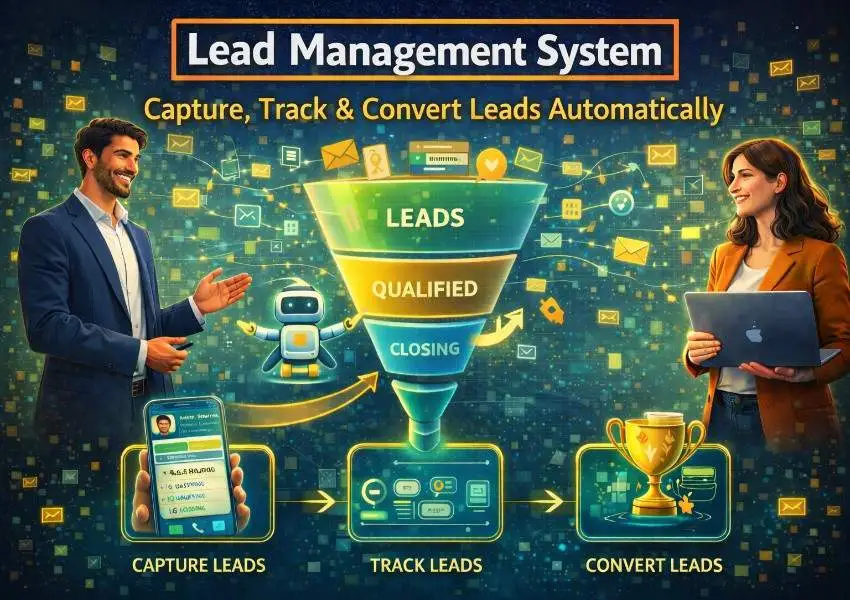
Every business runs on leads. But generating leads is only half the battle. The real challenge is what happens after a lead enters your world. Without a structured lead management system in place, even the most promising prospects slip through the cracks, go cold from slow follow-up, or get lost entirely in a messy inbox or spreadsheet.
A lead management system is the process and technology that helps your business capture every lead, track their journey, and convert them into paying customers in a systematic, repeatable way. It removes the guesswork from sales, replaces scattered manual effort with structured automation, and ensures that no lead ever goes unattended.
Whether you are a small business handling a few dozen leads a month or a growing sales team managing hundreds, the right system is what separates a pipeline full of missed opportunities from one that consistently delivers revenue.
This guide covers everything you need to know about building and optimizing a lead management system, from first capture to final conversion.
A lead management system is a combination of tools, processes, and workflows that help sales and marketing teams collect leads from multiple sources, organize and qualify them, assign them to the right people, and nurture them through the sales process until they are ready to buy.
At its core, it answers four fundamental questions: Where are your leads coming from? What stage of the buying journey are they in? Who is responsible for following up? And what needs to happen next to move them closer to a decision?
Without this structure, those questions get answered inconsistently, if at all. Reps rely on memory. Leads from different sources pile up in different places. Follow-ups happen when someone remembers rather than when they should. The result is a leaky pipeline where revenue walks out the door every single day.
A well-implemented lead management system, like the one built into Groweon CRM, fixes all of this by centralizing your lead data, automating key actions, and giving your team a clear, shared view of every prospect at every stage.
The numbers are hard to argue with. Companies with a strong lead management system generate 50% more sales-ready leads at 33% lower cost, according to Forrester Research. Yet a large portion of businesses still rely on spreadsheets, sticky notes, or informal processes to manage their leads.
The cost of a poor setup shows up in several ways.
Slow response times. Research consistently shows that the odds of qualifying a lead drop significantly after the first five minutes. Without automated follow-up triggered the moment a lead arrives, your team is losing prospects before the conversation even starts.
Inconsistent follow-up. When follow-ups depend on individual reps remembering to do them, they happen unevenly. Some leads get five touches. Others get one. A proper system ensures every lead receives consistent, timely attention regardless of who owns it.
No visibility into lead quality. Not all leads are worth the same effort. Without scoring and segmentation, reps waste time on poor-fit prospects while high-value leads wait.
Lost leads from poor handoff. When marketing passes leads to sales without a structured process, contacts fall through the cracks at the handoff point. A shared lead management system gives both teams visibility and accountability.
The first job of any lead management system is to capture every lead that expresses interest in your business, regardless of where that interest comes from.
Leads come from many sources: website contact forms, landing page signups, social media inquiries, live chat conversations, email campaigns, webinars, trade shows, paid ads, and referrals. Without a centralized platform, each of these channels delivers leads to a different place, creating silos that make it impossible to get a unified view of your pipeline.
A modern lead management system integrates all of your lead sources into a single database. Every form submission, every chat inquiry, every ad click that results in a conversion flows in automatically, tagged with its source so you always know which channels are performing.
Groweon CRM’s lead capture tools connect seamlessly with your website forms, landing pages, and third-party lead sources, ensuring every lead is captured instantly without manual data entry. The moment a prospect shows interest, they are in the system and the follow-up process begins.
Best practices for lead capture:
Keep your forms short. Every additional field reduces your conversion rate. Capture only what you need: name, email, company, and the specific product or service they are interested in.
Use progressive profiling. Enrich lead records over time as prospects engage with more of your content, rather than asking for everything upfront.
Tag every lead with its source. Knowing where leads come from is essential for measuring which channels deliver the best return. Source tagging should be automatic and consistent across every channel.
Capturing a lead is just the beginning. The real power of a lead management system is in what happens next: tracking every interaction, touchpoint, and behavior so your team always knows exactly where each prospect stands.
Lead tracking covers several dimensions.
Activity tracking logs every email sent and opened, every call made, every meeting held, and every document viewed against the lead’s record. When a rep opens a contact profile, they see the complete history at a glance, with no need to search through emails or ask colleagues for context.
Behavioral tracking goes deeper, monitoring how leads engage with your website and content. Which pages did they visit? Did they check out your pricing page? Did they download a case study? This behavioral data reveals buying intent that the prospect may not have verbally expressed yet.
Stage tracking shows where every lead sits in your sales process at any given moment. The pipeline view makes it easy for reps and managers to see which leads are progressing, which are stalling, and which need immediate attention.
Groweon CRM gives you all three layers of tracking in one dashboard, so you never have to guess what a prospect has seen, done, or responded to. Every touchpoint is logged automatically, giving your team the context they need for relevant, timely conversations.
Not every lead that enters your lead management system is ready to buy. Treating every lead the same way is one of the most common mistakes sales teams make. Lead scoring is the mechanism that separates high-priority prospects from those who need more time.
It works by assigning points to leads based on two factors.
Fit score measures how closely a lead matches your Ideal Customer Profile. A lead from a mid-sized technology company in your target geography scores higher than a solo freelancer outside your served market. Fit scores are calculated automatically using the demographic and firmographic data captured during intake.
Engagement score measures how actively the lead is interacting with your brand. Opens, clicks, page visits, demo requests, and content downloads all add points. A lead who has visited your pricing page three times and opened your last four emails is signaling strong intent, and your lead management system should surface them to your reps immediately.
When fit and engagement scores are combined, your team gets a composite score that tells them exactly which leads to call today, which to nurture, and which are not yet worth pursuing. This prioritization prevents high-value leads from sitting idle while reps spend time on poor-fit contacts.
Speed matters in lead management. The faster a qualified lead is assigned to the right rep, the higher the chance of a meaningful first conversation. A manual assignment process introduces delays and inconsistency that automation eliminates entirely.
Automated lead routing assigns every new lead to the right rep instantly, based on rules you define. Common routing criteria include territory or geography, industry or company size, product line of interest, lead source, and rep availability or workload.
With Groweon CRM, routing rules are set up once and applied automatically to every lead that enters the pipeline. No manual sorting. No leads sitting in a queue. The right rep gets the right lead the moment it arrives, and response time drops to near zero.
Round-robin assignment is another valuable feature that distributes leads evenly across your team, preventing any single rep from being overwhelmed while others sit idle.
Most leads are not ready to buy when they first enter your lead management system. Research from Marketo suggests that 50% of leads are qualified but not yet ready to purchase. Without a nurturing process, these leads go cold and are eventually lost to a competitor who stayed in touch.
Lead nurturing is the process of maintaining consistent, relevant communication with prospects over time, building trust and keeping your brand top of mind until they are ready to make a decision. A good system automates this process so it happens at scale without burdening your sales team.
Effective nurturing includes automated email sequences tailored to the lead’s industry, stage, or specific interest. It includes content delivered based on behavior, so a lead who downloaded a product comparison guide receives a follow-up with a relevant case study rather than a generic newsletter. And it includes timely alerts to reps when a nurtured lead re-engages, signaling that they may be ready for a sales conversation.
The key to nurturing that converts is relevance. Use the data your system holds about each prospect to make every automated touchpoint feel personal and well-timed rather than generic and scheduled.
Everything in your lead management system builds toward one outcome: converting a lead into a customer. This is the stage where all the tracking, scoring, nurturing, and follow-up pays off.
A strong setup supports conversion by ensuring reps have full context before every closing conversation. The complete history of a lead’s interactions is visible in their profile: every email they opened, every page they visited, every objection raised in a previous call. This context allows reps to have highly personalized conversations that address the prospect’s specific situation rather than starting from scratch.
Automated reminders ensure proposals are followed up on time. Stage-based alerts flag deals that are stalling. Manager notifications escalate high-value opportunities that need additional resources or approval.
When a lead converts, the system should trigger the next phase automatically: a handoff notification to the customer success team, an onboarding workflow, and a status update that removes them from active nurture sequences. A smooth transition from prospect to customer starts inside your lead management system.
Your lead management system is only valuable if it is delivering measurable results. Here are the metrics every business should track.
Lead response time measures how quickly your team contacts a new lead after they enter the system. The benchmark is under five minutes for inbound leads. Instant lead assignment and automated first-touch emails make this achievable.
Lead-to-opportunity conversion rate measures what percentage of captured leads become qualified sales opportunities. This tells you how well your capture and qualification processes are working.
Opportunity-to-close rate measures what percentage of qualified opportunities result in a closed deal. If this number is low, the issue is likely in your nurturing or conversion process.
Lead source ROI measures which channels deliver the leads most likely to convert and at what cost. Source tagging inside your CRM makes this analysis always available.
Average time to convert measures how long it takes a lead to move from first capture to closed deal. A well-optimized lead management system should reduce this number over time through better scoring, faster routing, and more consistent nurturing.
Groweon CRM is built from the ground up to serve as a complete lead management system for growing sales teams, combining lead capture, tracking, scoring, routing, nurturing, and conversion tools in a single, easy-to-use platform.
You get automated lead capture from all your channels in one place, smart scoring that surfaces your hottest prospects instantly, intelligent routing that assigns leads to the right rep in seconds, automated nurture sequences that keep leads warm without manual effort, full activity and behavioral tracking so your team always has context, and real-time dashboards that show the health of your pipeline at a glance.
For businesses tired of losing leads to slow follow-up, inconsistent processes, and poor visibility, Groweon CRM delivers the system that turns those leaks into closed deals.
Capturing leads without a follow-up plan. A lead management system that captures leads but has no automated follow-up is just a more organized way of losing prospects. Build your nurture workflows before you start driving traffic.
Treating all leads the same. Score and segment leads so high-priority prospects get faster, more personalized attention. Applying the same process to everyone wastes your team’s time and frustrates your best prospects.
Neglecting lead source tracking. If you do not know where your leads come from, you cannot measure what is working. Source tagging should be automatic and consistent.
Letting old leads go cold permanently. Leads that do not convert right away are not lost forever. Keep them in a long-term nurture track so when their situation changes, your brand is the first one they think of.
Not reviewing system performance. Review your conversion rates, response times, and sequence performance at least monthly and adjust based on what the data tells you.
The difference between a business that struggles to convert leads and one that does it consistently almost always comes down to one thing: a lead management system that works.
When it captures every lead automatically, scores and prioritizes them intelligently, routes them to the right rep instantly, and nurtures them with relevant communication over time, you stop relying on individual heroics and start building a sales engine that produces predictable results.
Groweon CRM gives you the complete lead management system to make this a reality. From first capture to final conversion, every stage of the lead journey is tracked, managed, and optimized in one platform designed for teams that are serious about growth.
Stop losing leads to manual processes and missed follow-ups. Build your lead management system with Groweon CRM and turn every lead into an opportunity. Book a quick 20-minute free Groweon CRM demo today!
Q1. What is a lead management system?
It is a tool and process that captures leads from all your channels, tracks their activity, scores them by fit and intent, assigns them to the right rep, and nurtures them until they are ready to buy, all in one place.
Q2. How does a lead management system help increase conversions?
It ensures no lead is missed, every follow-up happens on time, and reps always have full context before a conversation. Scoring and prioritization means your team focuses on the prospects most likely to close.
Q3. What is lead scoring and why does it matter?
Lead scoring assigns a value to each lead based on how well they match your target profile and how actively they are engaging. It tells your team exactly who to call first so high-intent prospects never wait too long.
Q4. Can a lead management system work for small businesses?
Absolutely. Small teams benefit most because it automates the follow-ups, routing, and nurturing that would otherwise require extra headcount. Groweon CRM is simple enough to set up quickly without any technical background.
Q5. How is a lead management system different from a CRM?
A CRM manages the full customer relationship across the entire lifecycle. A lead management system focuses specifically on the early stages, from first capture to qualified opportunity. Most modern CRMs like Groweon CRM include both in one platform.

17 Jul, 2026
Summary An AI calling agent responds in seconds; a human...

16 Jul, 2026
Look at five CRM websites and you’ll see the same...

13 Jul, 2026
Agentic AI in Education CRM helps education institutes increase student...

09 Jul, 2026
Summary Agentic AI for sales follow-up removes the bottlenecks in...

06 Jul, 2026
Traditional CRM is not dead, but for most businesses it...