

Best Lead Management Software in India: What to Check Before…
01 Oct, 2026
Summary (TL;DR): Lead management software captures, scores, routes, and nurtures...
Updated: 18th February, 2026
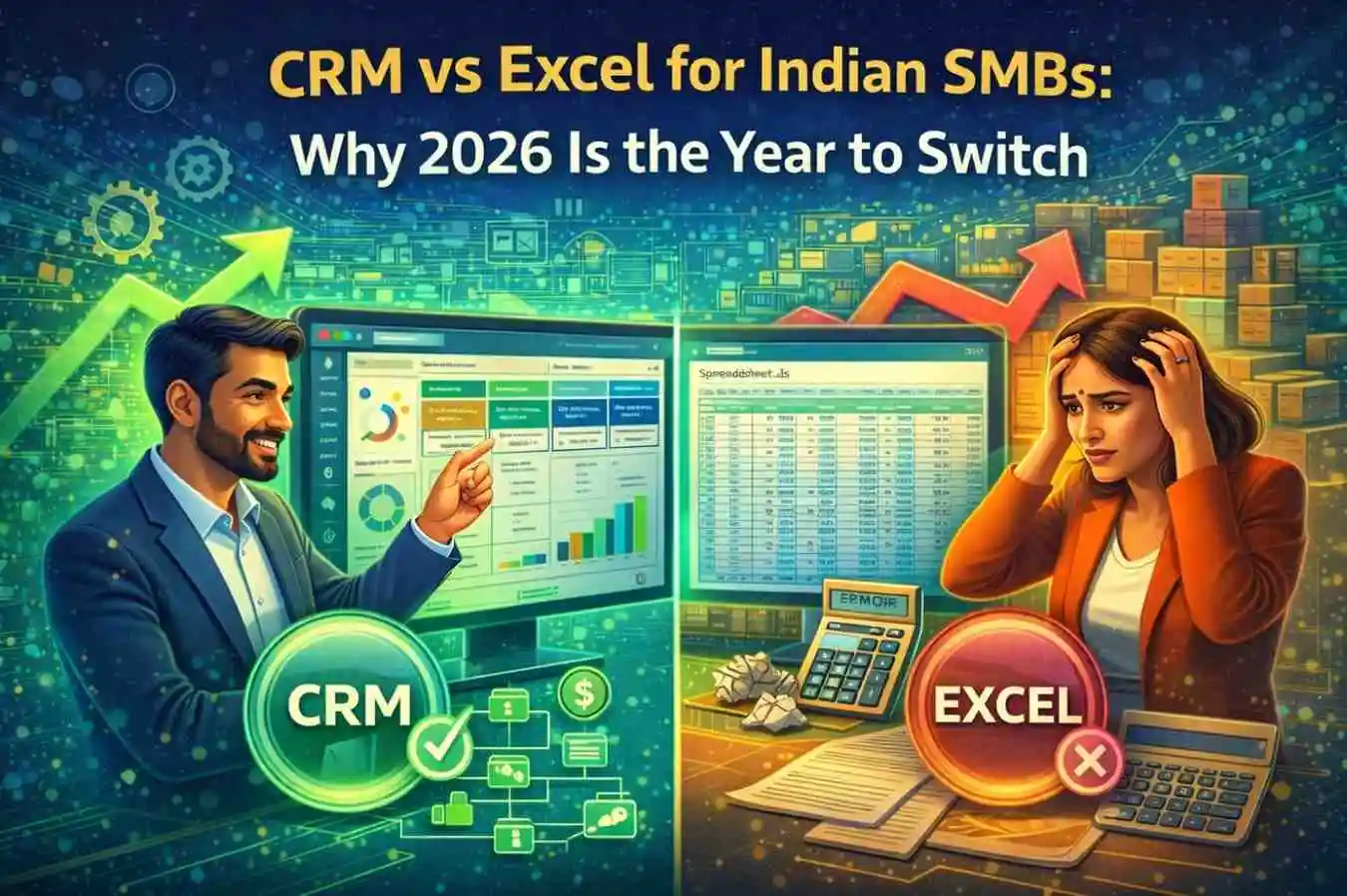
Indian businesses have used Excel for decades. It handled early customer lists, tracked payments, and logged follow-up notes when teams were small and lead volumes were manageable. For a long time, it worked well enough.
That era is ending. Not because Excel became worse, but because the way Indian SMBs sell, communicate, and compete has changed fundamentally. WhatsApp is now a primary sales channel. Leads come from IndiaMART, JustDial, Google Ads, and field visits, often simultaneously. Customers expect faster responses and more personalised follow-up than any spreadsheet can reliably deliver.
This article is not an argument that Excel is bad software. It is an honest look at what Excel was designed to do, where it falls short specifically for sales and customer management, and what switching to a CRM actually looks like for an Indian SMB in 2026.
Excel is a calculation and data organisation tool. It is excellent at financial modelling, inventory planning, and one-off data analysis. The problem is that it was never designed to manage active relationships with hundreds or thousands of customers across a live sales process.
When you try to use it that way, several things start to break.
Version chaos kills team alignment. The moment more than one person needs to update the same spreadsheet, you have a version problem. Files get emailed back and forth, saved under different names, or edited locally without syncing. By the time a manager tries to review the pipeline, four people are working off four different versions of reality. A single incorrect formula can cascade silently through calculations and shape decisions that cost real revenue before anyone notices.
No system means no consistency. Excel has no built-in concept of a lead stage, a follow-up reminder, or an activity log. Teams build these themselves, which means each person builds them slightly differently. When a sales rep leaves, their logic leaves with them. There is no handover process because there is no process at all, just a file full of colour-coded rows and personal conventions.
Security is genuinely fragile. Spreadsheets containing customer contact data, deal values, and pricing terms are regularly shared over WhatsApp or email with no encryption, no access control, and no audit trail. If that file is forwarded, downloaded to a personal device, or opened on an unsecured network, there is no record of it and no way to revoke access. As India moves toward stronger data protection under the DPDP Act, this is increasingly not just an operational risk but a compliance one.
Recovery from data loss is painful and often incomplete. Excel has no automatic backup by default. A corrupted file, an accidental delete, or a hardware failure can wipe months of customer data. Rebuilding it is not just time-consuming. Much of it is simply gone, because conversations, notes, and context live in people’s heads, not in structured records.
The WhatsApp disconnect. India has the world’s largest WhatsApp user base, and for most SMBs, WhatsApp is not just a messaging app. It is a primary sales and customer service channel. Excel cannot connect to WhatsApp in any reliable way. Every message has to be manually recorded if it is recorded at all. Leads that come through WhatsApp exist in the app, not in your customer database. Follow-up depends entirely on the individual rep remembering to check their phone.
None of these are theoretical risks. For most Indian SMBs that have been using Excel past the point where their team and lead volume grew, these are daily realities.
There are three forces converging in 2026 that make this year genuinely different from previous years when the CRM vs Excel debate was mostly theoretical for smaller businesses.
CRM has become genuinely affordable for small teams. Pricing has shifted dramatically. Entry-level CRM plans in India now start below ₹1,000 per user per month, less than the cost of a business lunch. The freemium models of a few years ago were often too limited to replace Excel in practice. Today’s entry-tier plans are functional enough for most small sales teams to get real value from day one.
| CRM Tier | Monthly Cost Per User | Who It Suits |
|---|---|---|
| Entry-level | ₹500 – ₹1,000 | Startups and micro SMBs, basic lead tracking and contact management |
| Mid-tier | ₹1,000 – ₹5,000 | Growing SMBs needing automation, custom fields, and integrations |
| Full suite | ₹5,000 – ₹15,000 | Businesses wanting sales, service, inventory, and reporting in one place |
AI features that used to be enterprise-only are now in SMB tools. Lead scoring, automated follow-up sequences, predictive deal prioritisation: these were previously available only to large organisations with dedicated IT teams. In 2026, they are standard or near-standard features in mid-tier CRM plans. This matters because it means a small team of five or ten people can get the same intelligence about their pipeline that a large sales organisation had to build from scratch.
India’s regulatory environment is tightening. The Digital Personal Data Protection Act creates real obligations around how customer data is stored, accessed, and protected. CRM platforms built for Indian businesses are incorporating DPDP-aligned features such as role-based access controls, audit logs, and data localisation options as standard. Continuing to manage customer data in shared Excel files creates genuine compliance exposure that did not exist in the same way three years ago.
The clearest way to explain this is to walk through the everyday moments where the difference is most visible.
Lead capture is automatic, not manual. With a CRM integrated into your lead sources, including IndiaMART, JustDial, your website contact form, and WhatsApp Business, every new enquiry appears in the CRM immediately, assigned to the right person, with a follow-up task created automatically. With Excel, someone has to notice the enquiry, open the spreadsheet, find the right row, add the contact, and remember to follow up. That gap between “notice” and “action” is where leads die.
Follow-up is enforced, not hoped for. CRM systems send reminders when a follow-up is due, flag deals that have gone cold, and escalate if a lead has not been contacted within a defined window. There is no equivalent in Excel. The follow-up happens if the rep remembers, if they check their notes, and if they find the right row. The data consistently shows that sales teams using manual tracking miss a significant proportion of follow-up windows that cost them deals, not from negligence, but from volume.
The entire conversation history is in one place. When a customer calls and a different rep picks up, that rep can see every previous interaction, every note, every promise made. In Excel, that context either does not exist or is buried in a personal notebook. The customer has to explain themselves again. That experience erodes trust quickly.
Pipeline visibility is real, not assembled on demand. A CRM shows your pipeline as it actually stands right now: how many deals are at each stage, which ones have been stalled longest, where the biggest revenue risk is, and what each rep is working on. Generating the same picture from Excel requires someone to manually clean and aggregate data, which means it is always slightly out of date and costs someone time they could spend selling.
Reporting takes minutes, not hours. Standard CRM dashboards track conversion rates, deal velocity, lead source performance, and team activity automatically. Building equivalent reporting in Excel requires formulas, pivot tables, and manual refreshing, and even then it breaks when someone changes a column header.
The argument for keeping Excel is usually that it is free. That is accurate as far as the licensing cost goes. The actual cost is different.
Consider a sales team of five people managing 200 active leads. Each rep spends an estimated two to four hours per week on manual data entry, copying information between WhatsApp, email, and the spreadsheet. At a conservative estimate, that is 500 to 1,000 hours of selling time lost annually to administrative work that could have been spent on calls, demos, and follow-ups. For a team of that size, the time cost alone justifies a CRM subscription many times over.
Then consider the leads that slip through. A team using manual tracking will miss a proportion of follow-up windows. If even five deals per month go cold because of missed follow-ups, and each deal is worth ₹20,000, that is ₹12 lakh in annual revenue that does not close, not because the product was wrong or the price was too high, but because no one called back at the right moment.
The cost of CRM for that same five-person team at ₹999 per user per month is roughly ₹60,000 per year. The arithmetic is not subtle.
There is also the cost of data loss. Recovering from a corrupted or accidentally deleted Excel file, reconstructing contact records, conversation history, and deal status, can take weeks and never fully restores what was there. The financial impact of a single serious data loss event typically dwarfs months of CRM subscription fees.
Not all CRM platforms are built with the Indian market in mind, and the differences matter in practice. Here are the features worth prioritising when evaluating options.
WhatsApp-native workflows. WhatsApp is not a nice-to-have integration. For most Indian SMBs, it is the primary way customers communicate. Look for a CRM where WhatsApp conversations are automatically logged to contact records, where you can send messages from within the CRM, and where leads coming through WhatsApp are captured directly without manual entry.
Integration with Indian lead sources. IndiaMART and JustDial are the primary B2B lead sources for many Indian manufacturers and distributors. A CRM that pulls leads directly from these platforms removes a major manual step and ensures no enquiry is missed.
GST and local compliance support. Indian businesses have specific requirements around invoicing, tax documentation, and now data protection. A CRM built for India will handle these natively rather than requiring workarounds.
Pricing in INR with no hidden costs. International CRM platforms often list pricing in USD, add currency conversion variability, and include features that are not relevant to Indian SMB workflows while missing ones that are. Local pricing, local support, and local understanding of how Indian businesses actually sell matter more than feature count.
Fast deployment. A CRM that takes months to implement is a different risk profile than one that can be configured and running in hours. For lean teams without dedicated IT, implementation speed is a practical requirement, not just a preference.
Mobile access for field sales. Many Indian sales operations involve field reps visiting customers and distributors. A CRM that works well on mobile, capturing visit notes, updating deal status, and logging calls, keeps data current without requiring reps to wait until they are back at a desk.
The transition from Excel to CRM does not have to be a large project. The businesses that manage it well treat it as a phased shift rather than a big-bang replacement.
Start by identifying your biggest pain point: missed follow-ups, version confusion, lost lead data, or inability to see the pipeline clearly. That pain point becomes your first use case, and it gives you a concrete measure of whether the CRM is working.
Before migrating your Excel data, clean it. Remove duplicates, standardise the format of phone numbers and company names, and decide which records are still active. Importing messy data into a CRM means starting with a messy CRM. Most platforms provide CSV import tools and will help with mapping, but the quality of what goes in determines the quality of what comes out.
Start with one team or one function, typically the sales team most affected by the Excel limitations you identified. Run the CRM alongside Excel for 30 days if needed. Measure adoption (are people actually using it?) and outcomes (are follow-ups more consistent, is pipeline visibility better?). Adjust configuration based on what you learn before rolling out further.
Train the team on what is in it for them individually. Reps who understand that the CRM reminder means they close more deals, and that management visibility reduces the number of times they are asked for manual updates, adopt the system faster and more completely than teams who are told to use it because the business needs better data.
Groweon is a CRM platform built specifically for Indian SMBs. It was not adapted from an international product and localised for India. It was designed from the start around the way Indian businesses sell, communicate, and operate.
It connects directly with WhatsApp Business API, IndiaMART, and JustDial, which means leads from these channels enter the CRM automatically without any manual step. It supports GST-integrated invoicing, Tally connectivity, and local payment gateway integrations including Razorpay and PhonePe. Pricing is in INR, starting at ₹999 per user per month, with no hidden charges and no long-term lock-in.
The platform holds ISO/IEC 27001:2022 certification for information security management and ISO/IEC 27701:2019 certification for privacy information management. These are the internationally recognised benchmarks in their respective areas, and they mean the data protection requirements of India’s DPDP Act are addressed by design rather than as an afterthought.
Groweon is used by more than 1,100 businesses and 6,000 active users across India, across sectors including manufacturing, real estate, pharmaceuticals, and education. It has been recognised by Forbes India among the Select 200 companies with Global Business Potential and received the Pioneer in Business Automation Award 2024.
For SMBs that have tried CRM before and found implementation too slow or too complex, Groweon is configured to be operational within two hours. There is no lengthy IT project, no dependency on external consultants, and no months-long rollout. A team can go from Excel to a running CRM in the same working day.
The real question is not whether CRM is better than Excel for managing customers. That question has a clear answer. The practical question is whether switching is worth the disruption and cost for your specific business right now.
For most Indian SMBs that have grown beyond ten to fifteen active leads per sales rep, the answer is yes. The earlier you make the shift, the less data loss, missed follow-up, and competitive disadvantage you absorb in the meantime.
The cost of waiting is not abstract. It shows up in deals that went cold because a follow-up was missed, in hours spent rebuilding a corrupted spreadsheet, in customer conversations that started over because no one had the history, and in sales managers who cannot see their pipeline clearly enough to forecast or coach effectively.
The businesses in India that are pulling ahead in 2026 are not doing so because they have more people or better products. They are doing so because they have better systems, and a CRM is the most direct upgrade available to a sales team still working in Excel.
Groweon is built for Indian SMBs that want to get off Excel without a months-long implementation project. Setup takes two hours. WhatsApp, IndiaMART, and JustDial integrations are included. Pricing starts at ₹999 per user per month with no hidden charges.
Book a free demo with Groweon and see how your pipeline, follow-ups, and customer data look when they are all in one place rather than scattered across spreadsheets, chat threads, and inboxes.
Is CRM software affordable for small businesses in India?
Yes. Entry-level CRM plans in India now start at ₹500 to ₹1,000 per user per month, and several platforms including Groweon offer plans starting at ₹999 per user per month with no hidden charges. For a team of five people, the annual cost is typically lower than the revenue lost from missed follow-ups in a single quarter. Many providers also offer free trials so you can test the platform before committing.
Can a CRM integrate with WhatsApp for Indian businesses?
Yes, and for Indian SMBs this is one of the most important integrations to look for. CRM platforms that support WhatsApp Business API allow you to automatically log conversations to customer records, send messages from within the CRM, and capture leads coming through WhatsApp without any manual entry. This is a significant operational upgrade over copying chat messages into a spreadsheet, which is how most Excel-based teams currently handle WhatsApp leads.
How difficult is it to migrate data from Excel to a CRM?
The migration itself is straightforward on most modern CRM platforms. You export your Excel data as a CSV file, clean it to remove duplicates and standardise formats, and import it using the CRM’s built-in import tool. The preparation step is where most businesses underestimate the time required. Data that has been maintained inconsistently across different spreadsheets takes longer to clean before it is ready to import. Platforms like Groweon provide migration support to help with this process, and the full switch including data import can typically be completed within a day.
What is the difference between a CRM and Excel for sales management?
Excel is a general-purpose data tool. It stores information well but has no built-in concept of a sales pipeline, automated follow-up, activity history, or lead assignment. A CRM is designed specifically for managing customer relationships and sales workflows. It tracks every interaction automatically, reminds your team when follow-ups are due, gives managers real-time pipeline visibility, and connects with the channels your customers use, including WhatsApp, email, and lead portals like IndiaMART. The practical difference shows up most clearly as your lead volume grows and manual tracking becomes the bottleneck.
How long does it take to set up a CRM for an Indian SMB?
This varies by platform, but CRMs built for Indian SMBs have significantly reduced implementation time compared with enterprise solutions. Groweon, for example, is configured to be operational within two hours, including basic pipeline setup, user accounts, and lead source integrations. There is no dependency on external consultants or a lengthy IT project. A small sales team can typically be up and running on the same day they decide to make the switch.
[wpforms id=”535″]

01 Oct, 2026
Summary (TL;DR): Lead management software captures, scores, routes, and nurtures...

01 Oct, 2026
Summary (TL;DR): CRM pricing in India typically runs ₹250 to...

30 Sep, 2026
Summary (TL;DR): A CRM with native Meta Conversions API integration...

29 Sep, 2026
Summary (TL;DR): The best choice depends on whether you want...

28 Sep, 2026
Summary (TL;DR): So, a B2B CRM has moved from a...