

How Businesses Can Use QR Codes to Improve Customer Engagement
26 Oct, 2026
It’s easier to scan a QR code than to type...
Updated: 5th October, 2026
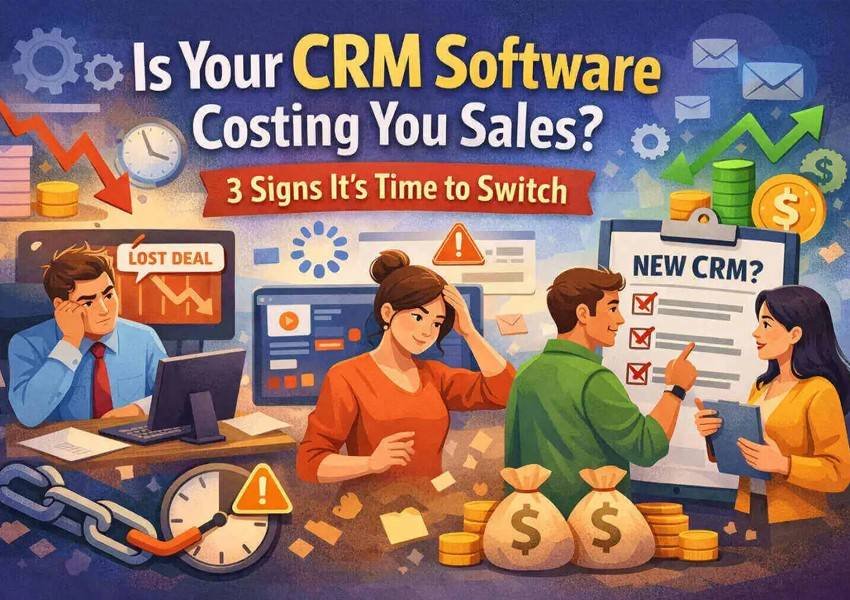
Most businesses invest in a CRM Software with one simple goal: sell more and work smarter.
But what if the very tool that’s supposed to help your sales team is silently doing the opposite?
In today’s fast-moving market, customers expect quick responses, personalised communication, and smooth follow-ups. If your CRM Software slows you down, creates confusion, or hides valuable data, it doesn’t just hurt productivity—it directly costs you sales.
Many teams don’t realise the problem isn’t their strategy or effort. It’s the CRM Software they’ve outgrown.
Let’s look at three clear signs your CRM Software might be holding your business back—and why switching could actually increase conversions, not complicate your workflow.
Before diving into the signs, it’s important to understand how much a CRM Software impacts revenue today.
Modern sales don’t come from a single channel. Leads now arrive from websites, ads, WhatsApp, social media, emails, referrals, and marketplaces. Managing all of this manually—or with an outdated CRM Software—creates delays, missed follow-ups, and poor customer experiences.
A good CRM Software should:
If your CRM Software fails at these basics, it’s not just inefficient—it’s expensive.
One clear warning sign is when your sales team doesn’t want to open the CRM Software at all.
If updating the system feels like extra work instead of actual help, something is clearly off.
Common signs you’ll notice
When this happens, updates get delayed or skipped completely. Managers stop getting the full picture, follow-ups are missed, and leads quietly slip away.
How this directly affects sales
Sales depends heavily on timing. If your CRM Software slows reps down or pulls their focus away from real conversations, you lose momentum. A delay of even a few hours can push a serious lead straight to a competitor who responded faster.
What a better CRM Software should actually do
A good CRM Software should stay out of the way. It should capture activity automatically, keep lead information updated on its own, and show only what the sales team really needs. When reps spend less time clicking around and more time talking to customers, sales numbers improve on their own.
Not all leads are equal, yet many CRM Softwares treat them that way.
If your team asks questions like:
…it’s a strong signal your CRM Software isn’t helping you prioritise.
Traditional CRM Softwares often rely on manual lead scoring or basic rules that don’t reflect real buying behaviour. They fail to account for:
As a result, sales teams either chase everyone or rely on gut feeling—both of which waste time.
When high-intent leads don’t get immediate attention, they cool off. Meanwhile, low-quality leads consume valuable sales hours. This imbalance directly lowers close rates and increases cost per acquisition.
A smarter CRM Software should highlight sales-ready leads automatically, based on real engagement and behaviour. Clear prioritisation helps sales teams focus their energy where it actually matters—on leads most likely to convert.
If people in your team keep saying things like:
Marketing sends useless leads.
Sales never follows up properly.
No one knows which campaign actually brings customers.
Then the issue is not effort. It’s the system you’re using.
What’s really happening
Leads come in, but there’s no clear link between marketing work and sales results. No one can clearly see where the lead came from, what the lead did before talking to sales, or which campaign actually made money. Because of this, everyone works on assumptions.
Why this hurts the business
Marketing continues spending on channels that look good in reports but don’t convert. Sales slowly stops trusting new leads and gives them less attention. Money gets wasted, frustration increases, and growth slows down even though leads are coming in.
What a better CRM Software should solve
A good CRM Software shows the full picture—from the first click to the final sale. When both teams see the same information, confusion reduces, decisions improve, and teamwork becomes easier. Leads also improve because everyone knows what actually works.
Many businesses hesitate to switch CRM Softwares because it feels risky or time-consuming. But staying with the wrong system has hidden costs:
Over time, these costs add up far more than the effort required to switch.
You should seriously consider switching if:
The right CRM Software should adapt to your business—not force your team to adapt to it.
When implemented correctly, a modern CRM Software can:
Instead of being a data storage tool, it becomes a revenue engine.
If your sales numbers aren’t where they should be, it’s worth asking an uncomfortable question:
Is our CRM Software helping us sell—or silently holding us back?
The signs are usually clear. Slow processes, poor visibility, and frustrated teams are not normal growing pains. They’re signals that your system no longer fits your business.
Switching to a CRM Software that supports speed, intelligence, and collaboration isn’t just a tech upgrade—it’s a strategic move. And in a competitive market, that decision can be the difference between losing leads and winning customers.
1. How do I know if my CRM Software is hurting my sales?
If your sales team is slow to respond, keeps doing things manually, isn’t sure which leads to call first, or simply avoids using the CRM Software, something is wrong. A CRM Software should make selling easier. If deals are getting missed because follow-ups happen late or data isn’t clear, the CRM Software is likely part of the problem.
2. Is switching a CRM Software difficult for a growing business?
It can look difficult, but in reality it’s manageable. Most CRM Softwares today help with data transfer and onboarding. There may be a short adjustment period, but if the new system saves time and helps the team work better, the switch is usually worth it.
3. Will changing my CRM Software help improve conversions?
Yes, it can. When leads are organised properly, follow-ups happen on time, and the sales team knows where to focus, closing deals becomes easier. A good CRM Software removes confusion and helps sales reps spend more time selling instead of figuring things out.
4. When should a business think about switching to a new CRM Software?
If your lead count has increased, you’re getting leads from more places, or your current CRM Software feels limited or slow, it’s probably time. When the system no longer fits how your sales team works, it starts holding the business back.
5. What should I look for in a modern CRM Software?
You should be able to manage all leads in one place, track conversations, follow up without reminders getting missed, and see clear reports. It should be simple enough that the sales team actually uses it daily, not something they avoid.
6. Can a CRM Software help align marketing and sales teams?
Absolutely. A good CRM Software connects lead sources, engagement data, and conversion outcomes. This shared visibility helps marketing understand what generates real revenue and allows sales teams to trust the quality of incoming leads.
7. Is a CRM Software only useful for large sales teams?
No. Small and mid-sized businesses often benefit even more from the right CRM Software. It helps smaller teams save time, manage leads efficiently, and compete with larger organisations by improving focus and follow-up quality.
8. How quickly can a business see results after switching CRM Softwares?
Many businesses start noticing improvements within a few weeks, such as better lead organisation, faster response times, and improved team productivity. Conversion improvements typically follow as sales teams adapt to the new workflow.

26 Oct, 2026
It’s easier to scan a QR code than to type...

26 Oct, 2026
Summary FMCG CRM Software connects field sales teams, distributors, retailers...

26 Oct, 2026
A supplier emails you a price sheet. But there is...

26 Oct, 2026
Summary Choose CRM Software according to your sales process, business...

23 Oct, 2026
Summary Compare 10 field service and field workforce software options...