

Best Zoho CRM Alternatives in India for Growing SMBs in…
21 Sep, 2026
Summary (TL;DR): The best Zoho CRM alternatives in India are...
Updated: 20th September, 2026
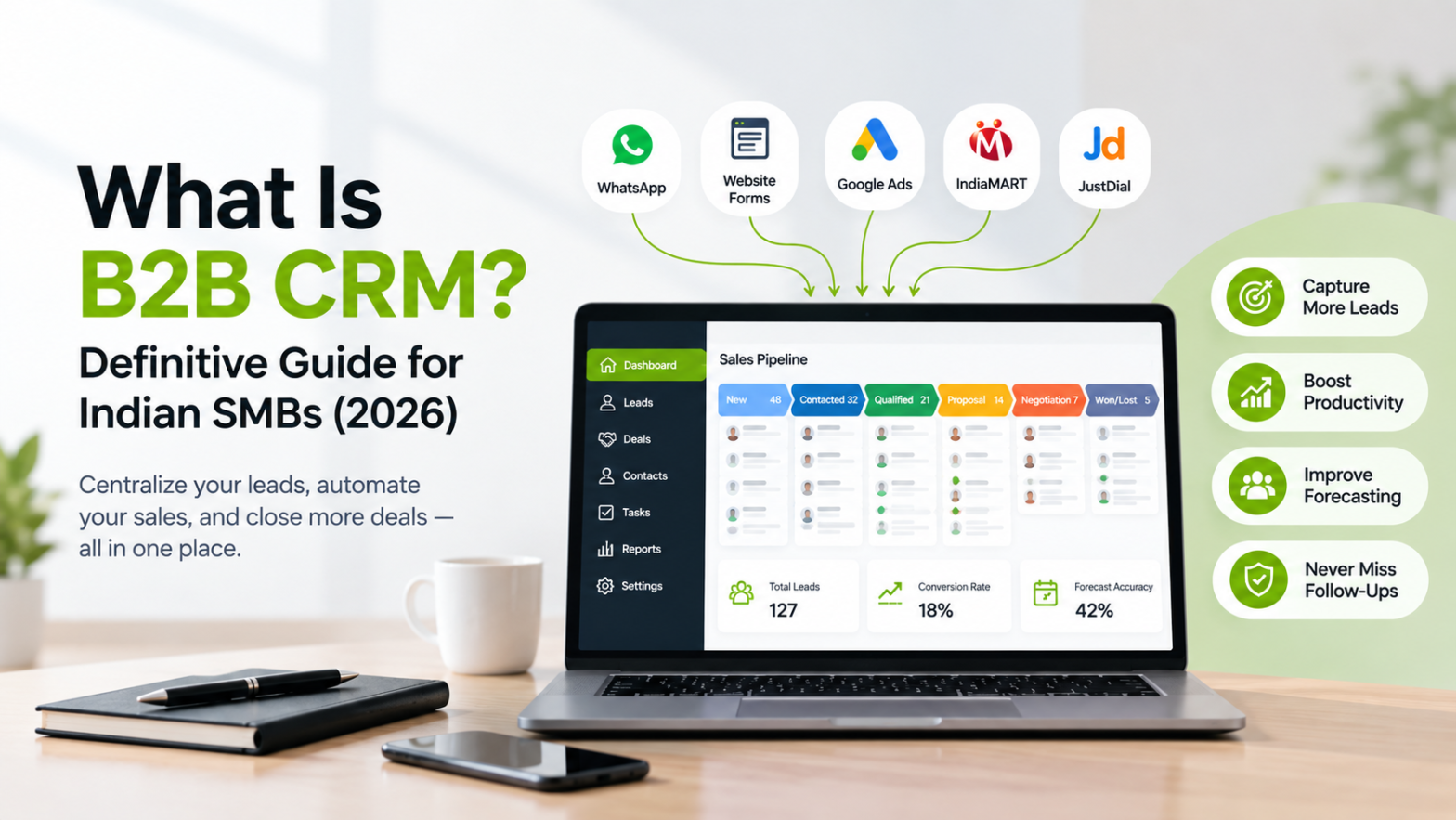
B2B CRM is essential infrastructure for Indian SMBs managing complex sales cycles and scaling customer bases. Specifically, it centralizes customer data, automates repetitive work, prevents lost leads, and provides real-time pipeline visibility that spreadsheets cannot match. Indeed, implementation data shows 34% productivity gains, 29% sales growth, and 42% forecast accuracy improvement. However, the platform must be built for India—WhatsApp integration, mobile-first design, local lead source integrations, and rapid deployment are non-negotiable. Therefore, choose a vendor aligned to your industry, prioritize ease of use and mobile capability, and invest in team training. Ultimately, the cost of CRM is negligible compared to the revenue lost to missed follow-ups and organizational chaos.
B2B CRM (Customer Relationship Management) is a centralized software platform that helps businesses organize customer data, automate sales workflows, track deals, and accelerate closure. For Indian SMBs—especially in Education, Automobile, Real Estate, Insurance, and FMCG Distribution—B2B CRM replaces scattered spreadsheets and WhatsApp logs with a single source of truth, enabling sales teams to move faster, prevent lost leads, and compete with larger competitors. Real-world data shows teams using B2B CRM report productivity gains up to 34% and forecast accuracy improvements of 42%.
B2B CRM software centralizes customer data, automates repetitive sales tasks, and provides real-time visibility into your entire sales pipeline. Unlike B2C CRM systems built for high-volume consumer interactions, B2B CRM manages complex, multi-stakeholder sales cycles where deals take weeks or months to close. For Indian SMBs, this means moving beyond spreadsheets and WhatsApp group chats to a unified system where every interaction—call, email, proposal, objection—lives in one place and is accessible to your entire team.
The difference is immediate: teams stop losing deals to missed follow-ups, sales reps spend less time on data entry, and managers gain real-time visibility into pipeline health instead of guessing. In India’s fast-paced SMB environment, this matters enormously.
Every Indian business starts with Excel or Google Sheets. It’s free, everyone knows it, and for your first 10 or 20 customers, it works fine. But spreadsheets stop working somewhere around 50 customers.
The Problem:
Your sales team spends 2 to 4 hours per week copying information between WhatsApp, email, and spreadsheets. For a 5-person team, that’s 500 to 1,000 hours annually of lost selling time. If even five deals per month go cold due to missed follow-ups—at ₹20,000 per deal—you’re losing ₹12 lakh in annual revenue, not because your product is weak, but because nobody called back at the right moment.
Beyond time loss, spreadsheets create structural problems. One rep logs a follow-up in column C. Another adds notes in column F. A third creates a new sheet entirely. Within months, your spreadsheet has fractured into multiple versions of truth. When a sales rep leaves—and in Indian SMBs, sales team turnover happens fast—all their knowledge walks out the door with them. The pipeline doesn’t scale.
Additionally, spreadsheets offer no audit trail, no access controls, and create legal exposure as India’s Digital Personal Data Protection (DPDP) Act comes into full compliance. Sharing customer data over WhatsApp or unsecured email means zero encryption and no record of who accessed what.
Research shows measurable, consistent gains across multiple dimensions.
| Metric | Improvement | Source |
|---|---|---|
| Sales Team Productivity | 34% increase | Nucleus Research (Getsales.io) |
| Overall Sales Growth | 29% increase | Nucleus Research |
| Forecast Accuracy | 42% improvement | Nucleus Research |
| Mobile CRM Users Meeting Quotas | 65% vs 22% | Teamgate Research |
These gains come from automation. B2B CRM systems automate routine tasks like sending reminders, generating reports, and creating standard proposals. This frees sales reps to focus on high-value activities: relationship building, objection handling, and closing. For Indian SMBs where every sales rep directly impacts revenue, this time reclamation is transformational.
With 853.8 million WhatsApp users in India, the platform is often the primary sales channel, not just another communications tool. Customers send inquiries via WhatsApp. Prospects negotiate via WhatsApp. Deals close via WhatsApp. Yet most generic CRM platforms treat WhatsApp as an afterthought.
What actually happens: A lead comes in through WhatsApp, gets forwarded to a spreadsheet, sits there for four days, and by the time someone calls back, the buyer has already signed with a competitor. This delay in replying to WhatsApp messages is one of the top reasons Indian SMEs lose sales, even if their product or pricing is strong.
A B2B CRM built for India doesn’t just log WhatsApp conversations. It automatically creates lead records from WhatsApp inquiries, triggers follow-up reminders, and gives sales managers visibility into response times. Speed becomes a competitive weapon.
| Feature | What It Does | Real-World Impact for Indian SMBs |
|---|---|---|
| Lead Capture & Scoring | Automatically pulls leads from WhatsApp, website forms, Google Ads, IndiaMART, JustDial. Scores based on engagement. | No lost leads. Sales teams work high-intent prospects first. |
| Pipeline Visibility | Every deal tracked across stages: New → Contacted → Qualified → Proposal → Negotiation → Won/Lost. | Managers see blockages in real time. Forecasting becomes accurate. |
| Automated Follow-Ups | Triggers email reminders, task assignments, and notifications without manual intervention. | No follow-up falls through cracks. Teams focus on selling, not administering. |
Business to business CRM manages complex, multi-stakeholder sales cycles (weeks to months). Example: A real estate developer negotiating with a corporate buyer involves property managers, finance teams, and legal counsel. B2B CRM tracks every stakeholder, every conversation, and every negotiation thread in parallel.
B2C CRM handles high-volume, transactional interactions with individual buyers. Example: An e-commerce platform tracks millions of customers making repeat purchases. B2C CRM emphasizes retention, service, and campaign management, not complex deal negotiation.
For Indian SMBs in Education, Automobile, Real Estate, Insurance, and FMCG Distribution—where sales involve multiple stakeholders, longer cycles, and relationship-based decision making—B2B CRM is not optional. It’s infrastructure.
Education sector
An online coaching institute tracks student inquiries from website visit through enrollment. As a result, prospects move from marketing nurture to sales follow-up to onboarding without losing context. Additionally, when a prospect goes inactive, automated reminders flag teachers to re-engage. Consequently, admissions teams can see conversion rates by traffic source, optimizing ad spend month to month.
Automobile dealership network
A regional chain with multiple showrooms logs every customer visit, test drive, and purchase signal into CRM. As a result, head office sees unified pipeline data across all locations. For example, sales managers can identify which showrooms are converting at 40% and which at 15%, then replicate high-conversion processes across underperforming locations.
Real estate brokerage
Managing 200+ active listings involves equally complex buyer journeys. To handle this, CRM captures buyer preferences, budget, timeline, and communication history. In addition, agents collaborate on group deals where one buyer is interested in multiple properties. Furthermore, when a property sells, the CRM automatically flags buyers with similar criteria on competing listings.
Insurance agencies
An insurance broker uses CRM to track renewal dates, flag cross-sell opportunities based on client profile, and manage commissions. For instance, when a policy is approaching renewal, an automated notification reaches the relationship manager three months prior. Similarly, when a customer purchases home insurance, the system flags auto insurance as a natural next sell.
FMCG distribution
A distributor supplying retailers across a state uses CRM to manage dealer relationships, order history, payment terms, and volume discounts. As a result, sales reps can access complete account health on mobile—outstanding invoices, payment dates, reorder frequency—before entering a dealer’s shop. Ultimately, this data-driven approach improves collection rates and identifies upsell opportunities on the spot.
Prioritize India-first design
Your CRM must understand your market. After all, generic CRM platforms built for Western sales processes don’t account for WhatsApp as a primary channel, local payment terms, or IndiaMART integration. Therefore, look for vendors with industry-specific playbooks for your vertical.
Confirm WhatsApp integration
If your CRM doesn’t sync WhatsApp conversations directly to lead records and create automatic assignment rules, you’re still relying on manual copy-paste. In other words, this defeats the purpose. So, verify that WhatsApp conversations automatically log to lead records, templates work within WhatsApp, and team visibility is built in.
Assess ease of use and rapid deployment
Indian SMBs don’t have patience for 3-6 month CRM implementations. Instead, they want to be live this week, not next quarter. Accordingly, look for platforms with quick setup, pre-built workflows, and minimal customization required before launch.
Verify mobile capability
Your sales team works in the field. Therefore, a CRM that only works on desktop is useless. In fact, sales reps using mobile CRM outperform peers, with 65% meeting quotas compared to just 22% using desktop-only systems. Clearly, mobile access isn’t a nice-to-have; it’s critical.
Check integration depth
Your CRM must integrate with Gmail, Google Calendar, Zapier, and accounting software. Moreover, verify that integrations sync bidirectionally and don’t require manual triggers. Otherwise, poor integrations create the very data silos you’re trying to eliminate.
Confirm security and compliance
The DPDP Act requires businesses to demonstrate how customer data is stored, who can access it, and when it’s deleted. Accordingly, your CRM provider must offer encryption, role-based access control, and audit trails. Above all, pricing pressure shouldn’t mean compromising data security.
Installing without a clear sales process
Teams often buy CRM hoping it magically improves sales. However, it doesn’t. Instead, success requires defining your sales stages, success criteria, and handoff points first. Essentially, the CRM enforces your process; it doesn’t create one.
Treating it as a filing cabinet, not an automation engine
Many teams log data but never use automation. For example, they enter contacts, then manually send follow-up emails. As a result, this wastes the entire value proposition. After all, automation—triggered emails, task reminders, lead scoring—is what frees reps to sell.
Limiting access to the sales team
Marketing and support teams benefit from CRM visibility too. For instance, marketing sees which lead sources convert fastest, while support sees every prior customer interaction. If you restrict access, however, you create information silos. Instead, establish role-based permissions that enable collaboration without compromising security.
Skipping training and adoption
Implementation fails when your team feels unprepared or unsupported. Therefore, invest in onboarding, create playbooks, and assign CRM champions to mentor peers. Without adoption, ultimately, the system is just an expensive spreadsheet replacement.
Agentic B2B CRM is no longer optional for Indian SMBs competing in crowded, fast-moving markets. In fact, research shows that businesses implementing CRM see productivity rise by 34%, overall sales increase by 29%, and forecast accuracy improve by 42%. These aren’t aspirational numbers; rather, they’re documented across multiple studies.
Your business moves at the speed of information. Ultimately, a platform that centralizes customer data, automates follow-ups, and provides real-time pipeline visibility separates winners from the rest. Whether you operate in Education, Automobile, Real Estate, Insurance, or FMCG Distribution, the right B2B CRM transforms how your team sells and competes.
So, the choice is simple: continue losing deals to spreadsheets and missed follow-ups, or adopt a system built for the way Indian SMBs actually sell.
Move From Spreadsheets to a Real Sales System
See how Groweon AION helps Indian SMBs close deals faster with WhatsApp integration, mobile-first design, and industry-specific playbooks. Schedule a demo and experience CRM built for your business.
What’s the main difference between B2B CRM and spreadsheets?
Spreadsheets store data passively; in contrast, CRM systems automate processes and enforce structure. A spreadsheet requires manual updates and offers zero visibility when team members leave. B2B CRM, on the other hand, centralizes information, automates follow-ups, and preserves institutional knowledge. As a result, when a sales rep leaves, the pipeline stays intact.
How quickly will we see ROI from B2B CRM?
Early wins typically appear within 60 to 90 days: reduced deal cycle time, fewer lost leads, and faster rep onboarding. However, full ROI materializes once your team fully adopts the system and leverages automation. Overall, most Indian SMBs see payback within 3 to 4 months when implementation is disciplined.
Is B2B CRM suitable for small teams with 5 or fewer salespeople?
Yes. Even micro-teams benefit from centralized customer data and automation. In fact, B2B CRM prevents early-stage businesses from outgrowing their systems as they scale. To put it simply, if manual data entry costs even ₹60,000 annually and a CRM costs ₹999 per user per month, ROI is immediate.
Can B2B CRM integrate with WhatsApp, Gmail, and local lead sources like IndiaMART?
Quality B2B CRM platforms built for India integrate with WhatsApp, Gmail, Google Calendar, Zapier, and local marketplaces. That said, verify bidirectional sync and confirm that integrations don’t require manual triggers. Overall, platforms with native WhatsApp integration are essential for Indian SMBs, since WhatsApp is the primary sales channel.
What about data security and DPDP Act compliance?
The DPDP Act requires businesses to demonstrate data storage, access controls, and deletion processes. Therefore, your CRM provider must offer encryption, role-based access, and audit trails. By comparison, spreadsheets shared over WhatsApp offer zero compliance. Instead, professional CRM platforms maintain enterprise-grade security at SMB pricing.
What’s typical CRM pricing for Indian SMBs?
B2B CRM pricing ranges from ₹500 to ₹5,000 per user per month, depending on features and deployment model. Typically, most Indian SMBs start with 3 to 10 seats and expand as hiring accelerates. Either way, look for transparent, per-user pricing with no hidden setup fees or implementation charges.

21 Sep, 2026
Summary (TL;DR): The best Zoho CRM alternatives in India are...

21 Sep, 2026
Summary (TL;DR): Groweon suits Indian SMBs that want one AI-first...

21 Sep, 2026
Summary (TL;DR): Groweon suits Indian SMBs that want one AI-first...
18 Sep, 2026
Summary (TL;DR) B2B CRM is essential infrastructure for Indian SMBs...

17 Sep, 2026
Summary: CRM Software Customer relationship management software has become essential...