

Groweon vs HubSpot: Which CRM Fits Indian SMBs in 2026
21 Sep, 2026
Summary (TL;DR): Groweon suits Indian SMBs that want one AI-first...
Updated: 23rd April, 2026
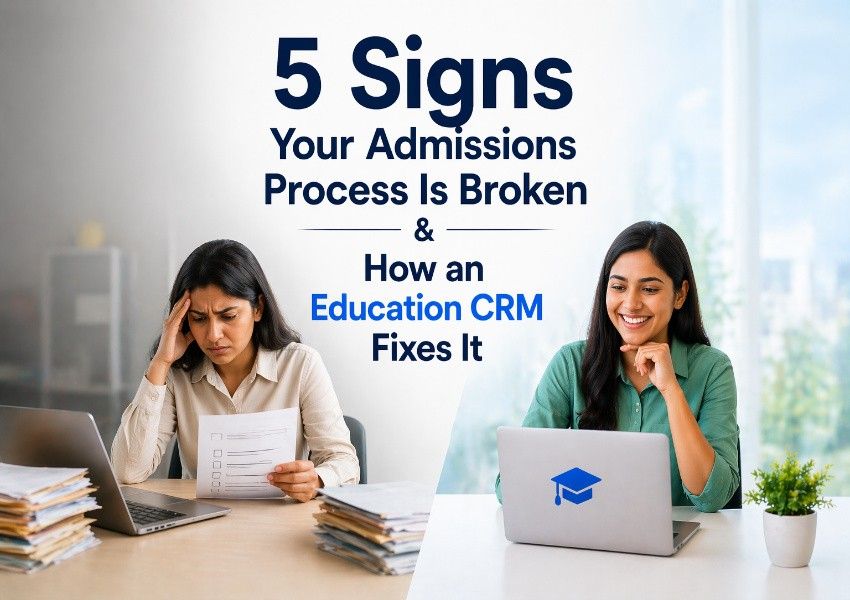
Your institution spends lakhs on advertising. Students visit your website, call your helpline, fill inquiry forms and then quietly disappear. If this sounds familiar, the problem might not be your brand. It might be your admissions process.
In India’s fiercely competitive education market, students have more choices than ever, from local colleges to international online programs. A slow, disorganised, or inconsistent admissions process doesn’t just lose leads; it actively damages your reputation among students and parents who talk.
The good news? Most admissions problems are not people problems. They are process and tooling problems and they can be solved with the right Education CRM.
In this blog, we walk you through 5 unmistakable signs that your admissions process is broken, and exactly how a purpose-built Education CRM addresses each one.
A student fills a form on your website, calls your front desk, and sends an Instagram DM and nobody connects these three touchpoints. Your team thinks he’s a new inquiry. The student thinks he’s been ignored. He joins a competitor.
When leads arrive from multiple channels, JustDial, IndiaMart, Google Ads, walk-ins, education fairs, and land in separate inboxes, notebooks, or Excel sheets, lead leakage is inevitable. Counsellors miss follow-ups. Managers have no visibility. And there’s no reliable way to know how many leads you received this month versus how many actually converted.
How an Education CRM fixes it: A platform like Groweon’s Smart Education CRM automatically captures leads from all channels into a single, unified inbox. Every lead gets a profile, a timestamp, and an assigned counsellor. No duplication, no missed entries, no guesswork.
How much of your counsellor’s day is actually spent counselling? If the honest answer is “not much,” you have a process problem. Manually entering inquiry data, composing follow-up emails one by one, updating spreadsheets, and chasing down documents from applicants, these tasks quietly consume three to five hours of a counsellor’s working day.
This administrative burden has two consequences: counsellor burnout (already high in this sector) and poor student experience. When a counsellor is buried in paperwork, they cannot give a student the warm, personalised attention that often tips an admissions decision in your institution’s favour.
How an Education CRM fixes it: An Education CRM automates routine tasks, sending inquiry acknowledgements, scheduling follow-up reminders, dispatching brochures over WhatsApp, and updating lead status after every interaction. Counsellors log a call in seconds and move on. Admin time drops sharply; student-facing time increases.
In admissions, timing is everything. A student who receives a follow-up call within five minutes of submitting an inquiry is significantly more likely to enrol than one who receives a call two days later. Yet in most institutions, follow-ups are left entirely to individual counsellor discipline, which is unreliable by design.
When a counsellor is managing 80 leads simultaneously, a missed follow-up is not negligence. It is the absence of a system. Without automated reminders and clear ownership, hot leads go cold every single day.
How an Education CRM fixes it: Education CRM platforms enable automated follow-up sequences. A lead who hasn’t responded in 48 hours automatically receives a WhatsApp message. A lead marked “interested” triggers a counsellor call reminder for the following morning. Every touchpoint is logged, every gap is flagged. The system remembers so your team doesn’t have to.
At the end of each admissions cycle, most institutions can tell you how many students enrolled. Very few can tell you why the other 70% didn’t. Was it pricing? A course mismatch? A slow response? A competitor’s scholarship offer? Without data, every admissions season is essentially a reset, the same mistakes repeat because there is no visibility into what went wrong.
This absence of dropout analytics is one of the most expensive blind spots in institutional management. You cannot improve what you cannot measure, and you cannot measure what you never tracked.
How an Education CRM fixes it: A robust Education CRM tracks every lead through the entire admissions funnel, from first inquiry to enrolment or dropout. It logs the reason a lead was marked lost, tracks which stage saw the highest drop-off, and generates pipeline reports for management review. Over time, this data reveals patterns that allow institutions to proactively address objections and close structural gaps in their process.
If your admissions process halts when one counsellor goes on leave, or if all the “how things work here” knowledge lives in one person’s head, you have built a process around individuals rather than systems. This is common in growing institutions where a two-person operation simply never got systematised as the team scaled.
People-dependent processes create inconsistency (every counsellor does things differently), fragility (key-person dependency), and onboarding nightmares when new staff joins mid-season.
How an Education CRM fixes it: Education CRM platforms codify your admissions process into repeatable, auditable workflows. Every counsellor follows the same stages, uses the same communication templates, and works within the same pipeline. Onboarding a new team member takes hours instead of weeks. Leads can be reassigned in seconds if someone is unavailable. The process becomes institution-owned, not person-owned.
| Admissions Task | Without Education CRM | With Education CRM |
|---|---|---|
| Lead Capture | Multiple spreadsheets, missed entries | Auto-captured from all channels |
| Follow-Up Scheduling | Manual reminders, often missed | Automated sequences and alerts |
| WhatsApp/Email Communication | Individual messages, no tracking | Templates with open/click tracking |
| Counsellor Workload Visibility | Unknown until too late | Real-time dashboards per rep |
| Dropout Reason Analysis | Guesswork and memory | Tagged loss reasons and reports |
| Admission Stage Tracking | Verbal updates, no audit trail | Stage-wise pipeline with history |
| Management Reporting | Weekly Excel exports | Live reports and conversion analytics |
Not all CRMs are designed for the education sector. A generic sales CRM may handle contact management well, but it won’t understand admission cycles, course-specific inquiry flows, or the WhatsApp-first communication preference of Indian students and parents. When evaluating an Education CRM, prioritise the following:
WhatsApp Integration: In India, WhatsApp is the primary channel for student-counsellor communication. Your CRM must support two-way WhatsApp messaging, bulk broadcasts, and message tracking, natively, not through a clunky workaround.
Multi-Channel Lead Capture: Leads come from JustDial, Facebook Ads, Google Ads, website forms, and walk-ins. Your Education CRM should aggregate all of these automatically, with source tagging so you know which channel delivers the best ROI.
Customisable Admission Pipeline: Every institution has a different funnel, inquiry, counselling call, campus visit, document collection, fee payment, enrolment. Your CRM should let you define these stages, not force you into a rigid template.
AI-Powered Lead Scoring: With hundreds of inquiries every week, counsellors need guidance on who to prioritise. AI lead scoring ranks leads based on engagement, response behaviour, and profile match, so your team focuses effort where conversion probability is highest.
Simple, Affordable, and Mobile-Friendly: Indian educational institutions range from large private universities to small coaching institutes. Your Education CRM should be priced for SMBs, easy to adopt without a technical team, and fully functional on a smartphone.
A broken admissions process costs your institution more than just revenue. It costs you reputation, counsellor morale, and the trust of students who deserved better. The five signs above are not rare edge cases; they are the everyday reality for thousands of institutions still relying on manual workflows.
An Education CRM doesn’t replace your counsellors. It empowers them. It removes the friction, the forgetfulness, and the fragmentation from admissions so your team can do what they do best: connect with students, answer their questions, and guide them confidently toward enrolment.
Whether you run a school, a college, a coaching centre, or a skill-development institute, the right Education CRM is the single highest-leverage investment you can make in your admissions function this year.
Groweon’s Smart Education CRM is built specifically for Indian educational institutions, with AI lead scoring, WhatsApp automation, multi-channel lead capture, and a counsellor-friendly pipeline your team will actually use.
Book a free demo today!
What is an Education CRM and how is it different from a regular CRM?
An Education CRM is a CRM platform designed specifically for educational institutions. Unlike a generic sales CRM, it understands admission cycles, student-parent communication dynamics, and India’s WhatsApp-first communication preferences. It manages the entire journey from inquiry to enrolment.
How does an Education CRM improve student enrolment rates?
By ensuring no lead is missed, every follow-up is timely, and counsellors focus on the most promising prospects. Automated follow-up sequences, AI lead scoring, and pipeline visibility work together to reduce lead leakage and accelerate student decision-making.
Is an Education CRM suitable for small coaching institutes or only large universities? Education CRM platforms are suitable for all institution sizes. Whether you have two counsellors or two hundred, the core problems, lead tracking, follow-up management, and pipeline visibility, are the same. Groweon is priced accessibly for SMB-scale institutions across India.
Can an Education CRM integrate with WhatsApp?
Yes. Leading Education CRMs, including Groweon, offer native WhatsApp integration, allowing counsellors to send messages, share brochures, schedule reminders, and track responses, all from within the CRM.
How long does it take to implement an Education CRM?
A cloud-based Education CRM like Groweon can typically be set up within a few days. No on-premise installation is required, and onboarding support is included. Most institutions see measurable improvements, fewer missed follow-ups, better lead tracking, within their first admissions cycle after going live.
What is AI lead scoring in an Education CRM?
AI lead scoring automatically ranks student inquiries by their likelihood to convert. The AI analyses factors like inquiry source, engagement level, and response behaviour to assign each lead a priority score. Counsellors focus on high-priority leads first, increasing conversion rates without longer working hours.
[wpforms id=”535″]

21 Sep, 2026
Summary (TL;DR): Groweon suits Indian SMBs that want one AI-first...

21 Sep, 2026
Summary (TL;DR): Groweon suits Indian SMBs that want one AI-first...
18 Sep, 2026
Summary (TL;DR) B2B CRM is essential infrastructure for Indian SMBs...

17 Sep, 2026
Summary: CRM Software Customer relationship management software has become essential...

17 Sep, 2026
Summary Customer relationship management in 2027 will be fundamentally different...