












Why 1,100+ Indian Businesses Trust Groweon CRM Software









What is CRM Software? Definition For Indian Businesses
A CRM software puts all your customer information, conversations, and daily business activities in one place. Instead of checking different spreadsheets, WhatsApp chats, and emails, your team can see everything together without running around. It basically becomes a single, clear source of information for everyone. For Indian businesses, using a proper CRM software makes everyday work easier, helps teams stay on the same page, and supports steady revenue growth. Many companies see better coordination and higher sales after shifting to a CRM.
📊 Industry Insight:
Companies using CRM software report a 47% improvement in customer retention rates and 41% increase in revenue per salesperson. The average payback period is just 13 months.-
Track leads and customers with complete history
-
Manage sales pipelines with visual forecasting
-
Automate follow-ups and eliminate manual tasks
-
Document all communication in one place
-
Predict revenue with AI-powered analytics
-
Improve customer satisfaction by 34% on average
Best CRM Solution for Your Business in India
Every business works differently, so the right CRM Software depends on what your team actually needs.
A solid CRM usually combines a good balance of the six points below.
India-First Design
This CRM Software is made to match the way Indian businesses really work. It comes with INR pricing, full GST support, local language options, and easy connections to tools like IndiaMART, JustDial, and Tally.
AI-Powered Automation
This CRM System has a bunch of smart features that basically save your team a lot of time. Things like automatically scoring leads, sending follow-up reminders, and giving you an idea of which deals might close. It also handles a lot of the small, repetitive tasks, so your team doesn’t have to keep doing them manually.
Affordable & Scalable
The pricing starts at ₹999 per user per month, and there aren’t any hidden charges or long-term commitments. As your business grows, the CRM Software can grow with you without any trouble. And if you ever need changes, there are plenty of customization options you can use.
Complete Business Solution
Everything is in one place — your sales pipeline, marketing stuff, support tickets, reports — all of it. So you don’t need to keep jumping between different tools.
Rapid Implementation
You can get started quickly, usually within 1–2 weeks. It’s already aligned with common Indian business processes, so you don’t need Your team can begin using it right away. outside consultants.
Zero Technical Barriers
The interface is easy to understand, even for non-technical users. Field teams can start using it on day one with very little training. And if you need help, there’s a support team based in India.
14 Key CRM Features For Every Modern Indian Business
Don't compromise on these capabilities. They're the foundation of a system your team will actually use daily.
Lead & Contact Management
360° customer view with interaction history
Pipeline & Opportunity Tracking
Visual deal stages with drag-and-drop
Email, Call & WhatsApp Integration
All communication in one timeline
Workflow Automation
Eliminate repetitive tasks automatically
Task & Appointment Reminders
Never miss a follow-up again
Reporting & Analytics
Real-time dashboards and forecasting
Role-Based Access Control
Secure data with granular permissions
Secure Cloud Storage
Access from anywhere, anytime
API & Third-Party Integrations
Connect with your existing tools
Mobile Accessibility
Full CRM power on iOS and Android
Marketing Automation
Email campaigns, drip sequences, lead nurturing
Mobile Accessibility to be renamed as “Mobile CRM App”
Access customer data on-the-go from any device
AI-Powered Insights
Predictive analytics and smart recommendations
Multi-Channel Communication
Email, SMS, WhatsApp integration
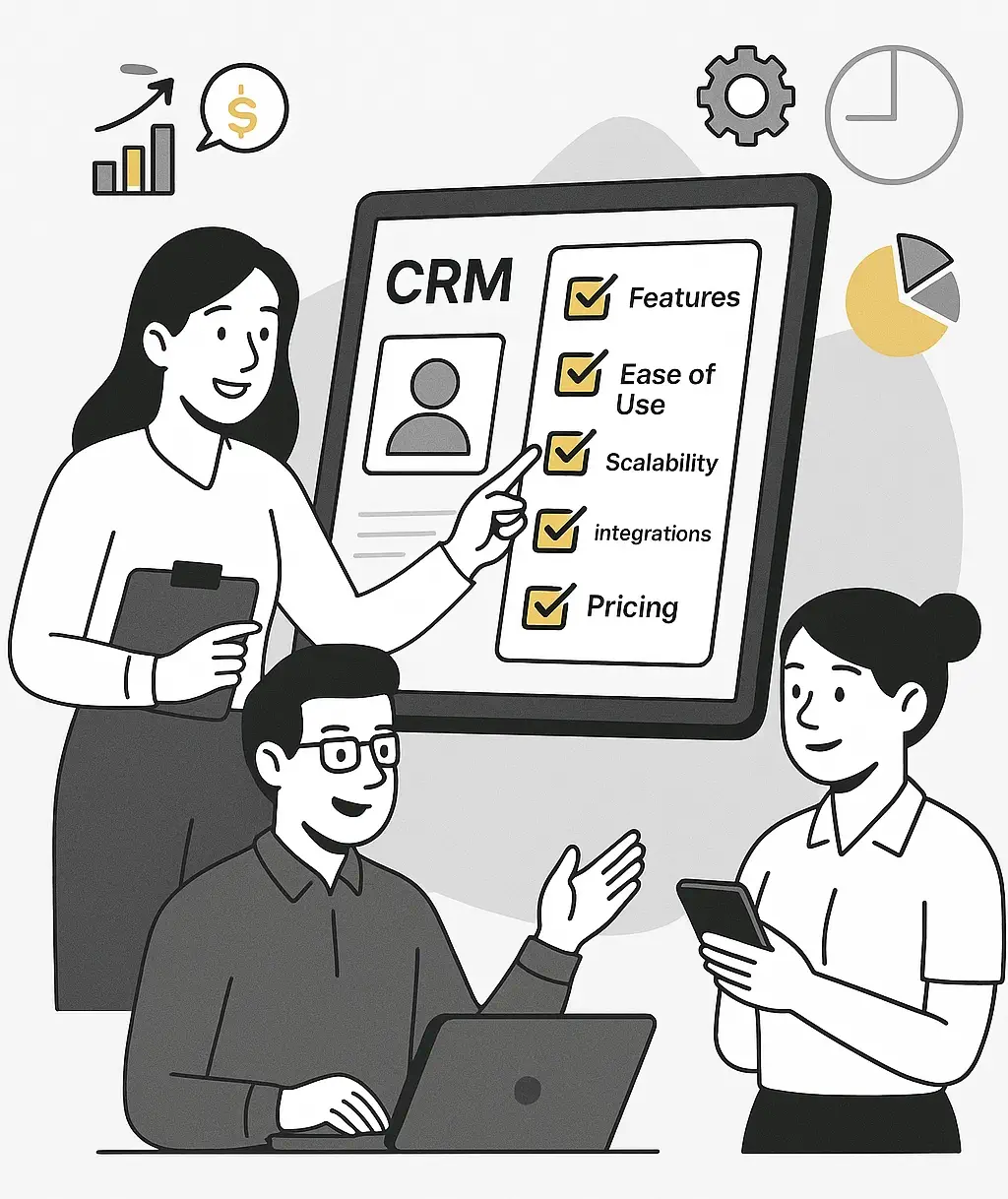
How to Evaluate CRM Software: Buyer's Checklist
Selecting the right CRM isn't about flashy features—it's about finding a system that naturally supports your workflows and scales with your growth. 70% of CRM projects fail due to poor selection and implementation. Don't become a statistic.
Critical Evaluation Criteria:
Pro Tip:
Ask vendors: "What are your system's limitations?" and "What happens when we scale from 5 to 100 users?" Their honesty reveals their integrity.
The 8-Step CRM Software Implementation Roadmap
A disciplined rollout is the difference between CRM success and becoming part of the 70% failure statistic. Follow this proven framework.
Requirement Assessment
Define problems, goals, and success metrics with stakeholders.
Process Mapping
Document current workflows and design optimized processes.
Data Preparation
Clean, deduplicate, and structure legacy data for migration.
System Configuration
Set up stages, fields, roles, permissions, and integrations.
Team Training
Hands-on training with real scenarios, not generic demos.
Pilot Launch
Test with a small team for 2-4 weeks, gather feedback.
Full Rollout
Deploy to entire organization with executive sponsorship.
Continuous Optimization
Refine workflows, add automation, measure KPIs monthly.
6 Common CRM Software Problems (and How to Fix Them)
No CRM System starts off perfect on day one. But if you already know what problems might come up, it becomes much easier to deal with them.
Low User Adoption
People don’t like changing how they work, so they think the CRM is extra work instead of something helpful.
✓ Solution:
Keep it simple
Show each person only what they actually need.
Do small training sessions, and make sure managers support the CRM Software
from the beginning—otherwise the team won’t use it properly.
Data Quality Issues
When the CRM Software is full of duplicate leads, half-filled info, or old contact details, it becomes messy and nobody really trusts what’s inside.
✓ Solution:
Clean your data before you move it in.
Set a few basic checks so wrong entries don’t get added.
And make it a habit to review and clean the data once in a while.
Over-Customization
When you keep adding a lot of fields or building complicated workflows, the CRM Software starts feeling heavy and difficult to use.People get confused, everything slows down, and it stops helping the team.
✓ Solution:
Begin with the basic stuff first.
Add more features only when your team actually needs them and is comfortable
using the system.
Integration Difficulties
When WhatsApp, email, or ERP doesn’t sync properly, data gets stuck in different places and someone ends up updating things manually.
✓ Solution:
Pick a CRM Software that has solid built-in integrations or good API
support.
Test everything before rolling it out.
Unrealistic ROI Expectations
A lot of teams expect the CRM Software to show results right away, and when it doesn’t, they feel like it’s not working. But CRM solution results always take time.
✓ Solution:
Just be realistic about how long it will take.
CRM usually takes around a year to show full ROI.
Track small weekly numbers and turn on automation slowly.
Lack of Leadership Alignment
When managers fail to review CRM system data, the team assumes it isn’t important, so they stop updating information, skip follow-ups, and the workflow slowly becomes confusing, inconsistent, and inefficient
✓ Solution:
Use CRM Software dashboards in your regular meetings.
Recognize and celebrate wins that come from good CRM usage.
7 CRM Software Best Practices For Sustained Success
Technology is only 20% of CRM success. The other 80% comes from disciplined habits and organizational commitment.
Data Hygiene:
Deduplicate weekly, enforce required fields, audit quarterly
Automation First:
Automate follow-ups, task creation, and lead scoring to save 5+ hours/week
Dashboard Reviews:
Make CRM metrics central to Monday morning meetings
Immediate Onboarding:
Train new hires on CRM within their first week, not later
Integration Strategy:
Connect website forms, WhatsApp, email, and marketing tools
Clear KPIs:
Track lead response time, conversion rates, and pipeline velocity
User Feedback Loop:
Monthly surveys to identify friction points and improvement areas
Remember:
CRM success comes from consistent usage and continuous refinement, not from having the most features.
Benefits of Using CRM Software for Your Business
Data points:
-
29% increase in sales revenue
-
34% boost in sales team productivity
-
42% improvement in forecast accuracy.
-
50% reduction in manual data entry tasks.
Business benefits
-
Streamlined sales processes
-
Enhanced customer experience
-
Data-driven decision making
-
Improved team collaboration
-
Higher customer retention rates
-
Faster deal closure times
CRM Software Pricing Models: A Deep Dive
Transparent pricing helps you budget accurately and avoid surprises. Here's what to expect across the industry.
Capture Leads
Import from multiple sources - website forms, IndiaMART, JustDial, spreadsheets, manual entry
Nurture & Engage
Automated follow-ups, email campaigns, task reminders, WhatsApp messaging
Track & Convert
Visual pipeline, deal stages, sales forecasting, quote generation
Analyze & Optimize
Custom reports, performance dashboards, team analytics, ROI tracking
Groweon CRM Pricing Philosophy
We believe in transparent, value-based pricing. No hidden fees, no surprise charges, no feature restrictions based on plan tiers. You know exactly what you're paying for and why.
View Pricing PlansCRM Solution for Every Industry & Use Case
Automobile businesses can manage leads, track dealer performance, and enhance customer satisfaction efficiently with the help of CRM solutions.
Suppliers of lab instruments benefit from CRM by automating client communication, managing bulk orders, and maintaining long-term scientific partnerships.
For furniture companies, CRM simplifies order tracking, helps manage design preferences, and strengthens relationships with interior designers and customers.
Industrial metal traders use CRM systems to track client requirements, automate quotations, and manage large-scale distribution effectively.
With CRM integration, machinery suppliers can monitor inquiries, schedule maintenance, and ensure smooth communication with industrial clients.
In construction projects, CRM assists in coordinating contractors, suppliers, and customers, ensuring seamless workflow and timely project delivery.
Textile manufacturers use CRM tools to monitor buyer interests, handle global orders, and improve long-term customer engagement.
For electronics distributors, CRM helps manage warranty requests, track retailers, and boost sales through personalized marketing strategies.
Packaging companies benefit from CRM by tracking customer requirements, managing after-sales support, and optimizing lead follow-ups.
CRM allows chemical suppliers to streamline client communication, handle orders efficiently, and maintain consistent industrial relationships.
Brands in cosmetics and jewelry industries use CRM to personalize experiences, track preferences, and enhance customer loyalty.
Manufacturers
Streamlined production and supply chain management
Exporters
International trade and logistics optimization
Traders
Market analysis and transaction management
Retailers
Customer experience and inventory optimization
Wholesalers
Bulk distribution and partner management
Dealers
Sales channel and territory management
Buying Houses
Procurement and vendor relationship management
6 Trends Shaping CRM Software Future in 2025
CRM Software isn’t just for sales teams anymore. It’s slowly turning into something businesses use to run almost everything, not just sales. Here’s what’s shaping the future and what you should know moving forward.
AI-Powered Automation
Predictive lead scoring, auto email replies, and smart task suggestions are taking away a huge chunk of manual work — almost 70%. Basically, the CRM software starts doing a lot of the boring tasks for you.
WhatsApp-First Communication
More Indian businesses are choosing WhatsApp over email for customer conversations. Because of that, CRM software now needs proper WhatsApp integration, not workarounds.
Conversational AI & Chatbots
Voice and text bots — in multiple Indian languages — handle simple questions round the clock. This lets teams focus on the more important and complicated conversations.
Predictive Analytics
AI can now estimate revenue, warn you about deals that might drop, and suggest what to do next. In many cases, the accuracy is above 85%.
Unified Business Platforms
CRMs are slowly merging with inventory, billing, order management, and other tools. Everything going into one system means fewer apps and fewer headaches.
Mobile-First Design
Field teams want full CRM Software access on their phones — not a small, limited version. Mobile-first design is now becoming a must, not just a nice extra.
📈 The global CRM market is projected to reach $145 billion by 2029, growing at 13.3% annually
Frequently Asked Questions About CRM Software
CRM software centralizes customer data and automates sales, marketing, and support processes for better relationship management.
CRM pricing in India ranges from ₹800 to ₹7,500+ per user/month, depending on features and providers.