Lead Nurturing Strategy: How to Convert Cold Leads into Paying…
31 Mar, 2026
Most businesses are sitting on a goldmine they’ve stopped mining....


Auto Capturing, nurturing, and converting potential customer leads.

Manage AMC contracts, track service requests, ensure timely renewals.

Tracks, resolves, manages issues, and gathers customer feedback.

Manage purchases, expenses, vendors, and POs efficiently with CRM.

Manages order lifecycle from placement to delivery completion.

Generates invoices and manages sales transactions and records efficiently.

Manages stock levels, tracks items, ensures efficient inventory control.

Manages dealer workflows, assigns leads, and tracks progress centrally.

WhatsApp CRM integration with bulk messaging, auto notifications, chatbots.

IVR enabled CRM integrates click-to-call, bulk dialling, recording features.

Achieves optimum productivity of tele-sales team with auto dialler.

Updated: 16th December, 2025
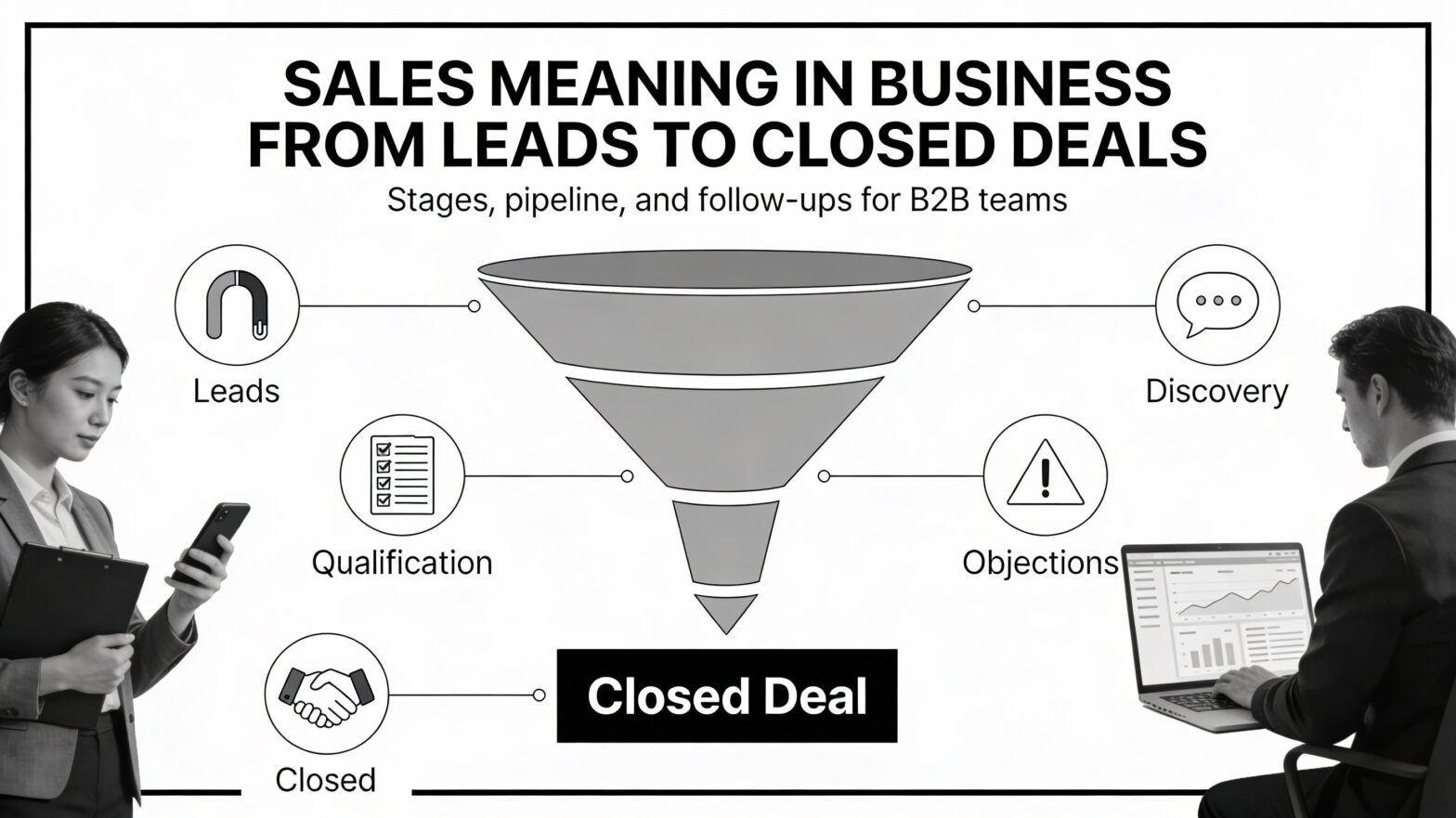
Sales is one of those words people use every day in business, but very few stop to think about what it actually involves. Many assume sales is just about convincing someone to buy something. In real situations, that idea does not hold up for long.
In practice, sales begin much earlier than the purchase and continue even after the deal is closed. It includes conversations, follow-ups, misunderstandings, delays, negotiations, and sometimes even silence. All of this is part of sales.
For any business that wants to grow steadily, understanding sales as a process—not an event—makes a noticeable difference.
Sales meaning in business: Sales is the process of guiding the right customer from interest to a confident buying decision by understanding their problem, presenting the right solution, handling concerns, and following through after purchase.
In simple terms, sales means helping the right customer reach a buying decision. That decision happens only when the customer feels confident about the value, timing, and outcome.
Sales is not one phone call or one meeting. It is a series of steps. Some move quickly, others take weeks. When businesses rush this process, deals usually fall apart later.
At the centre of sales is problem-solving. People do not buy products. They buy relief, improvement, or convenience. When customers feel your offering fits their situation, sales happen naturally.
Sales is not only “closing the deal.” It includes:
This is why strong sales teams look organised even when the market is tough—they follow a repeatable system.
Sales rarely follow a straight line. Still, most deals move through similar stages.
A lead is simply someone who shows interest. It could be a website enquiry, a message on WhatsApp, a call, or a referral. At this point, nothing is guaranteed.
Some leads are curious. Some are serious. Some disappear after the first conversation. This is normal.
Tip: A lead is not the same as a prospect. A prospect is a lead that fits your target and is worth pursuing.
Not every lead deserves the same amount of time. Businesses slowly learn to identify which enquiries are realistic and which are not. This saves energy and avoids frustration later.
Simple qualification questions:
This stage decides the future of the deal. The sales team listens, asks questions, and tries to understand what the customer actually needs—not what they assume.
Most failed sales come from poor listening, not poor pricing.
Good discovery is mostly questions, not pitching.
This might be a demo, a proposal, or a simple explanation. Customers look for clarity here. If things feel confusing or rushed, trust drops immediately.
What buyers need at this stage:
Price, timelines, features, or support concerns often come up. These are not negative signs. They show the customer is thinking seriously.
Best practice: Handle objections calmly, with proof (case studies, examples, simple breakdowns).
A deal closes when the customer feels comfortable moving forward. Pressure rarely works long-term. Confidence does.
Closing is often paperwork + clarity, not persuasion:
Sales do not end after payment. In fact, that is where relationships begin.
Customers remember how they were treated after buying. Follow-ups, support, and honest communication turn one-time buyers into long-term clients.
Repeat customers and referrals are often the result of good post-sale behaviour, not aggressive selling.
Many businesses struggle because they mix sales and marketing roles. Marketing creates interest; sales converts interest into revenue through conversations and closing.
A simple way to see it:
Both are needed, but the handoff must be clean.
Sales bring money into the business, but its role goes deeper.
A healthy sales process helps businesses understand market demand, plan cash flow, and improve offerings. It also reveals where things break down—whether in communication, pricing, or follow-up.
Without a clear sales approach, growth becomes unpredictable.
Many businesses lose deals quietly. No rejection. No complaint. Just silence.
This usually happens because:
These issues do not look serious at first, but over time, they cost revenue.
Root cause: Lack of a single system to track conversations, next steps, and ownership.
Markets change. Customer expectations change. What worked last year may not work today.
Businesses that review and improve their sales process regularly stay ahead. Those who don’t often struggle without understanding why.
A practical monthly review checklist:
Sales is not about talking more or pushing harder. It is about understanding people, being consistent, and following through on promises.
From the first enquiry to the final decision, every interaction leaves an impression. Businesses that respect this process build trust, stability, and sustainable growth.
When sales are handled thoughtfully, it stops feeling like pressure and starts feeling like progress.
If your business is handling leads, follow-ups, and deals manually, it may be time for a more organised approach. Groweon CRM helps you track leads, manage sales conversations, and maintain clear visibility across your sales pipeline—without adding complexity.
Explore Groweon CRM and see how a structured sales process can turn everyday enquiries into closed deals and long-term customer relationships.
1: What is sales in business (simple meaning)?
Sales in business means the set of activities used to convert a potential buyer’s interest into a purchase decision—typically through qualification, conversations, solution mapping, handling objections, and follow-up.
2: What is the difference between sales and marketing?
Marketing creates demand and brings attention (leads, awareness, interest), while sales converts that demand into revenue through conversations, proposals, negotiation, and closing.
3: What are the common stages of the sales process?
Most sales processes follow stages like lead generation/prospecting, qualification, discovery, presentation or demo, objection handling, negotiation, closing, and post-sale follow-up.
4: Why do B2B sales deals take longer than B2C?
B2B deals usually involve multiple stakeholders, budget approvals, longer evaluation cycles, and risk checks (security, compliance, procurement), so decisions naturally take more time than individual consumer purchases.
5: What is a sales pipeline, and why does it matter?
A sales pipeline is a visual view of where each deal sits in your sales stages (new lead, qualified, proposal, negotiation, won/lost), helping teams forecast revenue, prioritize follow-ups, and prevent deals from going cold.

31 Mar, 2026
Most businesses are sitting on a goldmine they’ve stopped mining....

30 Mar, 2026
Not every lead in your pipeline deserves equal attention. Some...

30 Mar, 2026
Let’s be honest. Not every lead is worth your time....

28 Mar, 2026
Small businesses do not need a CRM built for a...

28 Mar, 2026
If you run a small business in India, there is...